

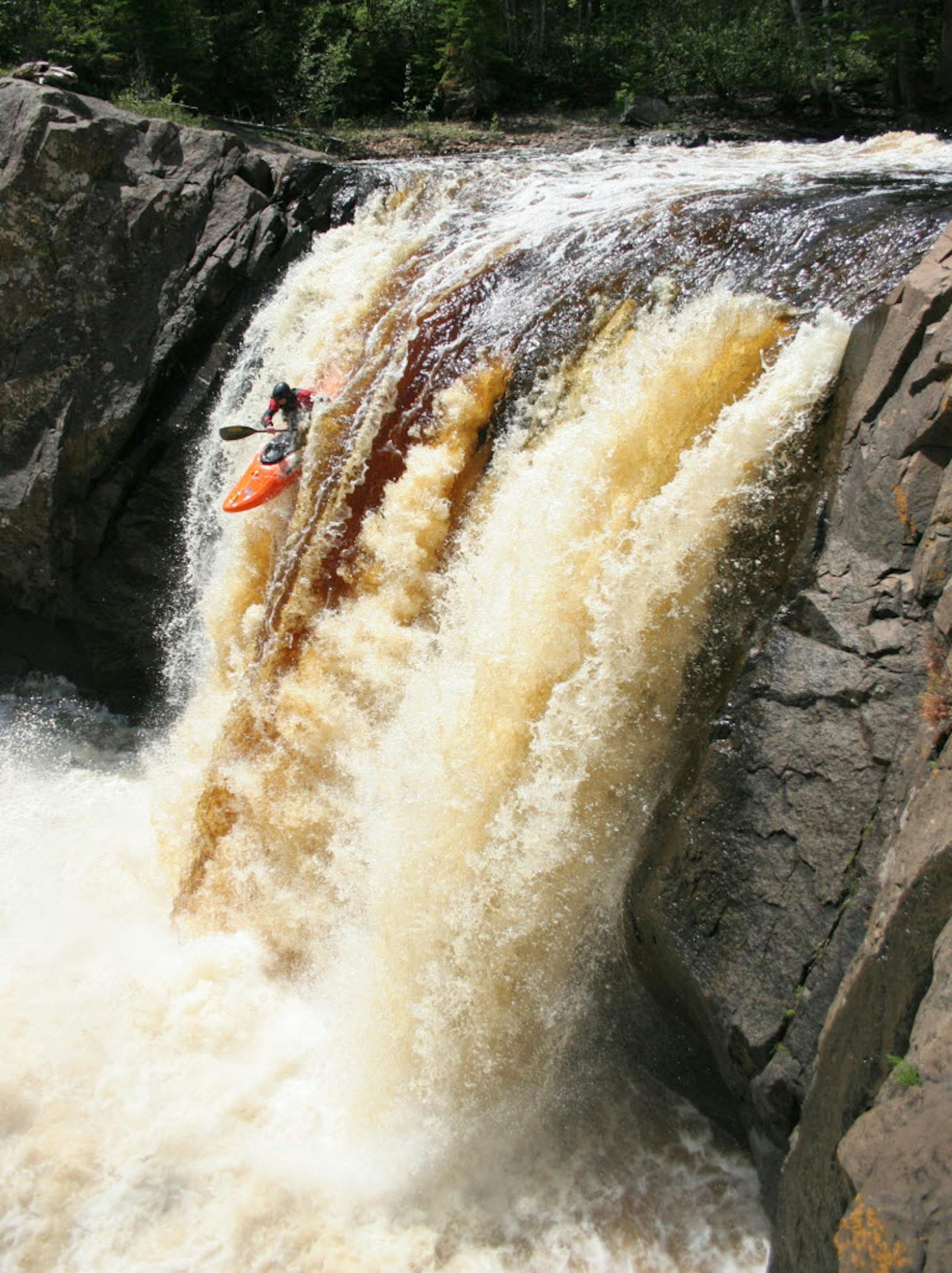
Rock walls closing in, his kayak moving downstream fast, John Kiffmeyer approached the edge of Brownstone Falls. A final nudge and Kiffmeyer was airborne, his boat a missile flying four stories high inside a roar of white. It was spring 2002, and Kiffmeyer, a machinist in his mid-20s from Big Lake, Minn., was attempting a risky waterfall drop on the Bad River in northern Wisconsin. The right line would net Kiffmeyer a bit of glory in the local creek-boating scene. A wrong move on Brownstone Falls, which jets 40 vertical feet in a tight gorge at Copper Falls State Park, would send Kiffmeyer to the hospital.
Creek boating -- a subset of whitewater kayaking in which paddlers seek narrow streams, fast currents and waterfall drops -- makes no pretense about risk. It is a sport that focuses on streams so steep that they look like water slides. Rapids tumble and explode, and expert-level Class V whitewater is the rule more often than the exception. Currents on some streams can pull a kayak completely under, its occupant suctioned along for the ride.
Started as a fringe movement
Nationwide, about 2.2 million people take part in whitewater kayaking, according to the Outdoor Industry Association of Boulder, Colo. Creek boaters are a small percentage of that figure.
The Sierra Nevada range in California, the Rocky Mountains and streams in the Southeast are creek-boating hot spots. But in the Upper Midwest, where rivers drain an immense watershed surrounding Lake Superior, dozens of creeks play host to kayakers in search of a rush.
"When the water is up, the Lake Superior area is as good as anything," said Peter Noren, a veteran kayaker from Minneapolis who manages the boating department at Midwest Mountaineering. "The density of streams is unique."
More than 25 navigable rivers and creeks lace Minnesota's North Shore alone, from Duluth's Amity Creek to the Pigeon River at the Canadian border. Two dozen more creeks and tributaries cut through Superior's South Shore in Wisconsin and Michigan's Upper Peninsula, making the Midwest a little-known mecca for steep-water seekers such as Kiffmeyer.
It's partly risk assessment


