
Kavanaugh fight galvanizes both parties for midterms

The most acrimonious Supreme Court confirmation battle in modern times hardened the fault lines in U.S. politics.

Bloomberg News
October 9, 2018 at 2:21AM
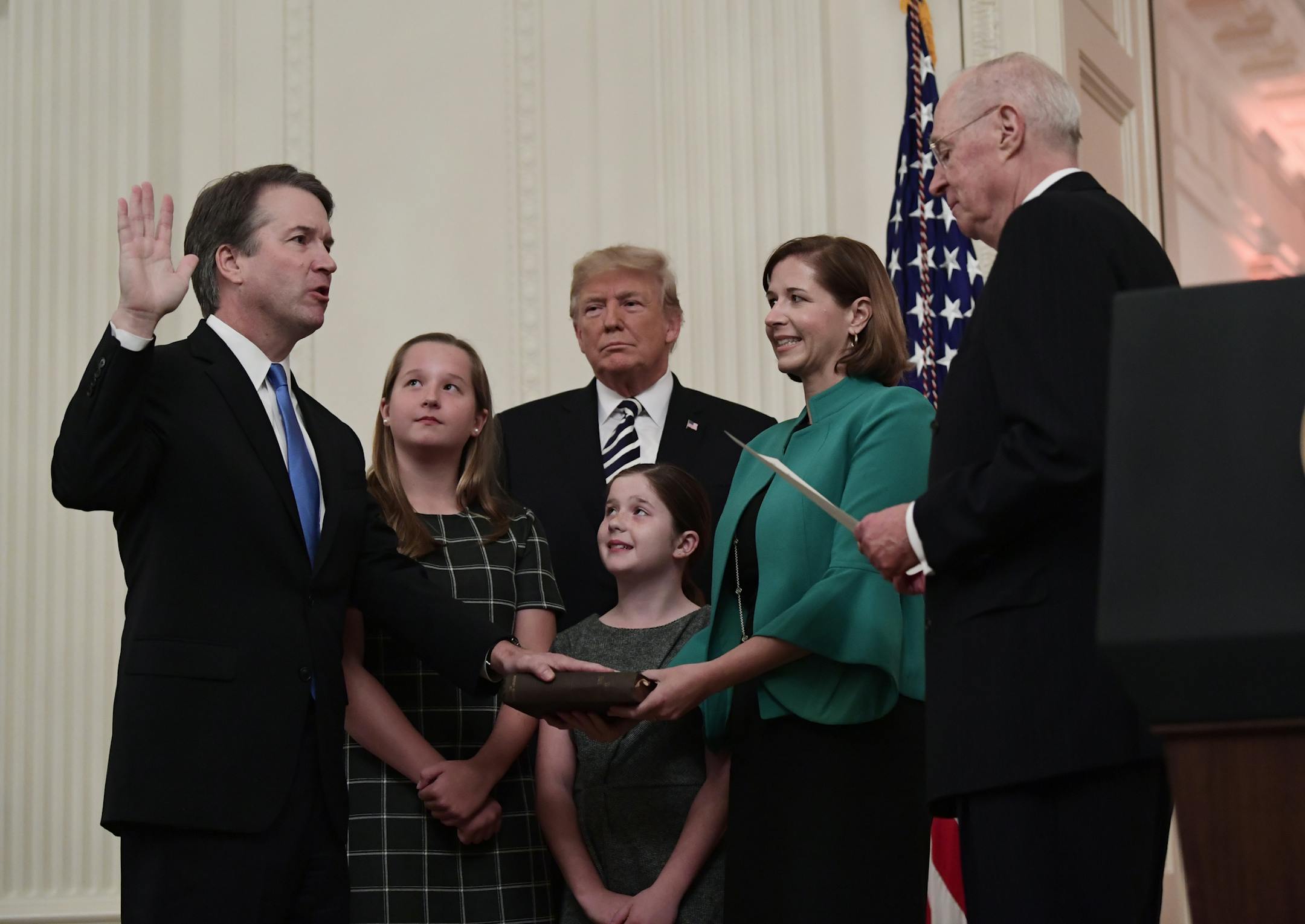
Retired Justice Anthony Kennedy, right, ceremonially swears-in Supreme Court Justice Brett Kavanaugh, as President Donald Trump looks on, in the East Room of the White House in Washington, Monday, Oct. 8, 2018. Ashley Kavanaugh holds the Bible and daughters Margaret, left, and Liza, look on. (AP Photo/Susan Walsh)
Retired Justice Anthony Kennedy, right, ceremonially swears in Supreme Court Justice Brett Kavanaugh, as President Donald Trump looks on, in the East Room of the White House in Washington, Monday, Oct. 8, 2018. Ashley Kavanaugh holds the Bible and daughters Margaret, left, and Liza, look on. (AP Photo/Susan Walsh) (The Minnesota Star Tribune)

The most acrimonious Supreme Court confirmation battle in modern times hardened the fault lines in U.S. politics that put President Donald Trump in office but now could give enraged Democratic voters the added motivation to oust Republicans from control of the House.

The fight over Brett Kavanaugh's elevation to the nation's highest court inflamed the voting bases of both parties a month before pivotal congressional elections. Republicans hope to gain in their quest to hold the Senate, as the Kavanaugh fight resurrected a defining issue that links the evangelical base to Trump: dreams of a generational lock on a conservative Supreme Court.

Still, backlash politics historically have been the driving force in midterms — it's the first chance for voters to weigh in on the president they picked just two years earlier. Traditionally, buyer's remorse has meant the party in the White House suffers significant losses.

"For Democrats there's been a tremendous amount of motivation brought on by the Trump presidency, and this has taken it over the top. We could not have had a more stark reminder of what's at stake in these elections," said Donna Edwards, a former Democratic representative from Maryland. "It's not going to be forgotten."

Edwards said the Kavanaugh fight would help Democrats flip as many as 20 GOP-held districts with "lots of suburban, college-educated white women," who polls show are breaking for Democrats by a 2-1 margin. "You're going to see an even higher turnout among women, particularly in these suburban districts that are swing districts," Edwards said.

Fifty percent of those surveyed for a Washington Post-Shar School poll of 69 battleground districts released Monday said they preferred Democratic candidates compared to 46 percent who backed Republicans, in the latest sign of potential GOP trouble. The same districts favored Republicans 56 percent to 41 percent two years ago, according to the Post.

The Senate is a different picture, with 12 out of the 13 most competitive races in states won by Trump in 2016. Some recent surveys show an enthusiasm boost among GOP voters, as Trump and his party allies have said repeatedly that Kavanaugh was treated unfairly by ideological foes. If GOP voters stay mobilized, it's likely to boost the party's prospects of retaining or expanding its thin 51-49 Senate advantage.

"This has energized our base like nothing we've been able" to do, Senate Majority Leader Mitch McConnell said in an interview just before the Senate voted 50-48 to confirm Kavanaugh on Saturday. McConnell, Trump and other Republicans repeatedly referred to anti-Kavanaugh protesters as a "mob." That "ended up being a big political help to us," he said.
The immediate focus is on five Democratic senators running for re-election in states where Trump won by double-digits in 2016: Joe Manchin in West Virginia, Heidi Heitkamp in North Dakota, Joe Donnelly in Indiana, Jon Tester in Montana, and Claire McCaskill in Missouri. All but Manchin voted against Kavanaugh.

"Obviously he's been receiving a ton of pressure from both sides, as one would imagine," Mike Plante, a Democratic strategist based in Charleston, W.V., said of Manchin. With promises to revive the coal industry, Trump won West Virginia by 42 points in 2016, his largest margin of any state.

Donnelly and McCaskill are depending on high Democratic turnout in urban areas and college towns, including blacks who were deeply skeptical of Kavanaugh. Tester and McCaskill emphasized concerns that Kavanaugh's skepticism of campaign-finance laws could lead to the proliferation of "dark money" in politics. Heitkamp raised questions about the judge's "temperament, honesty, and impartiality." All are campaigning on health care, and the justice's views about the legality of Obamacare's consumer protections are in doubt.

The red-state Democrats face a predicament: they need to preserve an image of independence to attract at least some GOP voters, but also need their Democratic base to turn out in big numbers. Midterm elections tend to be low turnout affairs where only about 4 in 10 eligible voters show up. In an era where the share of persuadable voters has been declining, campaigns increasingly put a premium on mobilizing the party faithful.

But it's not all good news for Senate Republicans. The Kavanaugh debate contains perils for Sen. Dean Heller of Nevada, a state won by Hillary Clinton in 2016. He trails in recent polls and was quickly attacked over his support for Kavanaugh by Democratic opponent Jacky Rosen. In Arizona, where Trump's winning margin was 3.5 points, Democrat Kyrsten Sinema is narrowly leading in the race for an open seat being vacated by Republican Jeff Flake. Inflaming the Democratic base and alienating suburban women carries big risks for Republicans.

Underlying the early liberal opposition to Kavanaugh was his lengthy record as a conservative jurist on the D.C. Circuit Court of Appeals, leading to fears that he'd lock in 5-4 majorities in cases involving gun rights and validating voting restrictions, while providing a potential fifth vote to weaken abortion rights and LGBT protections, where retired Justice Anthony Kennedy typically sided with the left.

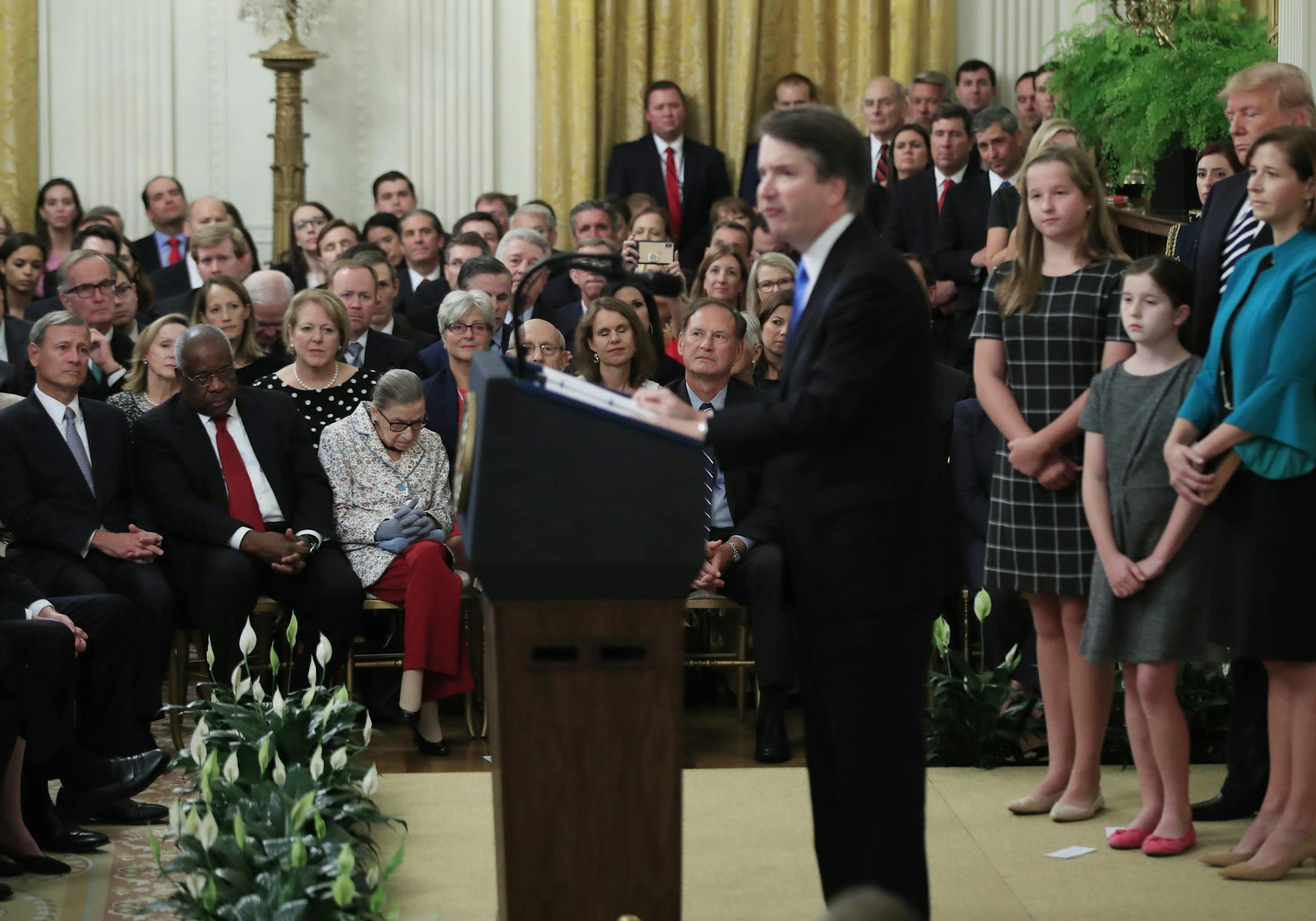
President Donald Trump, Chief Justice John Roberts, back left, and justices of the Supreme Court, listen to Justice Brett Kavanaugh speak during the ceremonial swearing-in ceremony of Kavanaugh as Associate Justice of the Supreme Court of the United States in the East Room of the White House in Washington, Monday, Oct. 8, 2018. Kavanaugh is accompanied by his wife Ashley Kavanaugh, third from left, and children Margaret, second from left, and Liza. (AP Photo/Manuel Balce Ceneta)
Do-over: Justice Brett Kavanaugh got his second swearing in ceremony Monday night at the White House. This time, all nine justices were present for the entirely ceremonial event. On Saturday night, Chief Justice John Roberts, back left, administered the oath at a private ceremony at the Supreme Court. On Monday, Kavanaugh was again accompanied by his wife, Ashley, and children Margaret and Liza. He already has been at the court preparing for his first day on the bench Tuesday. (The Minnesota Star Tribune)
about the writer

about the writer

Sahil Kapur

More from No Section

See More
FILE -- A rent deposit slot at an apartment complex in Tucker, Ga., on July 21, 2020. As an eviction crisis has seemed increasingly likely this summer, everyone in the housing market has made the same plea to Washington: Send money — lots of it — that would keep renters in their homes and landlords afloat. (Melissa Golden/The New York Times) ORG XMIT: XNYT58
Melissa Golden/The New York Times

It’s too soon to tell how much the immigration crackdown is to blame.