How Kaohly Her’s campaign strategy helped her win the St. Paul mayor’s race

Candidate beat Mayor Melvin Carter with a message that tapped into voter disaffection, data-informed tactics, and a lot of door knocking.

The Minnesota Star Tribune
November 7, 2025 at 9:58PM
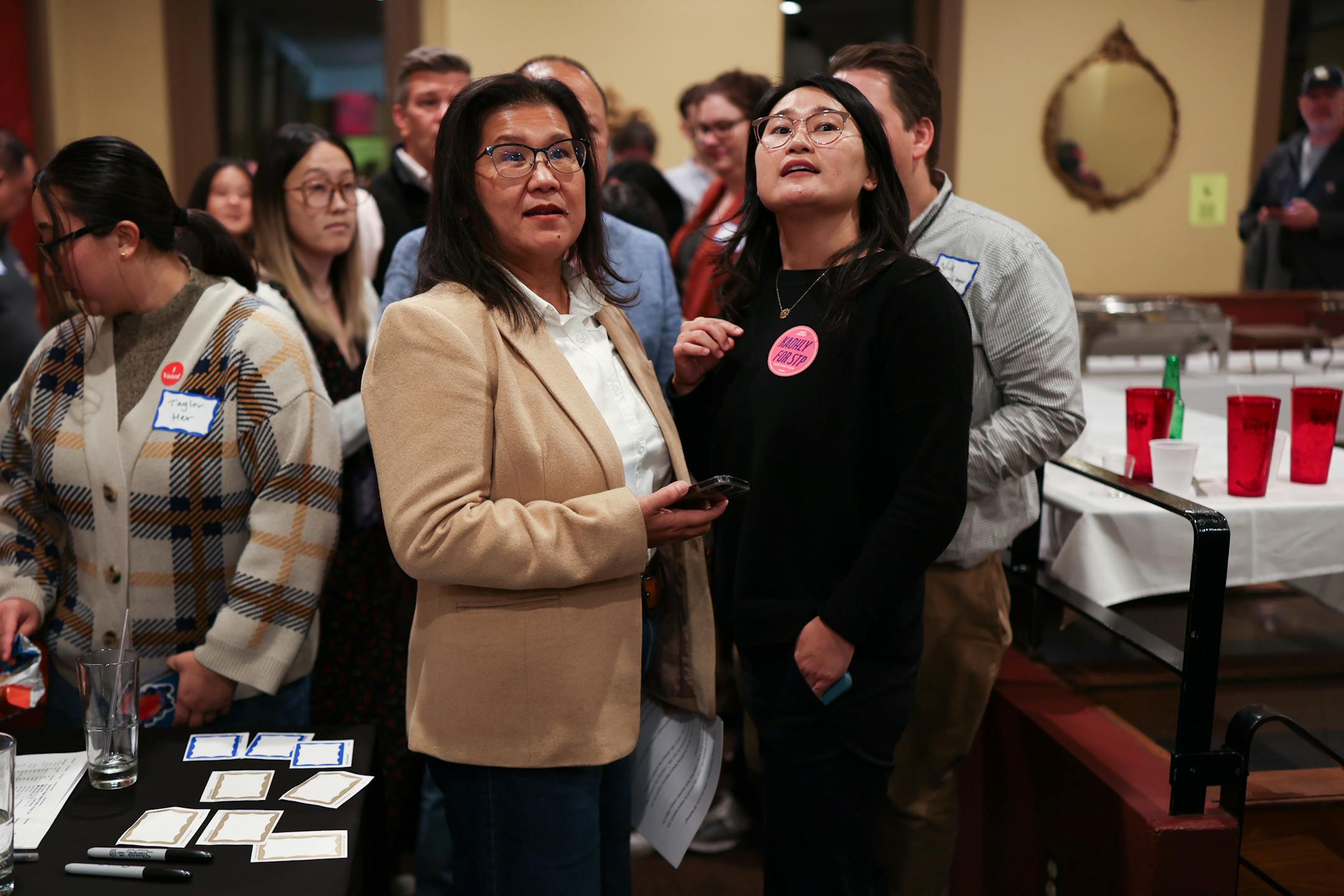
St. Paul mayoral candidate Kaohly Her watches election results come in at her Election Night party at Sweeney's Saloon in St. Paul on Tuesday. (Carlos Gonzalez/The Minnesota Star Tribune)

Kaohly Her had a tough task in front of her.

With just three months until Election Day, she had filed to run for St. Paul mayor against Melvin Carter, the charismatic incumbent with deep roots in the city and the backing of some of Minnesota’s most prominent politicians.

But Her won with a message that tapped into voters’ disaffection with the state of the city and a campaign strategy based in both retail politics and data analysis.

And a lot of hard work.

“She focused entirely on door-knocking. That’s just pure hustle,” said former state Rep. Ryan Winkler, who supported Her’s campaign. “She worked hard, her family worked hard, she got a team together and she got volunteers working hard.”

Carter faced headwinds too, as a mayor running for a third term amid unease about how St. Paul has fared since the pandemic.

Carter is popular, even beloved by some in St. Paul. Visiting Midway with the Minnesota Star Tribune during the campaign, a dozen people honked and waved at Carter from their cars. “I appreciate you! I appreciate you!” Carter called back. A handful crossed University Avenue to shake his hand, dap him up, embrace him.

But quieter resentment was building.

“Minnesotans are passive-aggressive,” said former Minneapolis state Sen. Jeff Hayden. “People were whispering, and clearly had issues with the mayor. They weren’t necessarily talking about it, but they were organizing behind the scenes.”

Her was able to tap into the sense that things in St. Paul were not going as well as they could be.

“She hit the ground, and all of a sudden people were supporting her,” Hayden said.

Ground work

Her credited her win to the data-driven focus on making contact with voters who would be open to her message, and her campaign’s commitment to responding to every email as a way to demonstrate how responsive she hopes her administration will be.

“I think that this is like the strength that I bring into running a city,” Her said.

“People often see just the outside part of it, like, who speaks the best, who is better able to articulate or move people,” Her said. “The strength of our team is the things that people could not see.”

The campaign had a detailed plan to reach out to voters in their three-month window before the election, and praised her team for their drive.

“They were relentless with me. They did not sleep. They worked day and night,” she said. “We would have objectives and goals, and we had a plan.”

Door-knocking was key, Her’s campaign team said.

“Talking to people is just the best way to get people to vote for you,” said Elise Shih, Her’s field director.

They focused first on solidifying support in Her’s House district, which includes parts of Macalester-Groveland, Highland Park and Summit Hill that typically see high voter turnout.

Next, they shifted to the East Side’s Ward 6 and Ward 7. Shih said she saw data from the 2021 and 2017 elections suggesting there were East Siders who had not voted for Carter before, so could perhaps be persuaded to vote for Her.

Then, she said, it was all about volume.

“At a certain point in the campaign we were knocking 1,000 doors a day,” Shih said.

Shih said the campaign largely skipped Carter’s base of support in Ward 1 and especially the Rondo neighborhood where Carter’s family roots run deep. Her’s campaign expected Como Park, St. Anthony Park, Hamline-Midway and Frogtown to break for Carter too, but they still knocked those doors, to “stem the bleeding” from those neighborhoods, Shih said.

In the end, Her’s campaign knocked on nearly 40,000 doors in St. Paul, and Her held more than 40 meet-and-greet events.

“She committed to being out and meeting with absolutely every possible voter they could and creating that relationship,” said Todd Rapp, a political consultant with St. Paul roots. “I don’t know that the mayor had time to do that or if he believed that was instrumental for the campaign.”

Hayden also said he wondered if Her’s late start put Carter on his heels.

“I think Her announcing late really was an advantage for her,” Hayden said, in that Carter had little time to stand up a campaign after going most of the year without a well-known challenger.

The message

Voters’ sense of malaise about the state of St. Paul gave Her an opportunity, said campaign manager Hnuchee Vang. “The city as a whole really wanted change and I think that was helpful,” she said.

Nick Stumo-Langer, Her’s deputy campaign manager, said they tried to strike the right balance between being critical and being too negative about St. Paul.

“We’re not saying everything is terrible that is happening in the city, but there are some missed pitches, or some meat left on the bone.”

Her’s supporters thought that was more in tune with the state of the world, the feeling of precarity and the sense that rising property taxes were not translating to better city services.

Carter’s administration has made major strides on public safety, with gun violence at a two-decade low, and Carter spoke about the growing pace of building sales in downtown St. Paul.

But statistics showing good news don’t resonate with voters who feel uneasy, Winkler said.

“The message coming from leadership in St. Paul was, ‘Don’t believe things aren’t great. Things are great, and here are the numbers to prove it,’” Winkler said. “Denying things voters are telling you doesn’t work. That didn’t work for Joe Biden in 2024.”

Third term

There’s precedent for third terms in St. Paul. The previous mayor, Chris Coleman served three terms, and George Latimer served for 14 years.

But former City Council President Amy Brendmoen said third terms are hard to win. “The shine is off,” Brendmoen said. “You really have to make the case, what are you bringing to the table for a third term.”

Brendmoen said she saw some stagnation in the senior levels of Carter’s administration, where Coleman had occasionally brought in a new deputy mayor or city attorney and shook things up.

“Maybe there was some stagnation that people sensed,” Brendmoen said.

Carter did little overt campaigning until the very end of the race. His summer was consumed by public appearances to explain the cyberattack on the city, and advocating for local gun control measures that the City Council is set to pass next week.

Incumbency can be a disadvantage, said Hayden, who lost a primary election as an incumbent in 2020 to state Sen. Omar Fateh.

The work of governing can mean less contact with constituents than someone who is campaigning full-time.

“You’re nine-to-five, you’re mayor, you’re working,” as an incumbent, Hayden said.

“Campaign mode is such a different mode. You’ve got to build up your team, you’ve got to fundraise, you’ve got to door-knock.”

about the writer

about the writer

Josie Albertson-Grove

Reporter

Josie Albertson-Grove covers politics and government for the Star Tribune.

See Moreicon

More from News & Politics

See More
card image

Amid never-ending grief after their 8-year-old son’s murder, Fletcher Merkel’s family finds strength in community.

card image
card image