

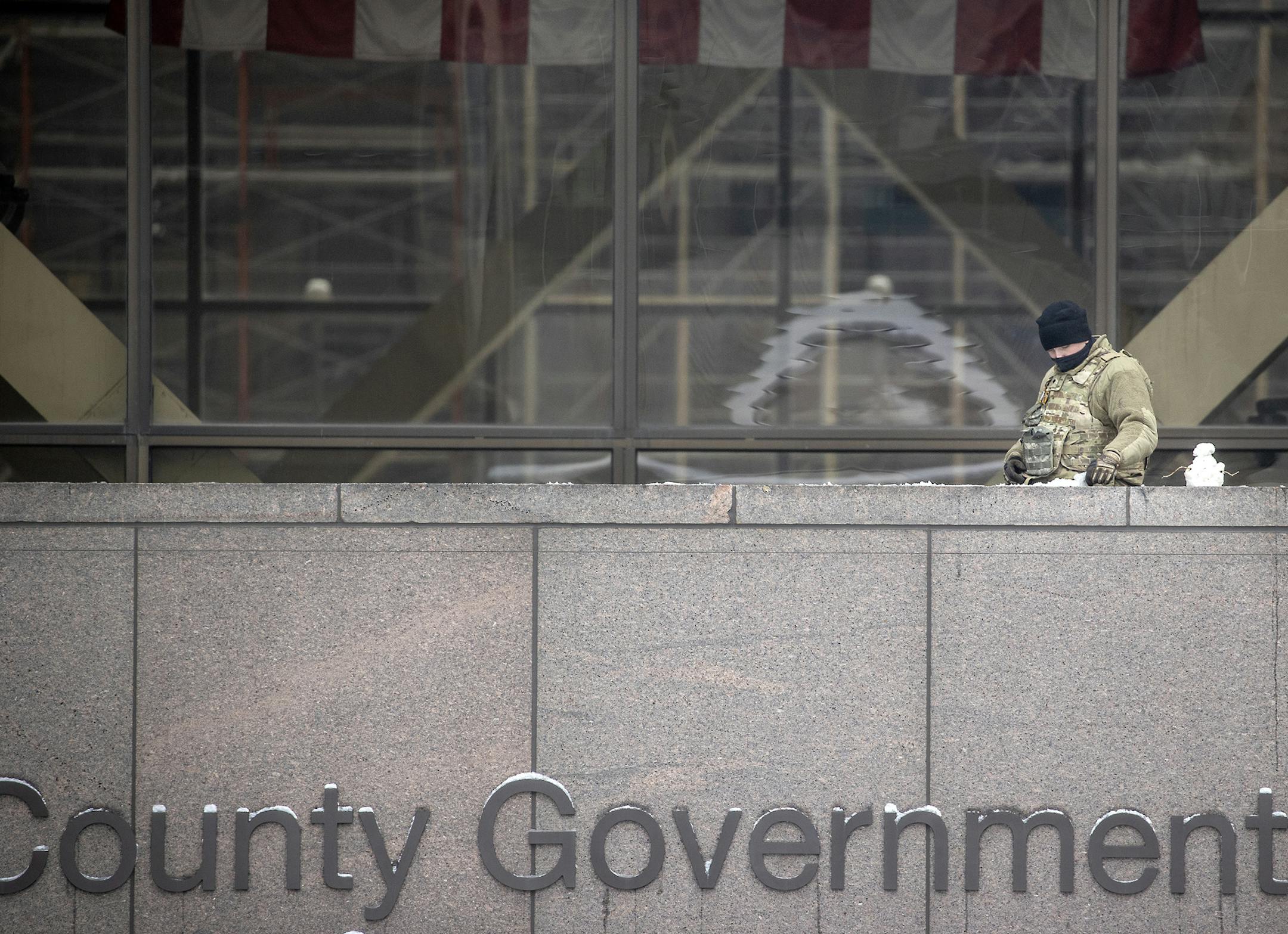
A Hennepin County judge ruled that the trial of a man charged in a stabbing last fall can move forward at the fortified Government Center, despite prosecutors' arguments that tight security related to Derek Chauvin's murder case could violate the defendant's right to a public trial.
On Tuesday, District Judge Kerry Meyer ordered that the trial of Arnold Benedict Cole, 32, would proceed once an overflow room could be found, from where court observers could watch the proceedings remotely.
Meyer's ruling comes a day after prosecutors made a motion to reconsider, again asking Meyer for a continuance on the grounds that public access to the case was limited by restrictions related to COVID-19 and security measures related to the ongoing murder trial of ex-Minneapolis police officer Chauvin in the death of George Floyd. The defense objected by arguing that delaying the case violated Cole's constitutional right to a speedy trial.
Both Chauvin and Cole's trials were set to start on March 8, but Cole's was postponed until this week when prosecutors pushed for a continuance until after the conclusion of the Chauvin trial, citing safety concerns. More than a week before the trials were to begin, the government center was locked down to almost everyone, including the 2,500 people who normally work there. It's surrounded by fencing and concertina wire, and access to the building is limited to a handful of court personnel and potential jurors, who are allowed in only through heavily guarded entrances and must carry credentials.
Cole is accused of second-degree attempted murder stemming from a Sept. 15, 2020, incident in which he allegedly stabbed and seriously injured another man at the 28th Avenue light-rail station in Bloomington.
In asking for Meyer to reconsider her earlier decision, Assistant Hennepin County Attorney Tara Ferguson Lopez argued that if the state won a conviction, it could be easily appealed and overturned because it violates Cole's Sixth Amendment right to a public trial.
"A district court must take 'every reasonable measure to accommodate public attendance at criminal trials,' " she wrote in the motion.
"… The State has grave concerns that any proceedings that take place under these circumstances will (violate) Defendant's constitutional rights and objects to proceeding in such a manner," Ferguson Lopez wrote.


