
Despite judge’s order, ICE sent an immigrant to Mexico instead of back to Minnesota

The government says the undocumented immigrant voluntarily left the U.S. His attorney is seeking a contempt of court finding as the federal courts remain overwhelmed by immigration cases.

The Minnesota Star Tribune
February 5, 2026 at 7:04PM
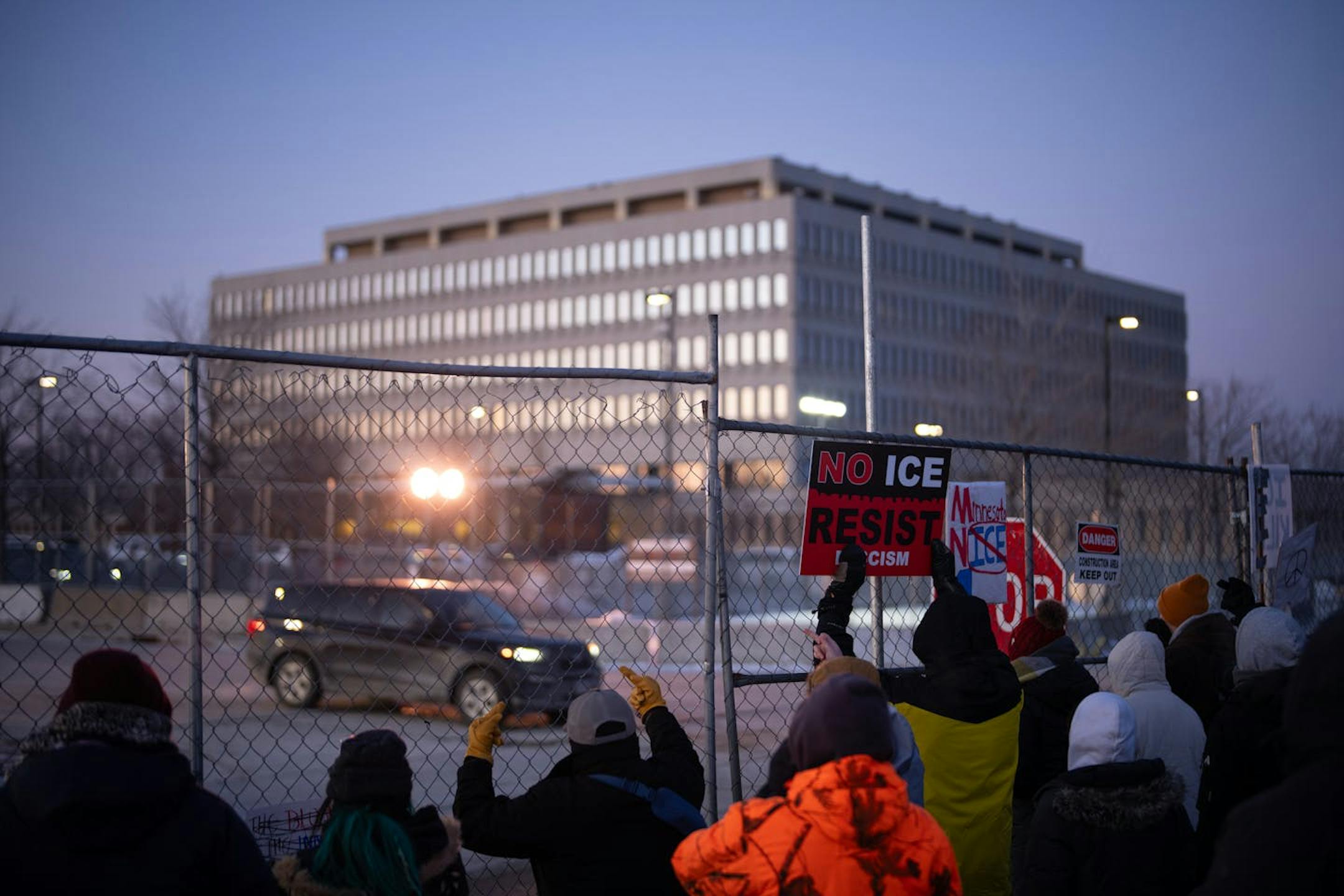
Protesters are blockaded across the street from the Whipple Federal Building near Fort Snelling on Jan. 25, where detainees are being held. Federal courts in Minnesota have been overwhelmed with unlawful detention lawsuits. (Jeff Wheeler/The Minnesota Star Tribune)

Despite two court orders to return Emilio Pena Jimenez to Minnesota from a detention center in Texas, the government sent the undocumented immigrant to Juárez, Mexico.

Now, Pena Jimenez’s attorney is asking a federal judge in Minnesota to hold the government in contempt of court for failing to comply with the orders.

Government attorneys argue that Pena Jimenez agreed to voluntarily leave the country two days before any court order mandating his return to Minnesota.

Pena Jimenez, 61, is one of hundreds of undocumented immigrants swept up in Operation Metro Surge who claim they were unlawfully detained by the federal government.

His is a rare case where an undocumented immigrant was sent to another country despite court orders mandating a return to Minnesota. And contempt of court motions in unlawful immigrant detention suits have been uncommon.

But the federal courts in Minnesota have been overwhelmed with unlawful detention suits. Minnesota’s top federal judge recently said ICE had violated dozens of court orders in habeas corpus cases involving detained immigrants.

Pena Jimenez’s attorney, Joseph Kantor, said in an interview that any documents his client signed were signed under “duress.”

In court documents, Kantor wrote that Pena Jimenez was deprived of his regular diabetes medication in detention and was not allowed to call an attorney despite several requests.

“He was compelled to sign documents that he did not understand, was unable to translate, and was not provided with copies after the fact,” Kantor said in a court filing.

The government said nothing about the voluntary agreement in its initial response to Pena Jimenez’s habeas petition.

Responding to the contempt of court motion, the government said in a court filing “Pena [Jimenez] knowingly voluntarily and intelligently” agreed to voluntary departure and that it was “interpreted into his preferred language.”

ICE arrested Pena Jimenez without a warrant on Jan. 24 while he was at a Walmart in Apple Valley, according to his petition against multiple federal government agencies.

Pena Jimenez, a Mexican citizen who lives in Lakeville, came to the U.S. in 2000, owns a tile installation business and has no criminal record, according to his petition.

The petition, filed Jan. 30, said he was detained at the Fort Snelling ICE field office. That same day, U.S. District Court Judge Jeffrey Bryan temporarily halted ICE and the Department of Homeland Security from transferring Pena Jimenez out of Minnesota.

If Pena Jimenez already had been removed from the state, Bryan ordered the government to return him “as soon as possible” and no later than Feb. 2. The judge issued a final order on Feb. 2 to release Pena Jimenez from custody “immediately in Minnesota without conditions.”

But by then, Pena Jimenez was already in Mexico.

ICE transferred Pena Jimenez to a detention center in El Paso the same day he was arrested, the U.S. Attorney’s Office said in a Feb. 4 court filing. On Jan. 28, Pena Jimenez had signed a “Form I-210,” voluntarily agreeing to leave the U.S. instead of facing formal removal proceedings, the filing said.

On Feb. 2, ICE brought Pena Jimenez in a bus to the border between El Paso and Juárez and released him.

Pena Jimenez was “extremely worried” about having no family or “support system” in Juárez and feared “criminal activity” in the city, his attorney said in a court filing. On Feb. 3, his family bought a ticket to fly him to Mexico City.

If the government continues refusing to return Pena Jimenez to Minnesota, Kantor asked the court that a “third party” be appointed to do so — at the government’s expense and with assistance from the U.S. Marshals Service.

“There is no excuse for not returning [Pena Jimenez] to Minnesota after the January 30, 2026 [court] order,” Kantor argued in his contempt of court filing.

The U.S. Attorney’s Office argued the government can’t be held in contempt because it “honored and executed Pena’s voluntary departure” before any deadline to return him to Minnesota.

In a review of more than 200 habeas corpus petitions, the Minnesota Star Tribune found five motions for contempt filed by immigrants’ attorneys against the federal government. None have been granted, though that might be because the government complied in some cases.

Last week, Minnesota’s chief federal judge, Patrick Schiltz, released a list of 74 wrongful-detention cases with at least one violation of a court order, or more than 1 in 7 cases filed since December.

He said the extent of the violations by ICE is almost certainly understated.

On Jan. 26, Schiltz, wrote his “patience is at an end” and ordered ICE’s acting director, Todd Lyons, to personally appear in court to explain why he should not be held in contempt.

Schiltz ultimately canceled the hearing after the Ecuadorian citizen at the center of the dispute was released but said his concerns remain.

The sheer number of federal cases, especially in light of the substantial increase in this month alone, is imposing a crushing burden on U.S. Attorneys’ offices. This has, in turn, compelled them to shift resources away from other critical priorities, including criminal matters, according to a filing that Daniel Rosen, U.S. Attorney for Minnesota, made to the 8th District Court of Appeals.

“The MNUSAO has cancelled all [affirmative civil enforcement] work and any other affirmative priorities,” he said in the filing.

He said assistant U.S. Attorneys in Minnesota “are appearing daily for hearings on contempt motions,” with district courts “setting deadlines within hours, including weekends and holidays.” Attorneys and support staff “are continuously working overtime” all while the civil division at the U.S. Attorney’s Office in Minnesota is at 50% capacity, the filing said.

Jeffrey Meitrodt and Sarah Nelson of the Minnesota Star Tribune contributed to this story.

about the writer

about the writer

Mike Hughlett

Reporter

Mike Hughlett covers energy and other topics for the Minnesota Star Tribune, where he has worked since 2010. Before that he was a reporter at newspapers in Chicago, St. Paul, New Orleans and Duluth.

See Moreicon

More from News & Politics

See More
card image
card image