

U.S. Rep. Jason Lewis highlighted his support for Republican-passed tax cuts while his Democratic challenger Angie Craig warned that Republicans like Lewis would cut entitlements, such as Medicare and Social Security, if they continue to hold power in Congress, as the two met for the final debate of their hard-fought election rematch.
Lewis, running for a second term in the Second Congressional District after narrowly beating Craig in 2016, touted the tax bill — passed by Republican congressional majorities and signed by President Donald Trump at the end of 2017 — as a huge shot in the arm for American taxpayers, business owners and the job market.
"This has been a great success story," Lewis said at the forum at Dakota County Technical College in Rosemount, adding that it's spurred economic growth and job openings. "We've got the greatest economy since 1969."
Craig disputed the benefit of the tax cuts, saying "trickle-down economics" has never worked and didn't help her family when she grew up living in a mobile home. She called for more tax cuts for middle-class families and small businesses and said the tax cuts Lewis supported just added to the federal deficit.
"They're coming after your Medicare and Social Security and they are going to cut it or raise the retirement age in order to pay for their tax cut for very large companies," Craig said.
With under two weeks to Election Day, Craig and Lewis have been locked in an intense contest in this district, which includes southeastern Twin Cities suburbs, and more rural areas to the south. As one of a handful of swing seats targeted by both national political parties, the race has seen major infusions of outside spending, and is likely to be a test of Republican staying power in suburban districts where Democrats are trying to capitalize on Trump's slumping support among women and college-educated voters.
In recent weeks, Lewis has tried to emphasize support from women. On Monday, he held a 25-minute discussion with a group of 10 preselected female constituents that was billed as centering on women's issues, with the economy and health care dominating the discussion.
At one point, Lewis asked how many women supported "Medicare for All" and the group groaned.
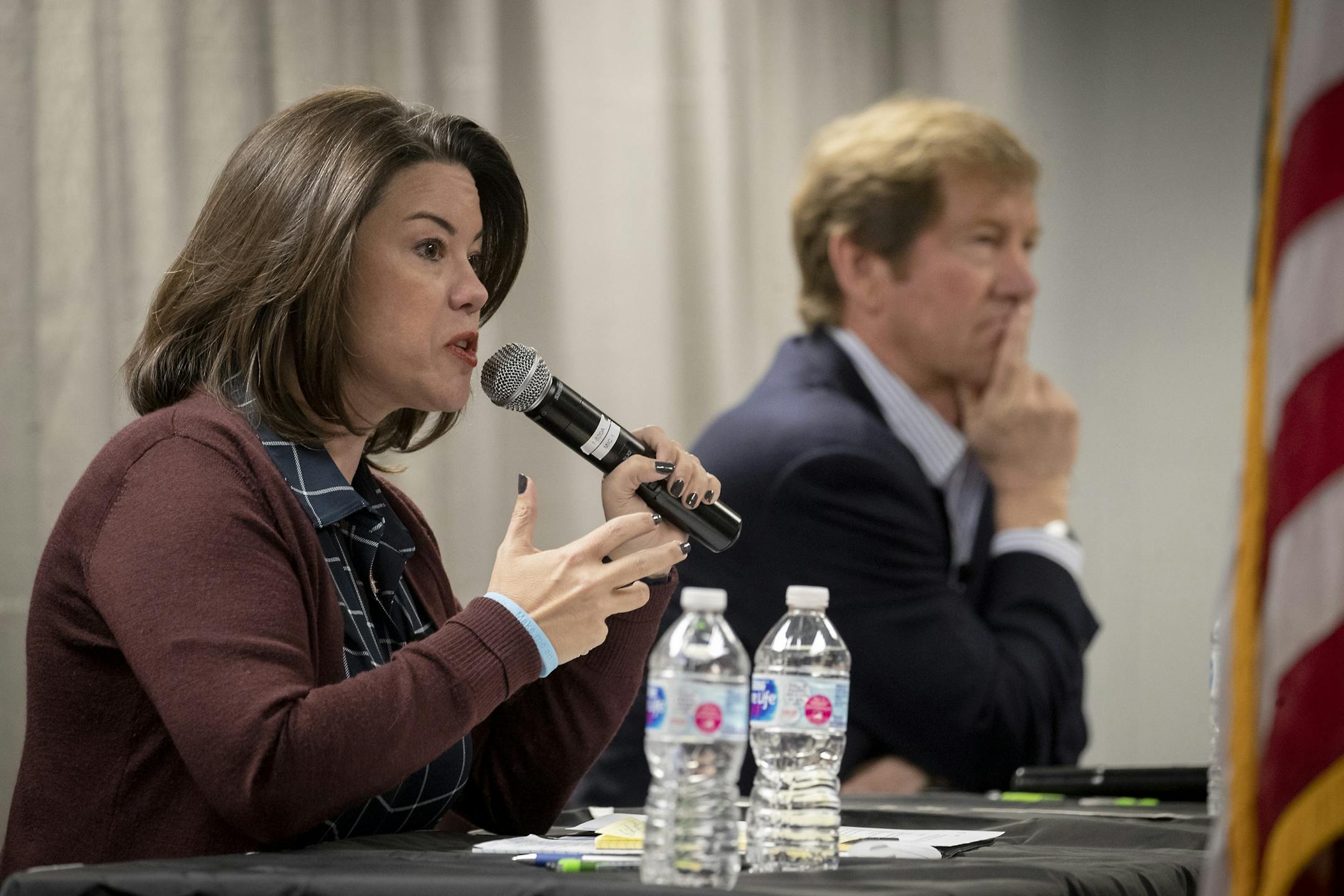
![Democrat Angie Craig, left, and Republican Jason Lewis, debated for the last time as they battle for Minnesota's Second Congressional District at the Dakota Technical College, Thursday, March 25, 2018 in Rosemount, MN. ] ELIZABETH FLORES ï liz.flores@startribune.com](https://arc.stimg.co/startribunemedia/LD3EPQFSJ2ZHSVX3RFFTRZRUMY.jpg?&w=1080)
![A crowd listened as Democrat Angie Craig, left, and Republican Jason Lewis, debated for the last time as they battle for Minnesota's Second Congressional District at the Dakota Technical College, Thursday, March 25, 2018 in Rosemount, MN. ] ELIZABETH FLORES ï liz.flores@startribune.com](https://arc.stimg.co/startribunemedia/QLACWELP3B4AHD5LGHUVOJ2ROY.jpg?&w=1080)


