
Japan announces name of next era ahead of imperial succession

April 2, 2019 at 1:50AM
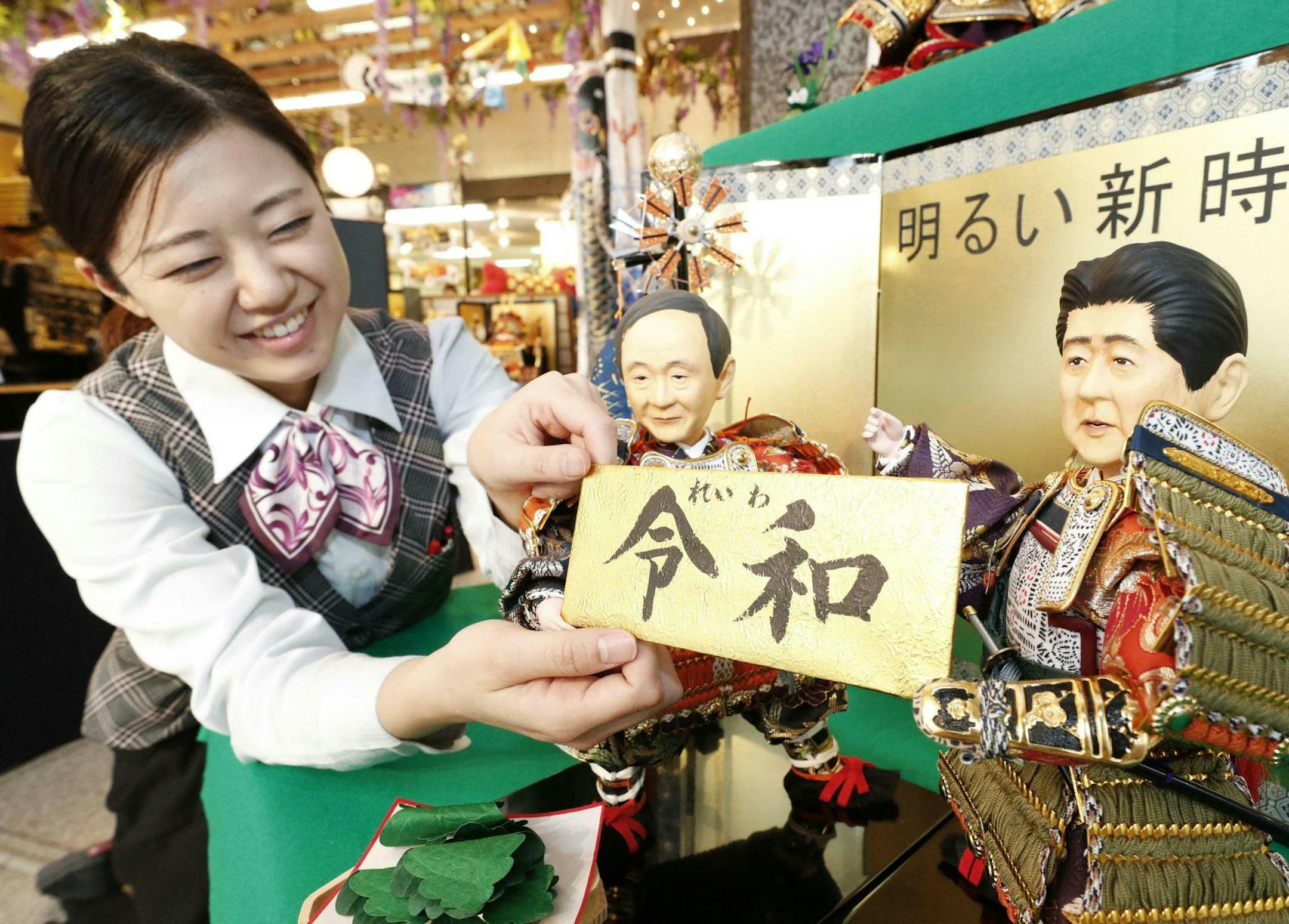
A shop worker arranges Japanese traditional dolls depicting Japanese Chief Cabinet Secretary Yoshihide Suga, left, and Japanese Prime Minister Shinzo Abe, right, holding the new era name "Reiwa" at Kyugetsu, a Japanese doll company, in Tokyo, Monday, April 1, 2019. Japan's government has unveiled an era name, "Reiwa," or "pursuing harmony," for soon-to-be Emperor Naruhito, who will succeed the Chrysanthemum throne on May 1. His father, Emperor Akihito, is abdicating, with his "Heisei" era coming
A shop worker on Monday held a sign with the new era’s name — Reiwa — at Kyugetsu, a Japanese doll company, in Tokyo. (The Minnesota Star Tribune)

Japan named its next imperial era Reiwa, or roughly "auspicious calm," as the nation prepared for a once-in-a-generation transition in the world's oldest continuous monarchy, with a new emperor to ascend the Chrysanthemum Throne next month.

The unveiling of what had been a closely guarded secret is among the first steps toward the imperial succession.

Emperor Akihito, 85, is preparing to step down at the end of the month, drawing the curtain on his three-decade reign. His oldest son, Crown Prince Naruhito, 59, will replace him May 1, marking the beginning of the new era.

"The word 'reiwa' implies the people's hearts coming together in beauty to create and develop culture," Prime Minister Shinzo Abe said.

The characters are taken from a poem about plum blossoms in an eighth-century anthology known as the "Manyoshu," or "Collection of Ten Thousand Leaves." Abe said he hopes that citizens' lives would blossom like the flowers in the poem.

Although no official English translation of the two Chinese characters used in the name was provided, many took them to mean "auspicious" and to "soothe" or "calm" in the context of ancient Japanese poetry.

There were many ways to interpret the characters, with the first one generally used to convey "order" or "instruction." The second character is often translated "harmony" and can also mean "Japanese."

Thousands crowded major urban centers to watch the name announcement on TV. Meanwhile, the Real Estate Institute of Western Australia, or REIWA, found itself accidentally at the center of a lot of attention from Japan.

Era names are how Japan defines its history, with epoch names going back about 1,300 years.

The country is in the final weeks of Heisei, which can be translated as "achieving peace." Driver's licenses, newspapers and a host of official documents mark years from the enthronement of the emperor, with 2019 currently referred to as the "31st year of Heisei."

The era saw the bursting of Japan's asset bubble and numerous natural disasters, including the March 2011 earthquake and tsunami that prompted a nuclear disaster, which left about 20,000 people dead or missing. Akihito and his wife, Michiko, visited survivors at shelters and were seen by many in Japan as helping a battered nation recover through their compassion.

From May 1, Japan will be in the first year of Reiwa. Emperor Akihito will be the first emperor to step down in about 200 years.

Bloomberg News

about the writer

about the writer