

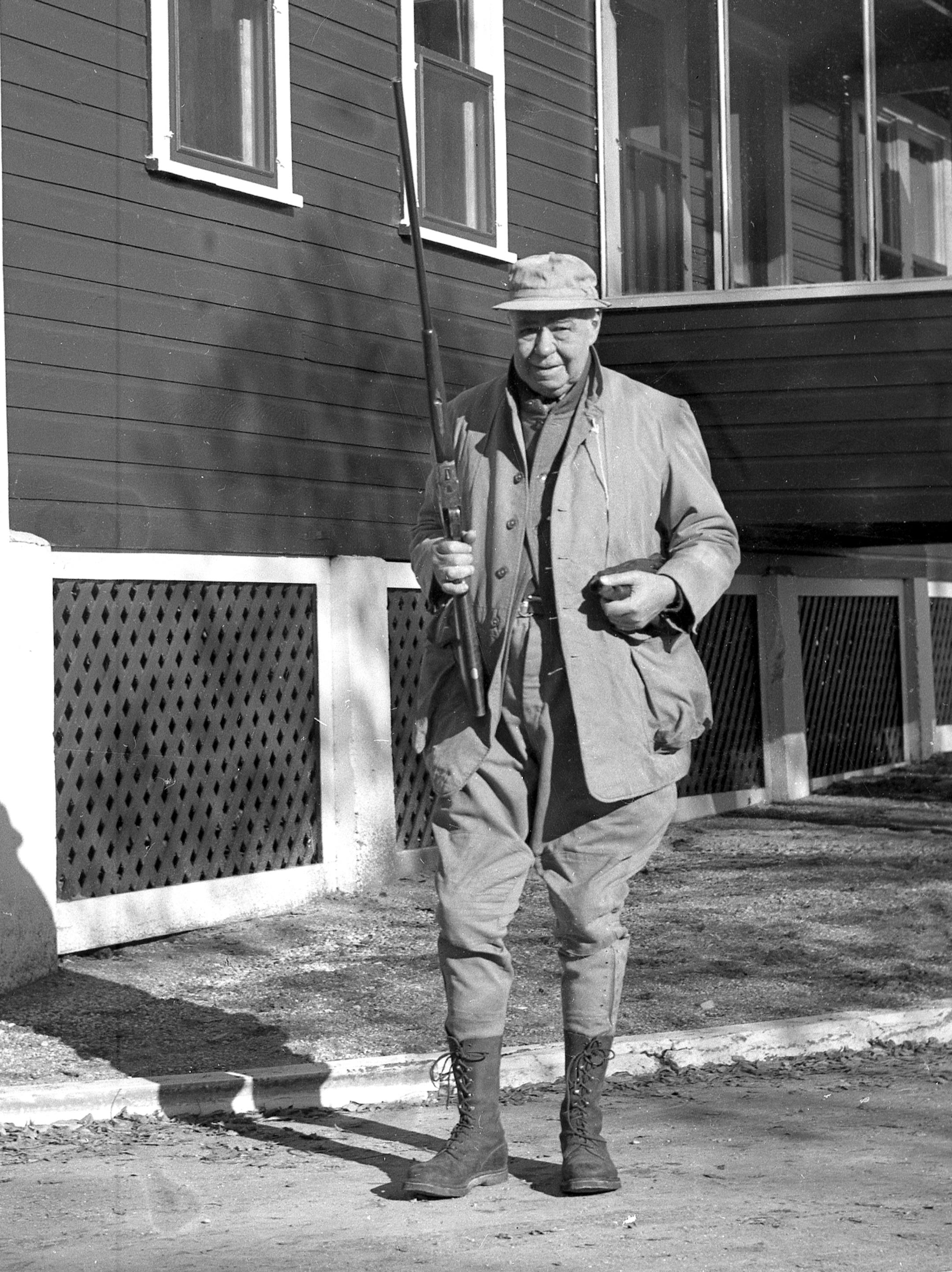
Sometimes I picture the late James Ford Bell sitting in a duck blind at Heron Lake in extreme southwest Minnesota, or at Ten Mile Lake road pass near Fergus Falls, or at historic Delta Marsh in Manitoba.
I see a string of canvasback decoys set and listing in the water. I see Bell, perhaps with a cigar dangling from his lips and a Parker boom stick cradled in his arms, watching the horizon for his beloved canvasbacks to appear, their snowy-white bellies buffeting the inky waters as they follow the string into shotgun range.
Who was James Ford Bell? Minnesotans today might recognize his name from the Bell Museum of Natural History at the University of Minnesota. The founder of General Mills in Minneapolis, Bell also was an entrepreneur, a philanthropist, a lay scientist, an avid sportsman and a conservationist who helped shape the history of waterfowling and waterfowl management in North America. To me, JFB, as he was often called, is waterfowling's unsung hero, a man to whom waterfowlers everywhere owe a debt of gratitude.
I first learned of Bell's contributions to waterfowling in 2011. At the time, I was working for the Delta Waterfowl Foundation, a waterfowl-conservation organization based in Bismarck, N.D. My editor and I were tasked with writing a special magazine commemorating Delta's 100-year anniversary.
My editor found out about a trove of information on display at the Archives of Manitoba in Winnipeg. The Hochbaum collection, named after Delta's first and longest-serving scientific director, Albert Hochbaum, contained 44 cardboard boxes of letters, reports, manuscripts, essays, artwork and photos that helped us fill the holes of Delta's rich, and sometimes controversial, history. The collection also made one thing abundantly clear: Delta Waterfowl would not exist if not for James Ford Bell.
During my research, when I read reams of Bell's letters, I was struck by how devoted he was to scientific exploration ("one must follow where research leads," he was quoted as saying numerous times) and by how seriously he took his role as a hunter-conservationist. He believed he needed to give back as much as he took, if not more.
Bell's conscience as a waterfowler had fully flowered by 1934 when he resigned as president of General Mills and became chairman of its board. He had started out as a teenager hunting ducks in the marshes at what's now 26th Street and Park Avenue S. in Minneapolis. Over the years, he had watched two of his favorite canvasback haunts — at Heron Lake and Ten Mile Pass — decline significantly. He subsequently bought some hunting land at Delta Marsh, a shallow 40,000-acre pool at the lower end of Lake Manitoba and probably the best canvasback haunt in North America at the time. Even on this rich habitat, Bell still could see that canvasback numbers were falling. The drought of the Dirty '30s and habitat degradation were taking their toll.
A fledgling field of study
Still, Bell's story could have easily ended with him happily and contentedly gunning canvasbacks at Delta Marsh, with nary a compelling historical footnote. Instead he donated the land while helping to finance and providing the vision for what would become North America's most prestigious waterfowl scientific research facility, the Delta Waterfowl Research Station at Delta Marsh. In doing so, Bell helped put meat on the bones of a fledgling field of study.

