
Advertisement

It's turkey time, but be patient

That alarm clock, those weather worries and the walk into the forest all lead to the back-and-forth that makes up a hunt and the satisfaction that soon follows.

For the Minnesota Star Tribune
April 29, 2008 at 3:36AM
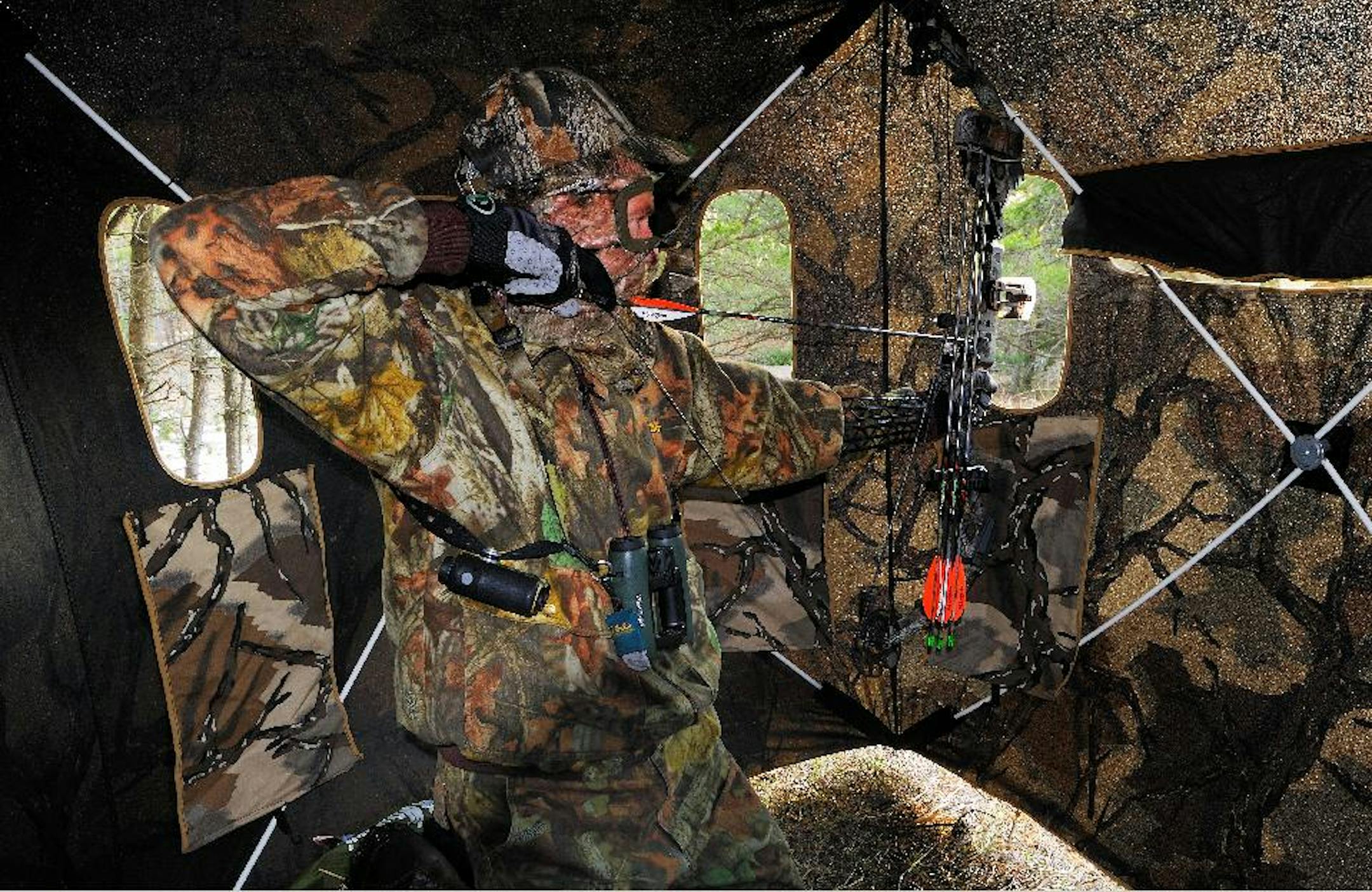
Shortly after bagging a wild turkey with his bow and arrow, Bill Marchel reenacted the shot. He was hunting near Fort Ripley, Minn., on opening day.
Shortly after bagging a wild turkey with his bow and arrow, Bill Marchel reenacted the shot. He was hunting near Fort Ripley, Minn., on opening day. (Ken Chia — Bill Marchel/The Minnesota Star Tribune)
Advertisement

FORT RIPLEY, MINN. -- Wednesday, April 16, 4:15 a.m. I awoke suddenly to the sound of a turkey gobble. Only a turkey hunter would own an alarm clock that provokes him from bed with the gobbling of an amorous tom turkey. And only a turkey hunter would think that was kind of neat. 4:20 a.m. Coffee is brewing. I glance at the outdoor thermometer -- it's 46 degrees. When I walk the dog, I note the sky is mostly cloudy, and a stiff breeze is blowing. That's not good for hearing turkey gobbles. Snow still remains in the shaded areas, remnants of a storm five days prior.

4:30 a.m. I had arisen plenty early. Legal shooting time is 6 a.m., give or take a minute or so. I had packed my gear the night before, and since it's a short drive to my hunting location, I have time to leisurely consume a bowl of cereal and sip coffee. I also took time to surf the various weather sites on the Web looking for the day's forecast. No problems, other than the wind.

5:25 a.m. I arrive at my hunting spot. As I step from my truck, I pause to listen, even though I know it's too early for turkeys to be gobbling. Before I leave, I double-check my gear. Bow and arrows, release, rangefinder, turkey calls, got'em.

5:30 a.m. It's about one-third of a mile walk in to where I'll hunt. That's perfect. Long enough of a walk to get the blood moving, short enough that I don't work up a sweat. In the oak woods, the snow is about 4 inches deep -- wet, slushy and quiet. I follow a faint set of footprints, mine from two days earlier when I had placed my blind. I had also carried in a folding chair and three turkey decoys. Then, the snow was more than a foot deep. As I near my blind, I break out of the oak forest into a meadow surrounded by jack pines. Many of those pines were snapped off because of the recent heavy snow. Even in the open meadow, patches of the white stuff remain, and much to my delight, in the gray light of predawn, I note turkey tracks here and there.

5:45 a.m. I arrive at my blind, and find it crumpled at the base of a jack pine. The day before, the wind had gusted to 40 miles per hour. One of my decoys is missing, too. Ten yards downwind I find the decoy. It only takes a minute to reset my blind. I pause and listen. Nothing. I am concerned because I figure it is gobbling time. I place one hen turkey decoy about 10 yards in front of my blind and settled in.

5:50 a.m. A tom just gobbled. Last spring, I had spent several days photographing turkeys at this location. I knew where the birds liked to roost --a stand of towering red pines about 300 yards behind me -- and the gobble has emanated from that location.

Other animals also are awakening. Nearby, a ruffed grouse drums. Sandhill cranes, Canada geese, wood ducks, mallards, all are announcing the coming day. Occasionally, a turkey gobble or two follows those announcements.

6 a.m. It's it now legal shooting time, and time to rehearse. I nock an arrow and clip my release to the bowstring. I kneel on the damp earth, draw my bow and aim through a port in my blind. To my surprise, standing just beyond my turkey decoy and aligned perfectly with my bow sight is a whitetail doe, a mere silhouette in the gray light. If I accidentally touch the trigger on my release, well, I might have some explaining to do. The turkeys still are gobbling. I guess there are at least two or three, maybe more. The doe wanders off.

Advertisement

6:10 a.m. Now the gobbling sounds are muffled. The birds have flown down from the roost. I "yelp" using a diaphragm turkey call. Nothing. Oh no! The jack pines are swaying in the wind. Whispering pines? I wish they would whisper more quietly. I call again. This time the toms answer.

6:30 a.m. I haven't heard a gobble for 15 minutes. I call only sparingly but get no response. I know the routine. It is early in the turkey "rut" and the toms are with hens. It's easy to visualize the toms, big black balls topped with heads of red, white and blue, following every move of the unimpressed hens, as they march about beneath the dark pines.

6:55 a.m. I hear a hen yelp from behind my blind. I yelp back. She answers. We duel for a few minutes. She is calling loudly, that's good. But then she goes quiet.

7 a.m. I spot a lone hen. She walks past my blind, then past my decoy. She ignores my decoy, but she also ignores my blind. She continues on, pecking at unseen goodies. I call occasionally, now throwing in a few "cuts" with my yelps.

7:10 a.m. Did I just hear a tom spit and drum? I haven't heard a gobble for nearly an hour, nor a hen yelp for 10 minutes. I listen intently, and again curse the "whispering" pines. There, I heard it again, this time for sure, the deep "varooom" of a drumming tom. The bird is behind me and to my left. I ease from my chair to a kneeling position, and reach for my bow. When I dare glance out the window, I can't believe what I see. There, only 30 yards away, are three strutting toms and about 10 hens, all walking in my direction.

7:11 a.m. Are those glowing blue heads and bright red wattles of the toms for real? At this point, the turkeys cannot see my decoy, so I cut loose with a hen yelp. All three toms gobble in unison. I shift position a bit, and focus on the shooting port ahead of the approaching toms. Now the strutting gobblers can see the decoy, and they hotfoot forward. I slowly draw my bow, but two of the toms spot the movement. Immediately they deflate and run. The third tom hesitates momentarily. The bird is quartering away, so I align my sight on its upper thigh and touch the trigger. The arrow strikes with a loud "whop." Immediately the tom takes flight. I watch as it flies across a meadow and into the pines, where it eventually disappears about 70 yards away. I burst from the blind and sprint with bow in hand across the meadow, parting hen turkeys as I go. Some of the hens fly, others run, most emitting anxious putts as they leave. When I enter the pines I immediately spot the orange fletching of my arrow protruding from an already-dead tom turkey.

Advertisement

7:30 a.m. I carry the tom back to my blind. For a long time I sit and admire the bird. A hazy sun illuminates its iridescent feathers -- gold, green, bronze, blue, copper. Those who think wild turkeys are ugly have never closely examined their feathers, nor have they seen a strutting tom lit by early light.

Bill Marchel is a wildlife photographer and outdoors columnist. He lives near Brainerd, Minn.

about the writer

about the writer

Bill Marchel

Advertisement