

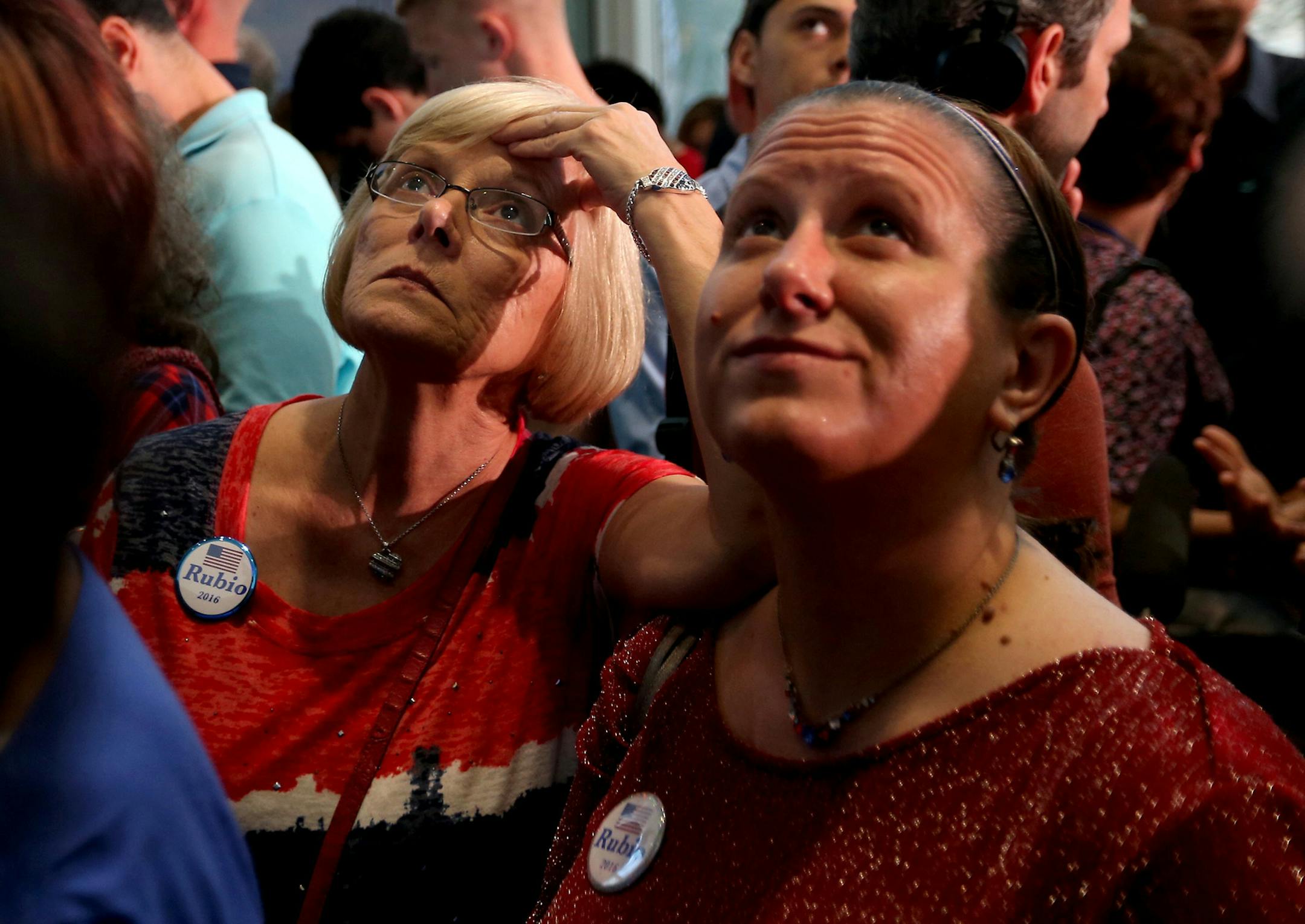
Marco Rubio speaking with a catch in his voice to a small Miami audience of die-hard supporters — and people in the audience openly weeping, hugging, hanging their heads — will be one of the most poignant images I will carry back with me when my tour of primary states is over. This is an image of people being left behind by the relentless logic of the U.S. political system.
In the last two months, I have talked to a slew of knowledgeable people in six early-voting states, and also in New York and Washington, D.C., who claimed not to understand what's going on in this election campaign. All bets are off, they said; all the rules are out the window.
I shrugged this off. What I saw in the early-voting states was a genuine, grass-roots democracy with hundreds of thousands of engaged voters. They don't know or follow the "rules."
One could juggle horse-race statistics, point out that no previous candidate had ever won the presidency without carrying this or that state, discuss obscure rules that could help turn losers into winners under certain circumstances. That's what experts do. Ordinary voters, though, weren't into any of this. They were just expressing their preferences along clear lines that suggested the U.S. really had far more strains of political thinking than two major parties represented.
I talked to them, and it became clear to me that Iowa and South Carolina evangelicals really did identify with Ted Cruz; that independent-minded New Hampshire voters really connected with the experience-based messages of John Kasich and Jeb Bush; that Colorado Democrats did believe, with all their heart, in Bernie Sanders's promise of a revolution that would put a certain kind of justice at the center of American life. Their voting wasn't strategic or calculated; they voted their values.
Too few Floridians backed Rubio for him to carry his home state, but these people really did believe in his version of the American dream. Some, like him, were Cubans, exiles and children of exiles. They wanted one of their own to win the big prize; even as he announced he was suspending his campaign, they shouted "Don't give up!" and "We don't want any other president, just you!"
Most of these people will not vote for Donald Trump in November. They will not be compelled by some abstract notion that Republicans must come together, strategically, to beat Democrats. I asked them, and they said, "Never." When a pro-Trump heckler disrupted Rubio's concession speech and was led out, muttering, "Loser, lose," they snatched his red "Make America Great Again" cap and tossed it contemptuously around the hall.
Nor will Trump get the votes of the evangelicals I talked to. They don't see him as a godly, or even trustworthy, man; they disagree with his style and with his values, such as they are. And Trump won't get those people in New Hampshire who wanted an experienced, hands-on, down-to-earth manager at the head of the country. Come November, they will still want one, not a reality TV star with an inherited fortune and a sketchy record as a businessman.


