
Is Yucca Mountain once again America's nuclear waste dump?

Washington power shift could mean nuclear waste will be stored at the site.

March 4, 2017 at 11:20PM
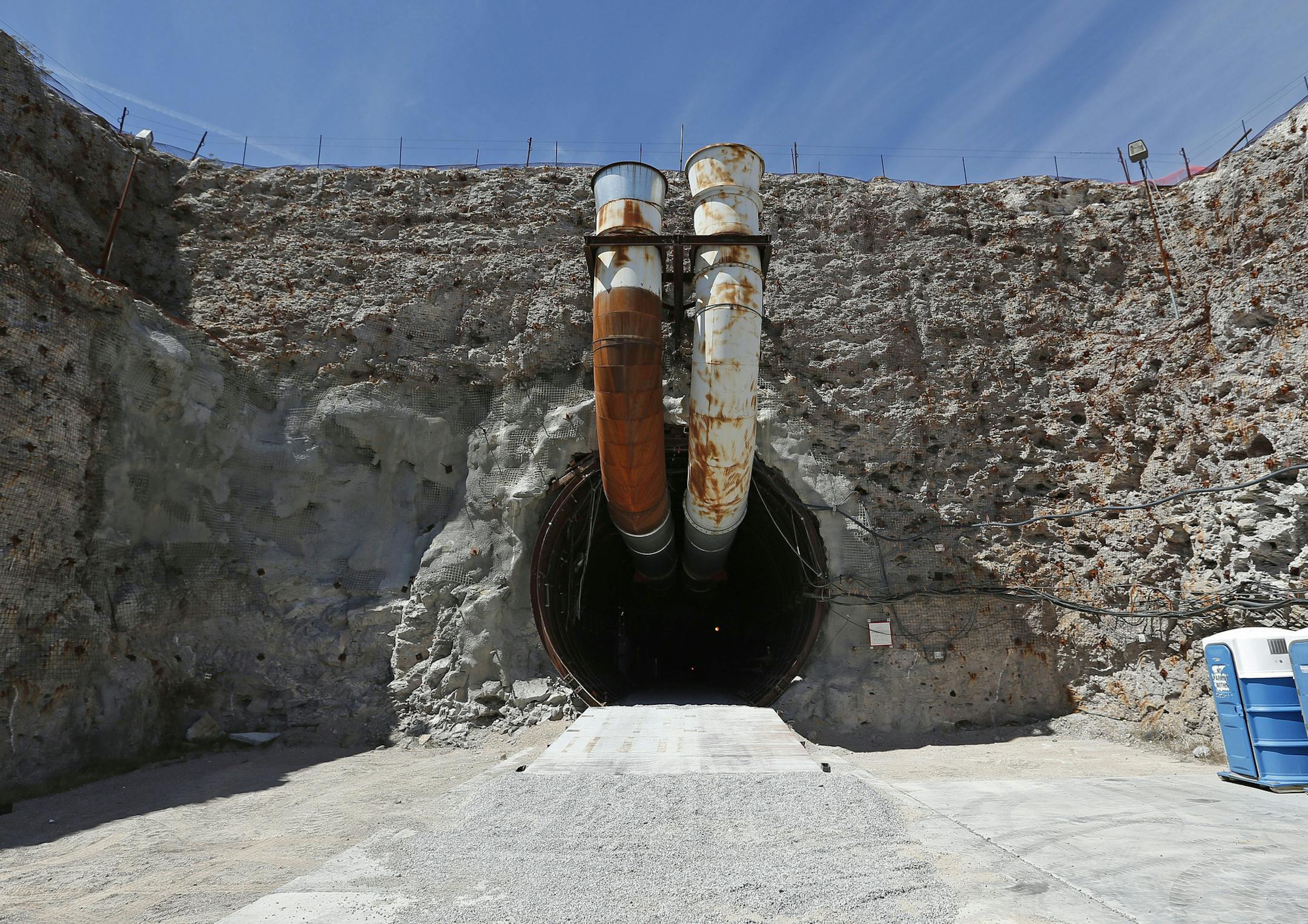
FILE - This April 9, 2015, file photo shows the south portal of the proposed Yucca Mountain nuclear waste dump near Mercury, Nev. Facing a new presidential administration and a Republican-controlled Congress without now retired Sen. Harry Reid, Nevada officials are gearing up to resume a 30-year fight to stop a federal proposal to bury the nation's nuclear waste about 100 miles northwest of Las Vegas though some local officials who live near the site aren't on the same page. (AP Photo/John Loche
The Yucca Mountain nuclear waste disposal site has sat unused for 30 years, but it may have new support in Washington, D.C. (The Minnesota Star Tribune)

WASHINGTON – Thirty years after Nevada's Yucca Mountain was designated as the United States' only dumping ground for nuclear waste, not a single isotope has been sent there.

The state's political clout in Washington made sure of that, effectively hitting pause on a process of scientific studies and planning that began in 1987.

But times changed dramatically this year. Suddenly, Yucca Mountain is being discussed again.

Thank goodness, say officials in South Carolina and 28 other states with nuclear reactors.

The notion of protecting Yucca Mountain enjoyed powerful allies for years, notably Sen. Harry Reid of Nevada, the Senate's Democratic leader from 2005 until January, and President Barack Obama.

But Obama is no longer the president, Reid is no longer a senator, and Democrats don't run Congress or the White House.

The future of Yucca Mountain now rests on President Donald Trump.

The president hasn't proposed anything specific, but the White House says it agrees with Secretary of Energy Rick Perry, who has implied he will consider reopening the process to use Yucca Mountain as a solution to a decades-old problem.

"Hopefully, this is the beginning of seeing real movement, real management of an issue that I think no longer can sit and be used as a political football, one that must be addressed," Perry said. "And I think we can find a solution, both in the interim and the long term, of our nuclear waste."

Opponents of reopening the discussion point to Trump's interest in a Las Vegas hotel near the rail line that would haul the highly radioactive spent fuel from U.S. nuclear power plants to the cavern under the mountain. They hope that will sway him from the site.

"This is a big year for us," said Robert J. Halstead, executive director of Nevada's Agency for Nuclear Projects, which oversees potential nuclear efforts in the state from the governor's office.

Obama's plan had been to look for new nuclear-waste disposal options. Opponents of his efforts say the United States was essentially back to the beginning in its attempt to develop a permanent solution to a problem that physicists say could last for a million years.

Rep. Joe Wilson, R-S.C., was one of those critics, and he saw the opening presented when Obama left office. He has introduced legislation to restart the Yucca Mountain licensing process.

U.S. taxpayers have already paid $3.7 billion to develop the site. South Carolina electricity customers have paid another $1.3 billion in fees intended to pay for operating a disposal site, and customers in other states with nuclear power production have paid billions more.

"The Department of Energy should at least complete the licensing process for Yucca Mountain to avoid South Carolina becoming a dumping ground for nuclear waste before pursuing an alternative that will cost billions of dollars and will take decades to complete," Wilson said.

Without a disposal site, more and more irradiated waste will pile up around reactors across the nation. There are an estimated 4,500 tons of spent nuclear fuel in temporary storage in South Carolina from commercial reactors.

Beyond that, there are more than 10,000 tons of military and research nuclear waste at the Savannah River Site, near the Georgia border. Much of that waste is encased in glass tubes, 10 feet high, 2 feet across and weighing about 5,000 pounds each. Today there are 4,100 of them. By the time the site has finished creating the tubes, there will be an estimated 8,000.

The Savannah River Site also is home to another 33,000 tons of spent fuel from its own research reactors, which are no longer operating. A decade ago, the site had been planning to begin shipments to Yucca Mountain sometime soon. Today, the site is scheduled to finally be clear of its nuclear waste by 2065, though that's based on the notion that a new disposal site will take about 50 years to locate, plan, license and build.

For perspective on the dangers of this waste, consider that spent fuel fresh from a reactor, if handled without the proper shielding, delivers a lethal dose of radiation in a couple of seconds. The stuff that's 10 years old can take more than a minute to kill.

In another 100 years, the "spent fuel" being cooled down today will need a full 12 minutes to prove fatal.

Yet the materials, as they are being stored today, are quite safe.

Michael Driscoll, who helped develop the "deep boreholes" high-level nuclear-disposal option while a professor at the Massachusetts Institute of Technology, said nuclear storage "is not a true crisis. Right now, you only need a parking lot and some cement containers and you can safely store nuclear waste today and for some time to come."

The problem comes after that "some time," though that is thought to be more than 100 years. Still, with the lack of a clock that is close to winding down, "the problem is entirely political," he said. "The technology we understand."

Experts generally agree that disposal sites must be geologic formations that haven't changed much in a million years, indicating they won't change much in the next million years. They can't interact with aquifers. They should not be subject to flooding or earthquakes. Department of Energy reports on Yucca Mountain say it is one such place.

The politics are another matter. Nobody wants nuclear waste in their backyard.

The licensing process for other sites will take 10 years or more, and construction can take another 10 years or more.

In the 1970s, the salt deposits under Lyons, Kan., were seen as a likely disposal site. But at the time, Sen. Bob Dole, R-Kan., was becoming a political force, and the Kansas option was abandoned.

It was replaced by the Yucca Mountain option at a time when Nevada's House and Senate members didn't have significant clout. In 2006, Sen. Jim Inhofe, R-Okla., issued a report titled "Yucca Mountain: The Most Studied Real Estate on the Planet."

about the writer

about the writer

Matthew Schofield, McClatchy Washington Bureau

More from No Section

See More
FILE -- A rent deposit slot at an apartment complex in Tucker, Ga., on July 21, 2020. As an eviction crisis has seemed increasingly likely this summer, everyone in the housing market has made the same plea to Washington: Send money — lots of it — that would keep renters in their homes and landlords afloat. (Melissa Golden/The New York Times) ORG XMIT: XNYT58
Melissa Golden/The New York Times

It’s too soon to tell how much the immigration crackdown is to blame.