

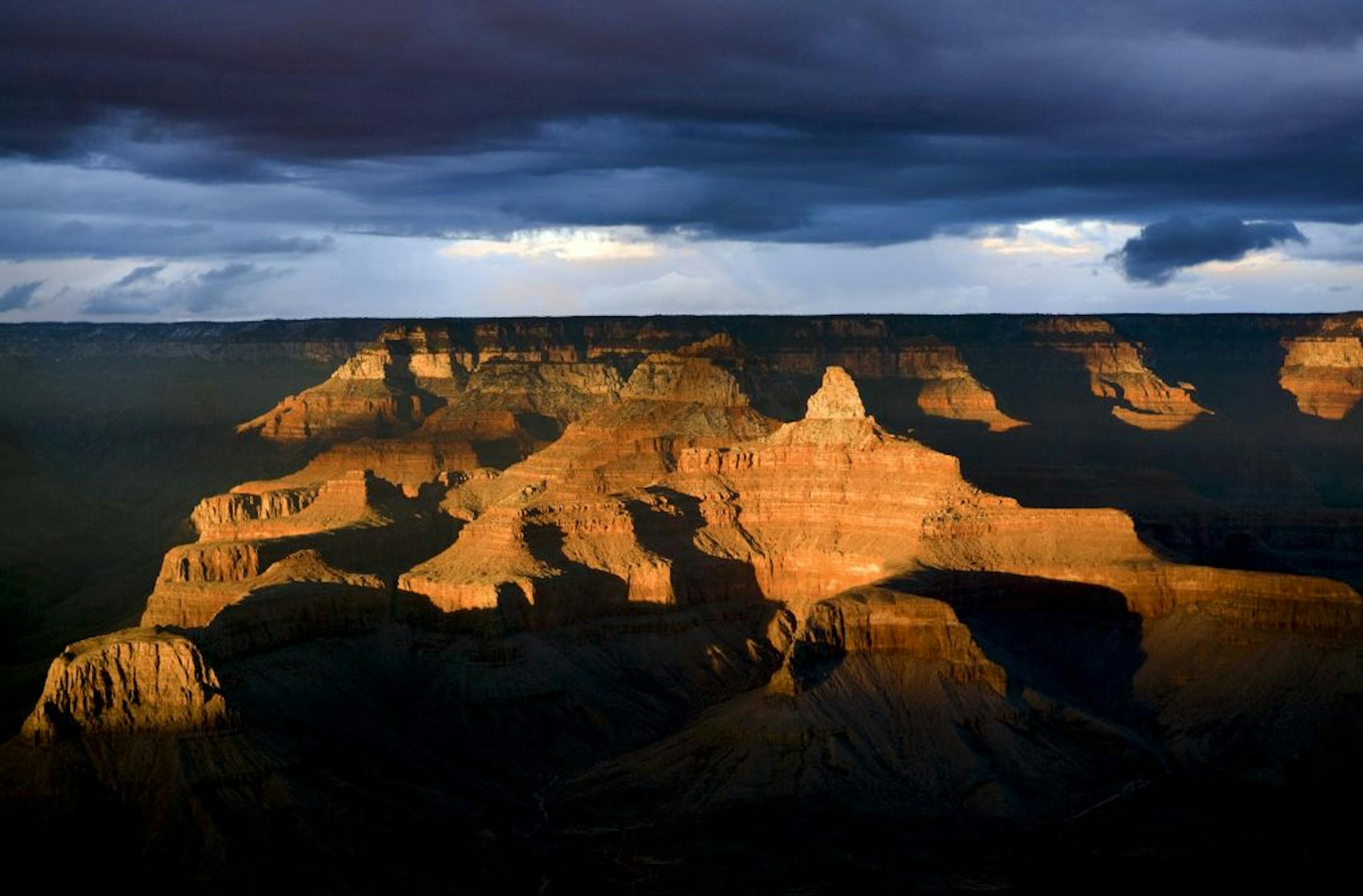
The Grand Canyon may be much older than widely believed, said a study that challenges the view that the landmark was born 5 million or 6 million years ago.
Analyzing helium levels in rocks chipped away from outcrops in the western portion of the canyon, geologist Rebecca Flowers of the University of Colorado at Boulder and geochemist Kenneth Farley of the California Institute of Technology concluded that the gorge was already there -- and within a few hundred meters of its modern depth -- around 70 million years ago, when dinosaurs still roamed Earth.
The findings, published online in the journal Science, add fuel to an ongoing debate between scientists who argue in favor of an "ancient Grand Canyon" and colleagues who maintain that the 280-mile-long, mile-deep formation must have been carved far more recently by the Colorado River.
"It's one of these classic conundrums," said California Institute of Technology geologist Brian Wernicke, a supporter of the ancient canyon theory who was not involved in this research. "You have two pieces of information that butt heads against each other. One of them isn't going to be right."
Determining a precise history of how and when the Grand Canyon came to be is a difficult problem, Flowers said, because there are few direct ways to read how it was carved from the rock. For example, scientists can determine the age of volcanic rocks that have been deposited in some portions of the canyon, she said. But while knowing the ages of such rocks does provide evidence that a river flowed through the area at a certain time, it doesn't explain when the canyon was hewn away in the first place.
The prevailing theory that the Grand Canyon was carved 5 to 6 million years ago is supported by the absence of river sediments dating from before that time in certain areas. But just because the Colorado River didn't flow then doesn't necessarily mean the canyon wasn't there, she said.
To pinpoint a date for the canyon's carving, Flowers and her colleagues measured helium levels in a mineral called apatite, which comes from granitic rocks formed below the Earth's surface more than a billion years ago. Uranium and thorium within the apatite decay into helium. When apatite remains deep underground, where temperatures are relatively hot, the helium dissipates away. But as the mineral cools, it begins to hold on to its helium. Canyon formation can cool apatite by eroding away the rocks above, bringing the apatite closer to the surface.
By detecting and measuring how much helium remained in exposed apatite she collected from the Grand Canyon's walls, Flowers calculated that the rocks had cooled to less than 30 degrees Celsius about 70 million years ago -- suggesting that some kind of canyon was already present by then.


