

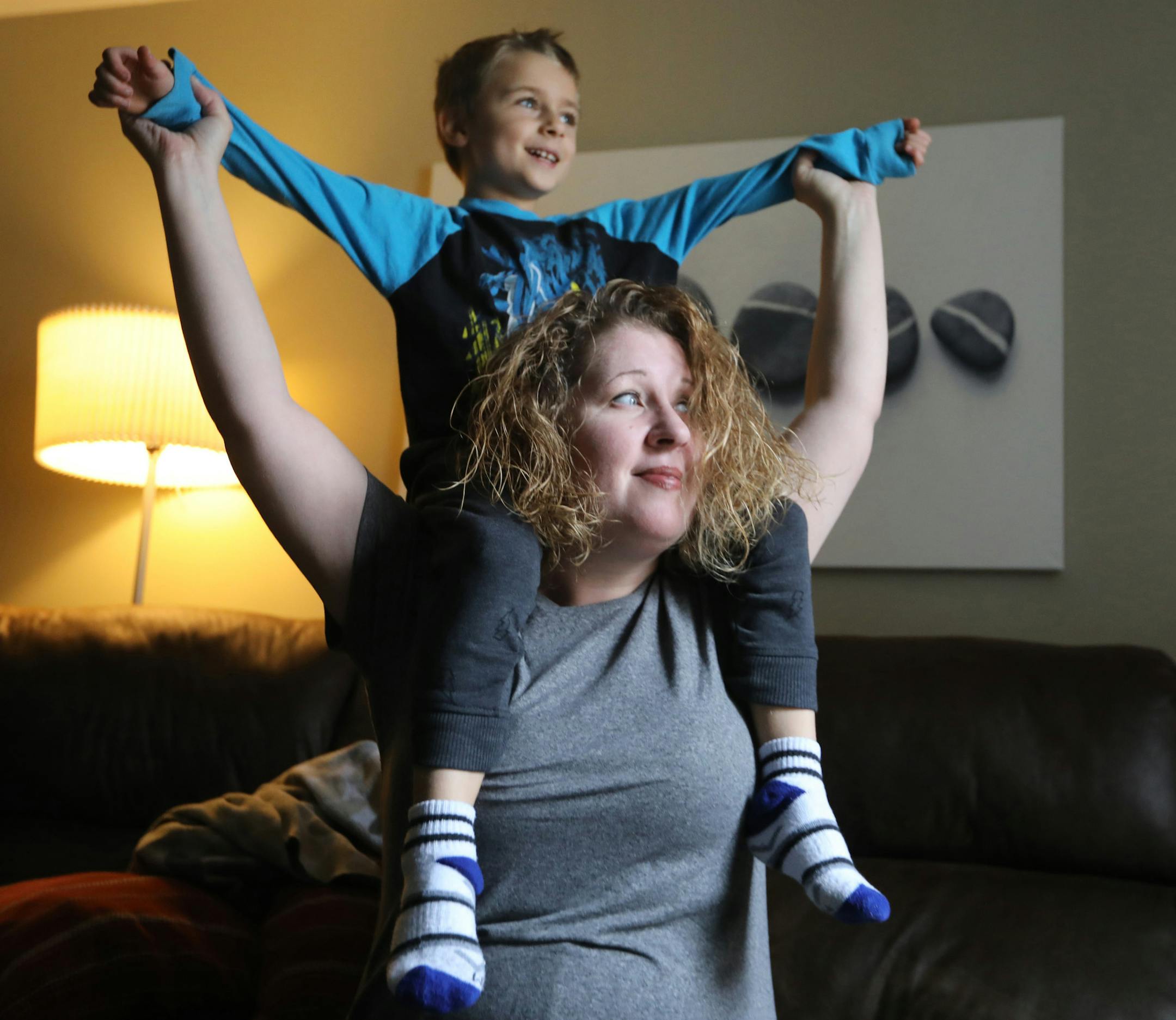
Weird. Nichole Lowther has heard the word her whole life. Bright, even charming, she nonetheless never felt comfortable making small talk. A hard worker, she had a tough time finding or keeping a job. Could it have been her unvarying wardrobe, her lack of eye contact, or the times when a loved one would plead, "be normal."
But a few years ago, when her son Matthew, now 6, wasn't meeting developmental milestones, Lowther took him to a specialist. The doctor noted telltale behaviors of autism — walking on his tiptoes, rocking, wiggling fingers near his eyes. "I said those weren't autistic behaviors, because I do them," Lowther recalled saying. "She said, 'Have you ever been tested?' "
So last year, at 42, she was tested. Textbook autism, she was told. "It was such a relief," she said. "Now a whole lot of my life makes sense."
For women and girls living on the autism spectrum, diagnoses often come late, if at all. Though boys with Autism Spectrum Disorder (ASD) — the country's fastest-growing developmental disability — are estimated to outnumber girls by 4-1, experts say that may be because many females are overlooked, their symptoms dismissed or misread.
"If girls are chronically diagnosed later than boys, they're missing that most valuable treatment time," said Diana L. Robins, head of the A.J. Drexel Autism Institute's Research Program in Early Detection and Intervention. Children who get treatment before age 2 or 3 show the most improvement.
But for many females, diagnosis doesn't come until adulthood. That can mean decades of rejection, depression, anxiety, and confusion.
ASD, though it covers a wide range of traits, is characterized by social and communication challenges, repetitive behaviors, and sometimes sensory hypersensitivity. Many professionals are used to looking for autism as it appears in boys. But females on the spectrum hide in plain sight; their behavior may conform more to social norms — not enough to be fully accepted, but enough to elude detection.
They may be glossed over as shy. Directness may be misread as hostility. Some have been told they can't have autism because they love writing and language, not science or math — a long debunked stereotype.


