
Invasive species battle gains force in east metro

Warnings, inspections, plant killers: Campaign against invasive species gains force.

July 4, 2015 at 3:38AM
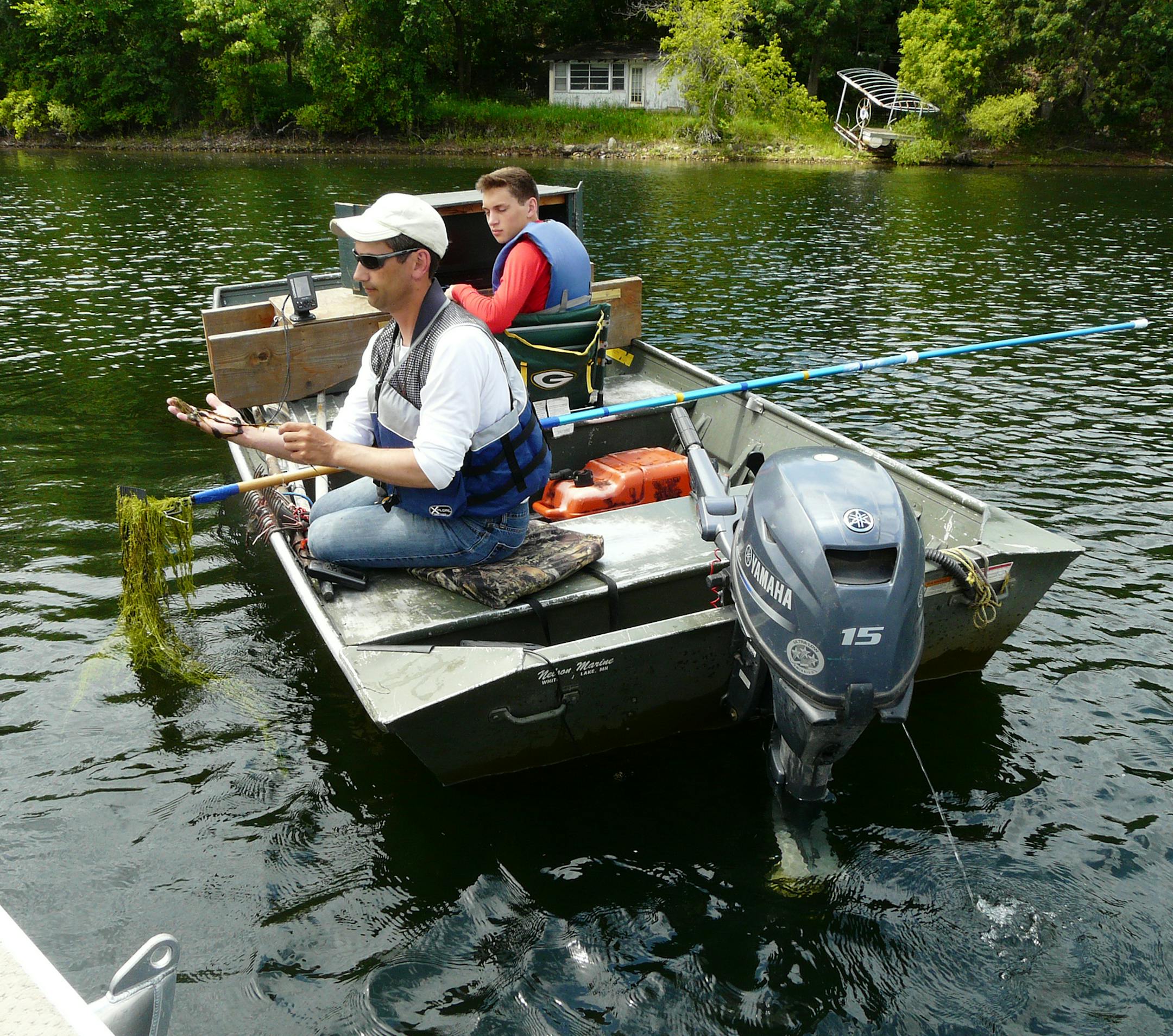
Matt Berg, a biologist with Endangered Resource Services, St. Croix Falls, and his son Mitchell surveyed plant species on Long Lake, in Washington County.
Matt Berg, a biologist with Endangered Resource Services, St. Croix Falls, and his son Mitchell surveyed plant species on Long Lake, in Washington County. (Star Tribune/The Minnesota Star Tribune)

The fight to protect the east metro's lakes and rivers is ramping up.

In a "creepy, Big-Brother-like way," boaters approaching certain lakes this summer are finding warnings about invasive species popping up on their smartphones.

At heavily-used lakes, the number of inspectors checking boats for trouble is on the rise.

And experiments are underway to test whether it's better to treat invasive milfoil much like you'd treat an infection: by hitting it several times a day with strong doses to knock it back.

Those were some of the strategies discussed recently at a meeting in Stillwater, where dozens of people with key roles in protecting the area's lakes and rivers gathered to share news and advice.

Officials and citizens attending were all recipients of Washington County grants aimed at testing approaches to the battle. A common theme: Concern is rising, and so are steps to intervene.

Angelique Edgerton, invasive species coordinator for the St. Croix River Association, St. Croix Falls, Wis., said the key questions are: "What's happening where? Who is learning what? Which species are where? Who can help?"

As she spoke, she projected onto a screen the photos of 13 "St. Croix invaders," both animals and plants — but also the names of dozens of organizations, public and private, planning to fight back. More than $250,000 has flowed in to help finance the fight, Edgerton said, the bulk of it from the Wisconsin side.
A four-lake project to attack Eurasian water milfoil was described by John Hanson of Barr Engineering, who is working with the Valley Branch Watershed District out of Lake Elmo and three lake associations: Friends of Long Lake, Lake DeMontre- ville/Olson Lakeshore Property Owners Association and the Lake Jane Association.

The goal, he said, is to "reduce frequency by at least half," while increasing the number of native plants.

Dosages on Big Marine

Mike Blehert, of the lake association for the much bigger, 1,800-acre Big Marine Lake, near Forest Lake, described a plan to hit milfoil there with multiple doses of the herbicide 2,4-D in a single day.

Divers found milfoil in that lake in 2004, he said, and a lake association was in place by 2009, ready to counterattack as just a few plants around a boat landing started spreading outward.

The problem, Blehert said, is that milfoil can be knocked back by herbicides, only to return "with a vengeance."

"Our proposal is to treat at 7 a.m., come back at 1 p.m., back again at 7 p.m., three treatments in one day, like antibiotics: Dosages need to be X for X amount of time or it comes back stronger. We believe it's never been done this way."

Others at the meeting talked about ramping up inspections.

Mike Kinney, administrator of the Comfort Lake Forest Lake Watershed District, said that in the past, two full-time inspectors rotated to five busy lake access points, for 975 hours of coverage. Now, he said, six full-time inspectors and one part-timer will provide 2,500 hours of coverage.

Jerry Spetzman, water resource manager for Chisago County, described a "substantial expansion" in his county, from just one inspector to 18 county employees trained to pitch in.

Ninety-eight percent of the county's water flows into the St. Croix River, he added.

Cellphone alerts

One of the more intriguing battle plans was outlined by Angie Hong, education specialist with the Washington Conservation District, who spoke half-kiddingly of the "creepy, Big-Brother-like" way in which officials are reaching out to boaters to warn them about invasive species.

New technology enables pop-up public service announcements aimed at folks within a certain distance of boat landings, she said.

They could reach a computer user living on the lake or a prospective boater approaching the water who might be checking a Weather Channel app. Either person could suddenly see a small ad to click to reach a Conservation District Web page and find out, for instance, whether a lake is infested.

So far, the public service announcement has popped up on computers or cellphones more than 100,000 times, Hong said, with people clicking on the ad 360 times to get more information.

More inspections and sign- age also are being used in the invasive species fight, she said, and officials are curious to see what, if anything, works in changing behavior.

"Is there a change in how many people follow the rules and come with boats already cleaned?"

No one doubted what's at stake: Spetzman described a lake so thick with invasive plants that "you could just about walk across it."

David Peterson • 651-925-5039

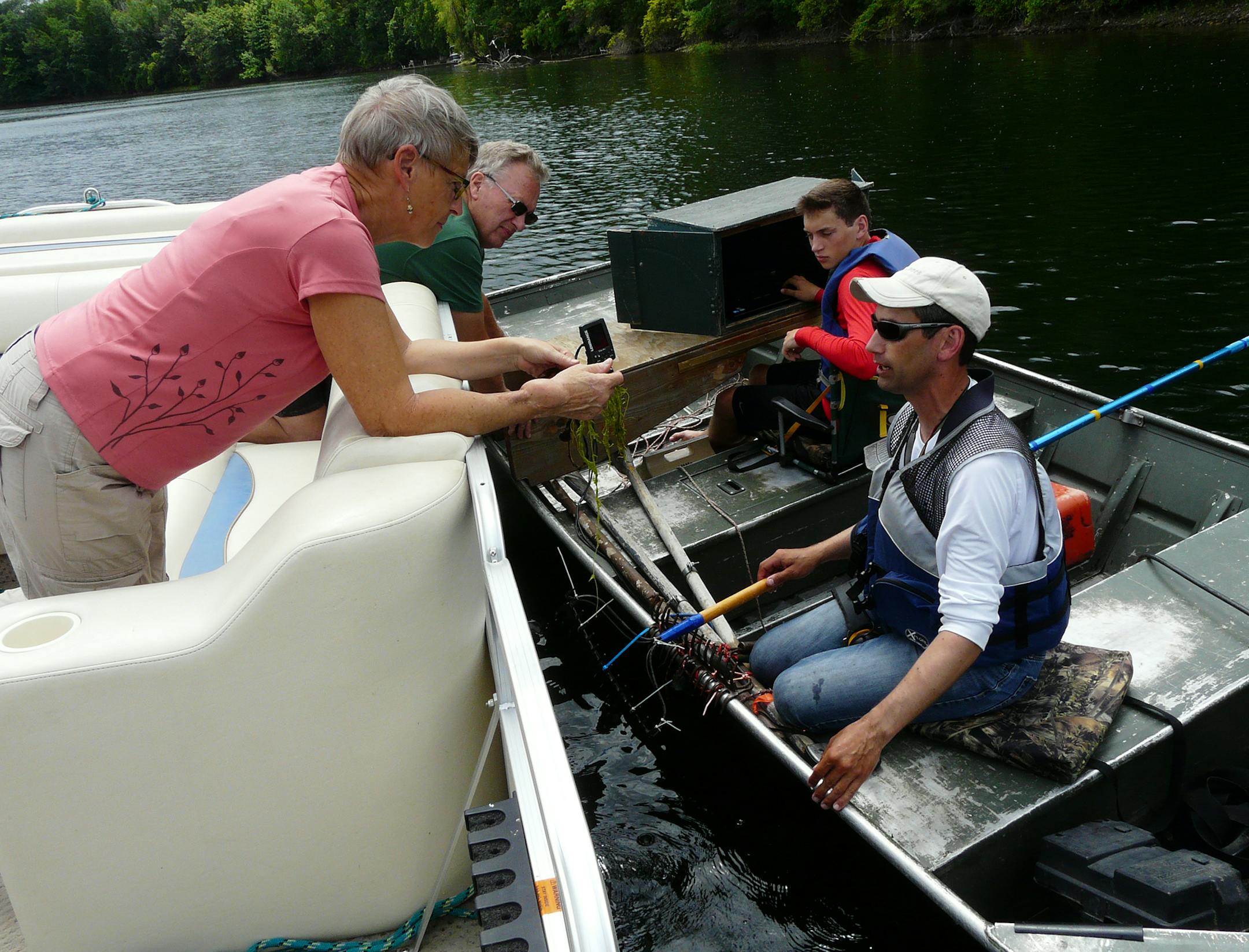
On pontoon: Brian Buchmayer, of Pine Springs, president of Friends of Long Lake Elaine Mulcahy, Long Lake resident. With rake in low boat: Matt Berg, Endangered Resource Services, St. Croix Falls, and son Mitchell Photo by David Peterson
Elaine Mulcahy and Brian Buchmayer, Long Lake residents, met with plant biologist Matt Berg, of Endangered Resource Services, St. Croix Falls, and his son Mitchell, at the computer. (The Minnesota Star Tribune)
about the writer

about the writer

David Peterson

Reporter

See Moreicon

More from No Section

See More
FILE -- A rent deposit slot at an apartment complex in Tucker, Ga., on July 21, 2020. As an eviction crisis has seemed increasingly likely this summer, everyone in the housing market has made the same plea to Washington: Send money — lots of it — that would keep renters in their homes and landlords afloat. (Melissa Golden/The New York Times) ORG XMIT: XNYT58
Melissa Golden/The New York Times

It’s too soon to tell how much the immigration crackdown is to blame.