

ST. CLOUD, MINN. - Jason Carlson spends little time standing in front of his general biology class. He bounces around the room, checking a student's quiz, peeking in on a group exercise, suggesting a different idea. His students have already heard him lecture -- online.
Carlson, who teaches at St. Cloud Technical and Community College, is one of a growing number of college instructors who have "flipped" their courses. Students get lectured at home, through audio or video, and in class they debate ideas, work in groups or solve problems. Homework is classwork, if you will.
"We're so used to college teaching being a traditional lecture," Carlson said. "But it just made so much more sense to me to do the simple part outside of class. Then, in the class, that's when we should be working on understanding and applying and reinforcing."
The "flip" format is yet another example of how technology is transforming higher education -- and how universities are striving to set themselves apart from an Internet full of free online lectures.
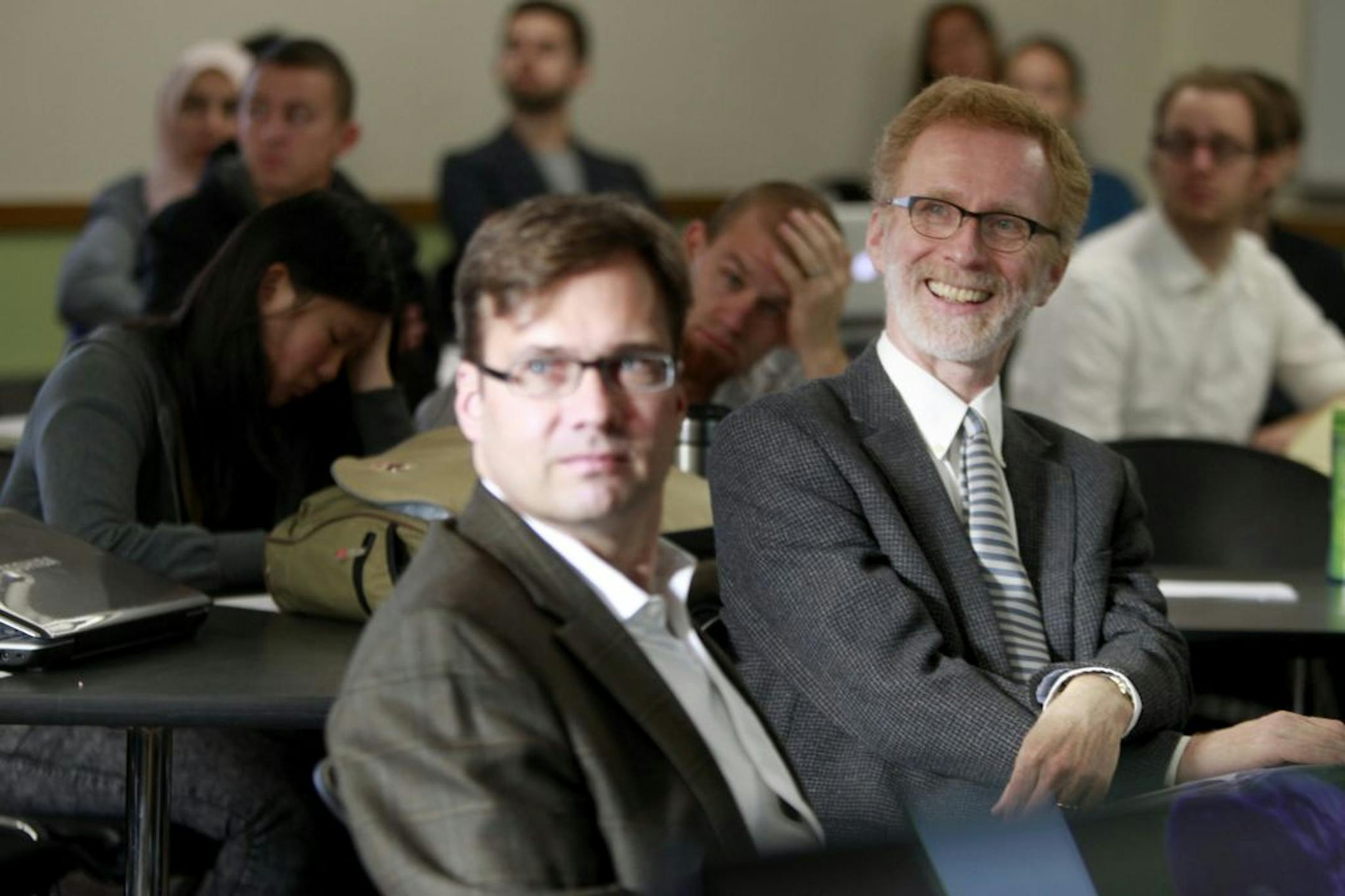
"There has to be a reason you come to class. It's no longer to get information from a professor," said Tom Fisher, dean of the University of Minnesota's College of Design, who "flipped" his course this fall. "So why come? Well, I think the reason is to learn with other individuals, face to face, with a faculty member facilitating that conversation. Those are interactions you can't have in the online world."
New leaders of the U and Minnesota State Colleges and Universities systems are encouraging faculty to try "flipping" and other digital teaching methods. Soon, the U will fund a few programs that use technology in creative ways.
"It is no longer going to be true that ... an effective class consists of a person standing in front, rubbing a rock on a rock, while students transcribe that information into their notebooks," U President Eric Kaler said at a "Campus Conversation" last week. The university has the opportunity to "turn those classrooms inside out."
'We have time to think'


