
Inflation: America's fastest growing export?

How "spillover" from the U.S. economic mess deepens misery in Argentina.

January 22, 2023 at 12:00AM
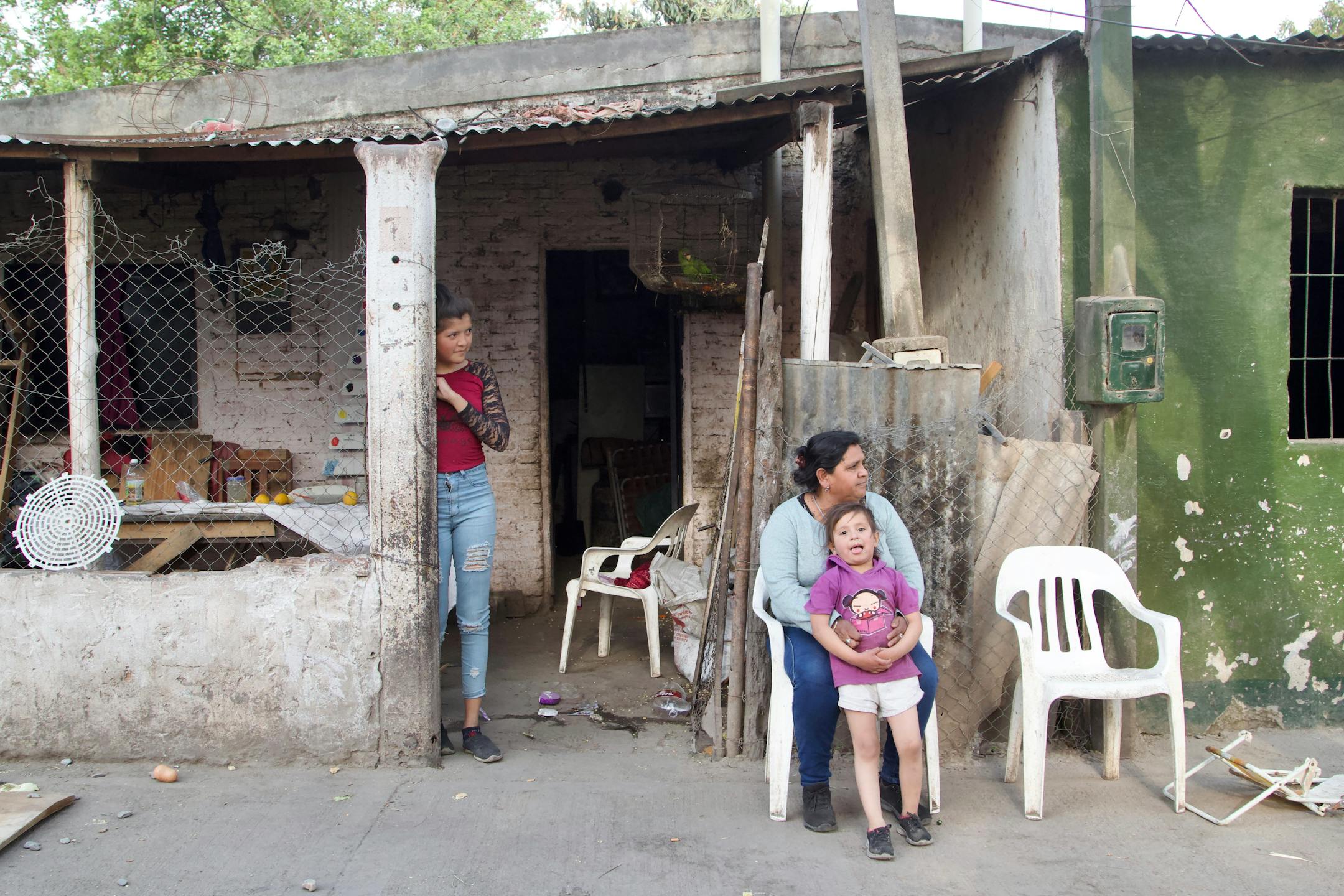
Rosa Alderete with her grandchildren in Tucumán, Argentina. (Amelia Rayno/The Minnesota Star Tribune)

Opinion editor's note: Star Tribune Opinion publishes a mix of national and local commentaries online and in print each day. To contribute, click here.

•••

TUCUMÁN, ARGENTINA — Rosa Alderete's heart hurts when her daughter calls to say she can't feed her two young children that day.

"It's one thing to live it," she said. "It's another to say it."

In the makeshift house where Alderete, her husband, four children and six grandchildren live in Tucumán, one of Argentina's poorest provinces, there isn't much food either. Jobs in the area are few and many, frustrated by daily rising prices, have taken to collecting cardboard to sell to survive. In Argentina, the informal sector accounts for nearly half of workers.

Heading into 2023, Argentina's economy could be described as one of the world's most fragile. Inflation ended 2022 at 95%, a 32-year high. Meanwhile the weight of Argentina's massive dollar-denominated debt resulting from the largest loan in IMF history — one the fund itself admitted did not serve its purpose — combined with dwindling foreign reserves in the Central Bank, has forced Argentina's government to slash spending that disproportionately helps the poor.

Onto this panorama of immense economic stress arrives the U.S. Federal Reserve Board's interest rate hikes — ostensibly domestic American economic policies that directly affect countries across the globe as the dollar grows stronger, other currencies weaken and an already indebted world finds itself still deeper in the hole. In Argentina, whose economy is more intertwined with the dollar than most, the peso's free fall accelerates, exacerbating pressures on runaway prices.

Once one of the richest nations in the Americas, Argentina has been spiraling into instability for decades. Part of the problem is the country's dual currency (dollar and peso) system — a legacy, in part, of U.S. economic intervention dating back to the 1970s dictatorships.

In 1976, after a military junta led by Jorge Videla took control of the government, Argentina plunged into its darkest chapter, a seven-year period characterized by systematic state terrorism, mass kidnapping, murder and critical U.S. support. Mired in its Cold War hegemonic crisis, the U.S. was eager to help the junta install its neoliberal plan — during this time, U.S. banks and U.S.-led corporations arrived to Argentina like a wave.

Besides providing weapons and communication technology and training officers at the notorious School of the Americas in Panama, the U.S. government helped keep the junta in power by organizing exorbitant loans from the IMF, a multilateral organization whose office remains in Washington, D.C. By 1983, when the dictatorship ended, Argentina's foreign debt had ballooned by 700%.

Returning to democracy saddled with massive loan payments, Argentina was in new, serious need of dollar streams; in order to boost export sales, the government began to devalue the peso, a trend that continued so erratically that Argentines begin to favor the dollar as a stable alternative. At the turn of the century, a new wave of loans artificially kept the economy afloat after dollar convertibility, under U.S.-aligned President Carlos Menem, led to a deep trade deficit and the privatization of key state assets. But that blew up in Argentina's face when, under IMF supervision, the government was forced to default in 2001, decimating any remaining trust the Argentine public had in local financial institutions.

"The intervention of the IMF — it only makes the explosion bigger," Argentine anthropologist Nicolás de Brea Dulcich said. "We are not getting invaded militarily anymore," he added. "Dollar diplomacy is the core of U.S. intervention and domination in South America."

For Argentines, saving in dollars became the norm, leading the government — which desperately needed to keep its dollars in the Central Bank — to cap dollar purchases and create a series of dizzying parallel exchange rates. Those varying dollar rates, emphasized by the media, foreign corporations and anyone else who will benefit, now serve to dictate local prices and ultimately force further devaluations of the peso. A vicious cycle swirls: the more Argentina demands the dollar, the more the peso depreciates, which creates more demand for the dollar.

It's ironic, de Brea said, that the prevailing discussion is about Argentina's dollar shortage when estimates show that the country holds 10% of the world's existing greenbacks, many of them stuffed under mattresses.

That Argentina and the world are flooded with dollars is not an accident. After World War II, the Marshall Plan ensured the dollar would pervade Europe and become the main currency in the international market. U.S.-led financial institutions have also contributed to a dollar-flush world, as has the fact that oil is priced and sold with dollars. To gauge just how much this global system means to the U.S., one only needs to consider the fate of Libya's Muammar Gaddafi or Venezuela's Hugo Chavez, each in the midst of developing a currency plan to escape the dollar's clutch when the U.S. supported their ousters. Today, as U.S. relations with Saudi Arabia become more tense, it is no coincidence that Riyadh is discussing selling oil to China in yuan.

Despite this long, concerted effort to keep the dollar the global currency, the U.S. has made it clear it has no interest in taking responsibility for "international spillover" effects from the waves of hikes, as Federal Reserve Chairman Jay Powell has called them.

But without a world full of dollars, the Fed wouldn't be able to adjust interest rates with relative impunity. No other country in the world is able to maintain a permanent trade deficit without making corresponding cuts — to print money at will and export the inflation by raising interest rates. As the world's investors rush to buy U.S. bonds, other currencies in newly abandoned markets plunge and countries like Argentina feel the brunt of the pain — with more misery to come.

"It's going to get worse," Argentine economist Juan Kornblitt said. "Argentina was already falling off the ledge … now, the Fed's interest rate hikes create a slower-growing economy, for China, for everyone. This slower growth, this inflation — two sides of the same problem — is going to impact the price of [Argentina's export] commodities. And then you have a real problem."

Amelia Rayno is a former Star Tribune reporter, now an independent journalist living in Argentina.

about the writer

about the writer

Amelia Rayno

More from Commentaries

See More
card image
Steve Karnowski/The Associated Press

Minnesota has a proven process. Let it work.

card image
card image