
Scoggins: Indiana’s CFP title sends college football into new realm

The transfer portal, name, image and likeness payments and revenue sharing have leveled the sport’s playing field in ways previously unimaginable.

Columnist Icon
The Minnesota Star Tribune
January 20, 2026 at 10:00PM
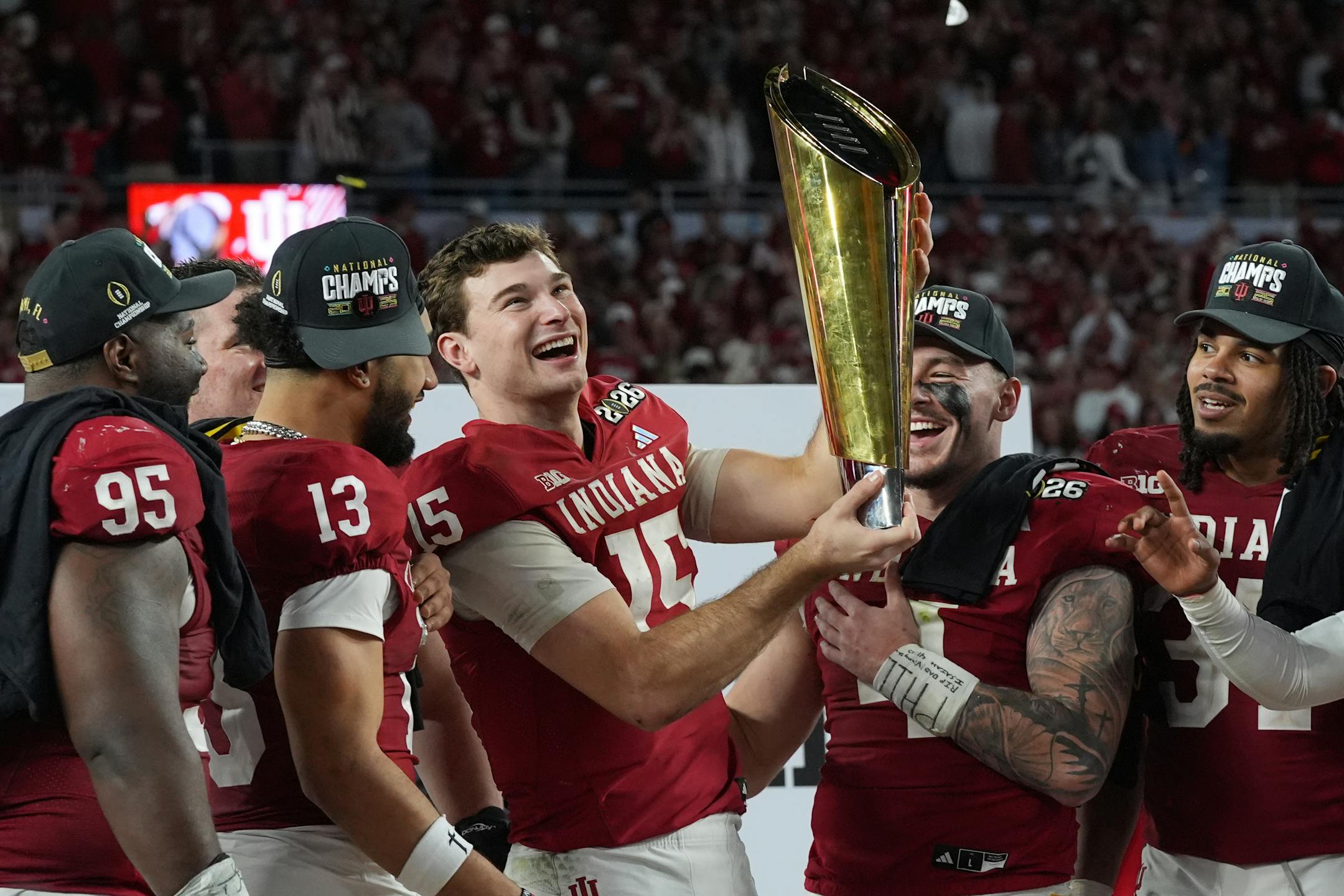
Indiana quarterback Fernando Mendoza (15) holds the College Football Playoff championship trophy after defeating Miami on Jan. 19 in Miami Gardens, Fla. The Hoosiers' win signals a paradigm shift in the sport. (Marta Lavandier)

The knock against college football grew louder with each passing season that ended with a blueblood program from a warm-weather locale standing on stage with the national championship trophy in hand.

Nick Saban built an indestructible dynasty at Alabama. Then Georgia took the crown. Clemson had its moment before that. LSU, too. And Florida. Pete Carroll’s USC Trojans left everybody playing for second during their window of dominance.

Seasons began and ended with the same complaints:

College football has become boring.

The same two teams play for the national championship every year.

The lack of parity is killing interest.

Only a select few had a realistic chance of winning a national title. Plunking money down on Alabama in August was as safe as betting on the sun rising. The SEC held a death grip on the sport, telling everyone else that football “just means more” in that part of the country.

College football entered a new realm on Monday, Jan. 19. A crazy, unbelievable, fairytale leap into a different universe.

ADVERTISEMENT

The Indiana Hoosiers are national champions. In football. Winners of all 16 games in the most remarkable program revival in college football history.

From this day forward, no scenario should be viewed as outlandish or inconceivable. The confluence of three landmark changes in college athletics — the transfer portal, name, image and likeness payments and revenue sharing — has leveled the playing field in ways previously unimaginable.

“I think that’s called a paradigm shift,” Indiana coach Curt Cignetti told reporters in Miami Gardens, Fla. “It’s kind of like people can cling to an old way of thinking, categorizing teams as this or that or conferences as this or that. Or they can adjust to the new world, the shift of the power balance in the way college football is today.”

Facts are facts. Every national champion this season in the NCAA’s four football divisions hails from a Midwest or northern state.

FBS: Indiana, the program’s first national title.

FCS: Montana State, the program’s first title since 1984.

Division II: Ferris State of Big Rapids, Mich.

Division III: Wisconsin-River Falls, the program’s first championship.

The college football landscape hasn’t just changed; it’s been rewired.

The transfer portal and direct payment of athletes have caused chaos and consternation inside the world of college sports. Up is down, left is right. The wild west byproduct has created unintended consequences that might never be resolved.

Not all is bad, though.

The transfer portal unquestionably has brought more parity to college football by spreading out talent. Teams can plug holes, upgrade positions and improve overall roster depth year to year by scouring the portal.

Want a veteran quarterback? Go get one, if you’re willing to spend money.

Cignetti brought 13 players with him from James Madison, a group that became key contributors on a national championship team. Quarterback Fernando Mendoza arrived via the transfer portal from California and became the Heisman Trophy winner. The price tag reportedly was north of $2 million, but nobody in Indiana is second-guessing that investment.

“I think to look back at what happened to Indiana previous to us coming — 10, 20, 50 years ago — strictly lacked a commitment from the top,” Cignetti said. “That’s it, plain and simple. Nothing else. And we have a commitment [now].”

That is part of the secret sauce that outsiders will try to duplicate under the belief that, if it can happen at Indiana, it can happen anywhere. It takes smart leadership, money, luck and more money.

Indiana struck gold with Cignetti. Indiana officials should give thanks every day that their coaching search ended with him. The school and donor base simultaneously made a commitment to football that is essential to maximizing this new landscape, not just treading water.

College football has never felt more wild or wide open. The Big Ten has now won three consecutive national championships. The SEC has not put a team in the championship game in that span.

Teams with the richest boosters still have an advantage because success is more intertwined with finances than ever. Indiana should not be mistaken as a poor kid overcoming impossible odds. The Hoosiers are big spenders, just not the biggest. Their blueprint goes much deeper than money.

Indiana becomes a billboard for all others to look up to and see that anything is possible.

In 2021, I traveled to Bloomington to cover the Gophers-Hoosiers football game in late November. The vibe suggested fans had moved on to basketball season. Attendance was announced at 38,079.

Final score: Gophers 35, Indiana 14.

Here’s how I began my column: “The Gophers received the college football version of a get-well gift on Saturday. A two-win opponent that deserves the title of worst Big Ten team.”

Four years later, that team is the undefeated national champion and the toast of college football. A paradigm shift, indeed.

about the writer

about the writer

Chip Scoggins

Columnist

Chip Scoggins is a sports columnist and enterprise writer for the Minnesota Star Tribune. He has worked at the Minnesota Star Tribune since 2000 and previously covered the Vikings, Gophers football, Wild, Wolves and high school sports.

See Moreicon

More from Colleges

See More
card image
Marta Lavandier

The transfer portal, name, image and likeness payments and revenue sharing have leveled the sport’s playing field in ways previously unimaginable.

card image