

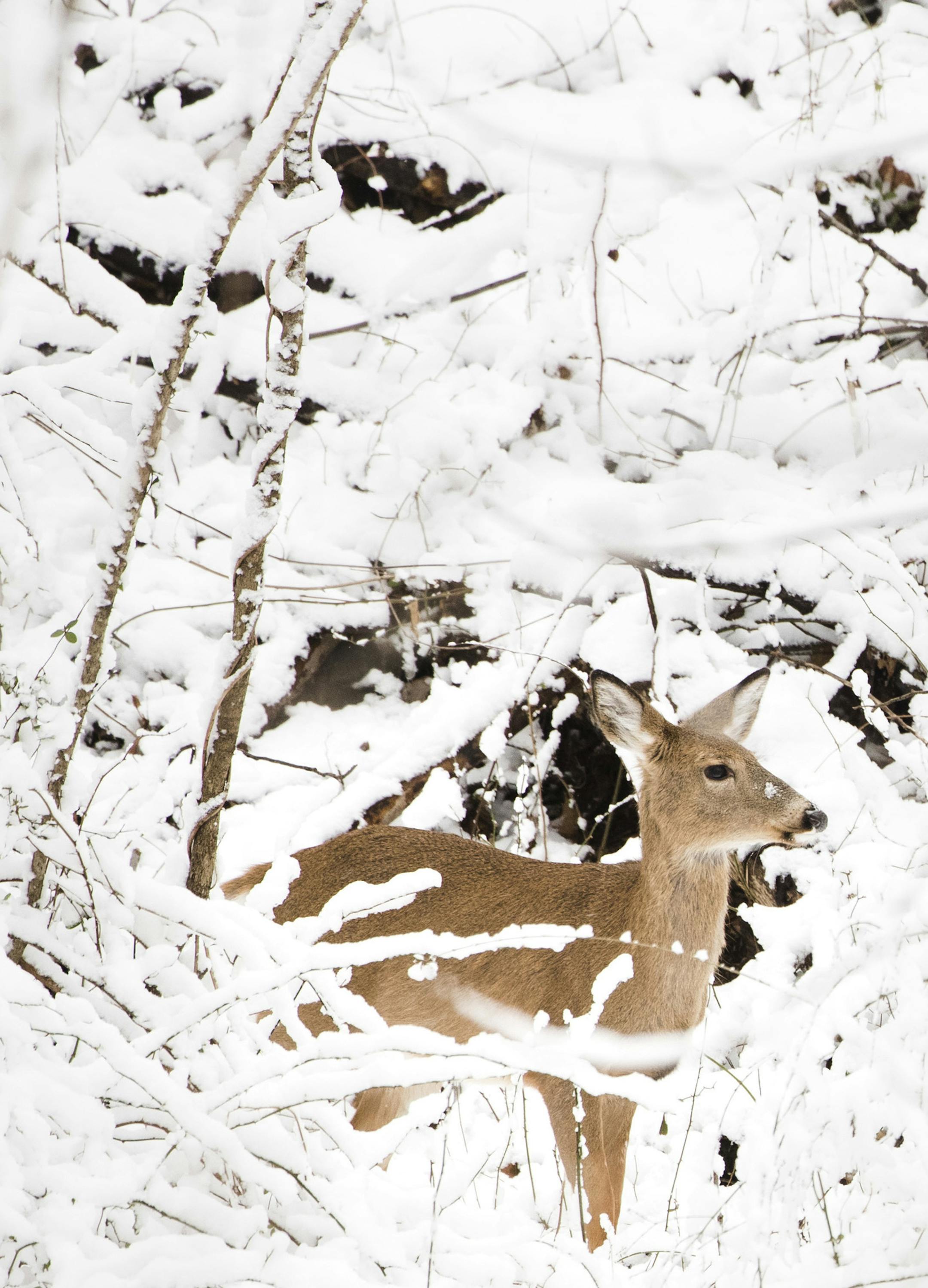
Convincing a scientist to speak in hypotheticals isn't the easiest task in the world. Especially when the question is a little silly. But Glenn DelGiudice, moose and deer project leader with the Minnesota Department of Natural Resources, took the bait.
"If I were out in the woods and I wanted to mimic the behavior of a deer in order to survive?" asked DelGiudice, who works in the agency's Forest Wildlife Populations and Research Group. "I'd stay out of the wind and I might stay curled up in a dense stand of conifers where I'm sheltered. I'd reduce the exposure of my ears and extremities to the air, and I'd wear layers (to replicate the body fat, underfur and external guard hairs that serve to keep deer warm). And I've have food with me to maintain my metabolism and produce metabolic heat."
Odd as it may sound, there is a lot that humans can learn — and have learned — from animals when it comes to staying warm when the mercury plummets.
While some of it isn't possible (some frog species, for example, are mostly frozen during the winter) and some of it isn't desirable (who wants to pack on a bunch of fat?), some of it makes a lot of sense. Deer, for example, on cold days will lie down and curl their legs beneath them, using their own bodies to keep their extremities warm. Who among us hasn't done the human equivalent and stuck our shivering hands in our armpits? Deer also grow different, warmer fur for the winter, while animals such as muskrats and beavers — even though they live in ponds and wetlands — pack into houses with their families, emerging at various points throughout the day to collect food.
"You can see a muskrat house with steam coming off it on a cold morning, which tells you it's warm in there," said Jason Abraham, furbearer specialist for the DNR. "Clearly, humans also take more of that shelter-type strategy for staying warm, though some of us have more hair than others."
Animals such as badgers, fishers and pine martens stay warm by staying on the move. Want proof humans do this, too? Look out the window to see how many of your neighbors are standing around the next time the temperature dips below freezing. These animals' bodies are shaped almost like tubes and, as such, aren't great for staying warm. So they wile away the winter primarily hunting and eating, hunting and eating — all in an effort to maintain their body temperature. Birds such as chickadees spend a lot of the winter on the move, showing up often at bird feeders. They need to feed to maintain their energy level, but they also have an innate knowledge not to overdo it.
"Your average chickadee is going to want to make sure it doesn't fatten up at the feeder too much," said Nicole Davros, upland game project leader for the DNR's Farmland Wildlife Populations and Research Group. "The birds that fatten up too much at the feeder are going to be too slow to get away when a Cooper's hawk swoops down."
But watch a feeder long enough on a winter day (or any day, really) and it seems like chickadees do nothing but grab seeds, fly away and then return. It's hard to believe they're familiar with the concept of moderation. In reality, they're not eating every seed. Instead, they're caching some of them elsewhere — and staying warm in the process of doing so — said Brandon Baker, a naturalist at the Three River Park District's Eastman Nature Center in Osseo.


