

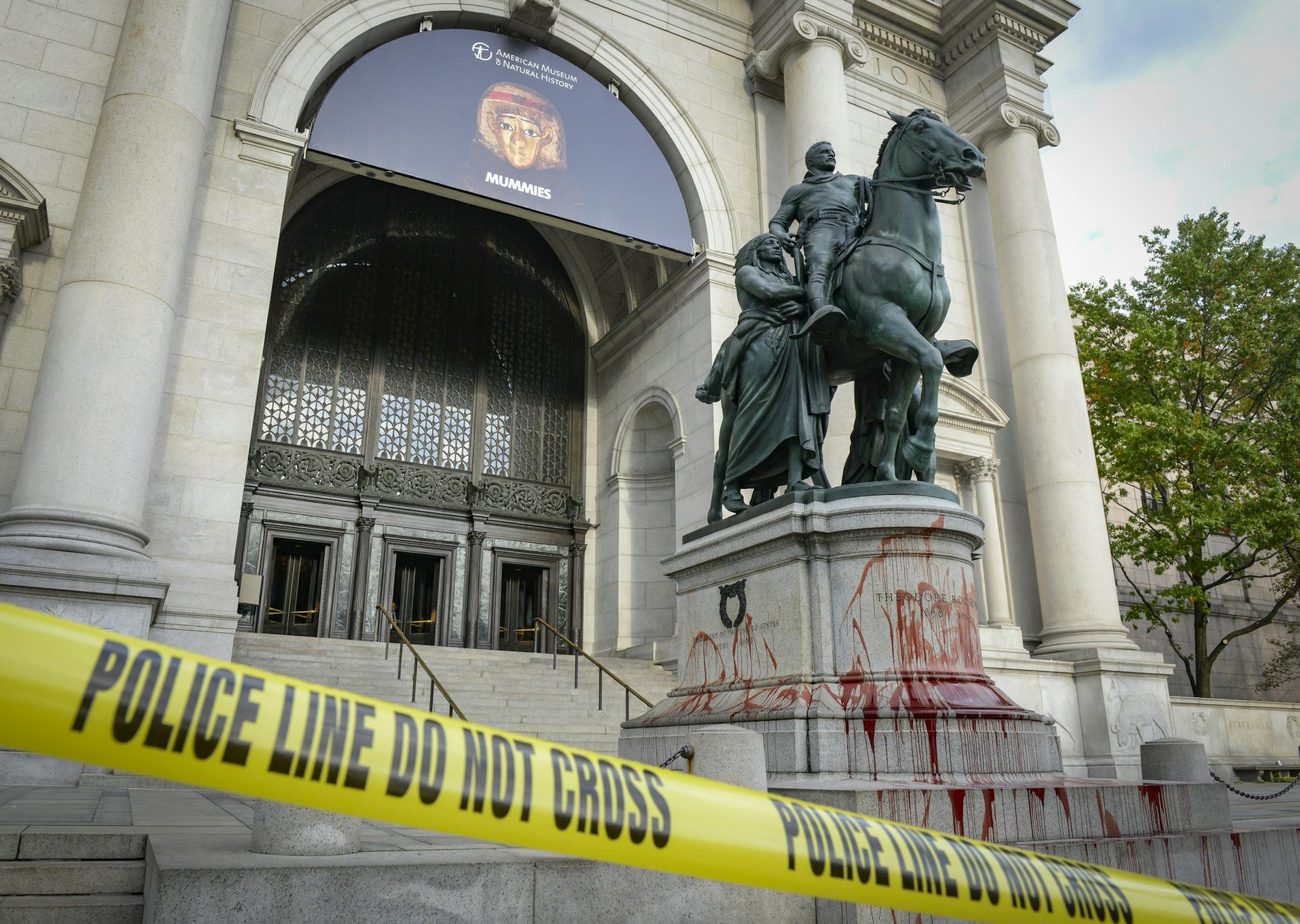
WASHINGTON – The controversy that swept Southern states over Confederate monuments is spreading across the nation, as cities contend with calls to remove statues depicting stereotyped and subjugated American Indians.
Among them: a sculpture in San Francisco's Pioneer Monument near City Hall that shows an Indian at the feet of a Spanish missionary and vaquero, and one in New York City that depicts an Indian and an African holding the stirrups of Theodore Roosevelt astride a horse. Earlier this year in Kalamazoo, Mich., a granite sculpture from the city's Fountain of the Pioneers was trucked away to storage. It showed a pioneer, weapon raised, rising above an Indian.
In all three cases, Indians have criticized the statues as inaccurate, demeaning and racist for decades. Red paint symbolizing blood was splashed over the Roosevelt statue as long ago as 1971, and as recently as October.
But the deadly violence at a white supremacist rally in Charlottesville, Va., last August has prompted renewed activism from Native Americans protesting statues in their own communities. It has also shifted attitudes among some city officials, who now recognize that they have monuments akin to Confederate statues in their own backyards.
"It doesn't take much to put two and two together and think, 'Well we've got an issue here in La Crosse,' " said Democratic Mayor Tim Kabat of La Crosse, Wis. City officials are meeting with members of the Ho-Chunk Nation to plan for the removal from a public park of a 25-foot painted concrete statue of an Indian dubbed "Hiawatha."
The events in Charlottesville prompted San Francisco's Historic Preservation and Arts commissions to vote in March to remove the Pioneer Monument statue, with support from the mayor and the city's Board of Supervisors.
"The climate now is ripe for people to take it seriously," said Barbara Mumby Huerta, an arts commission member of Powhatan and Maidu descent who began advocating for the statue's removal before joining the commission. "People evolve."
But in April, the city's Board of Appeals struck down the decision. Board member Rick Swig called removing the statue "suppression of thought."


