

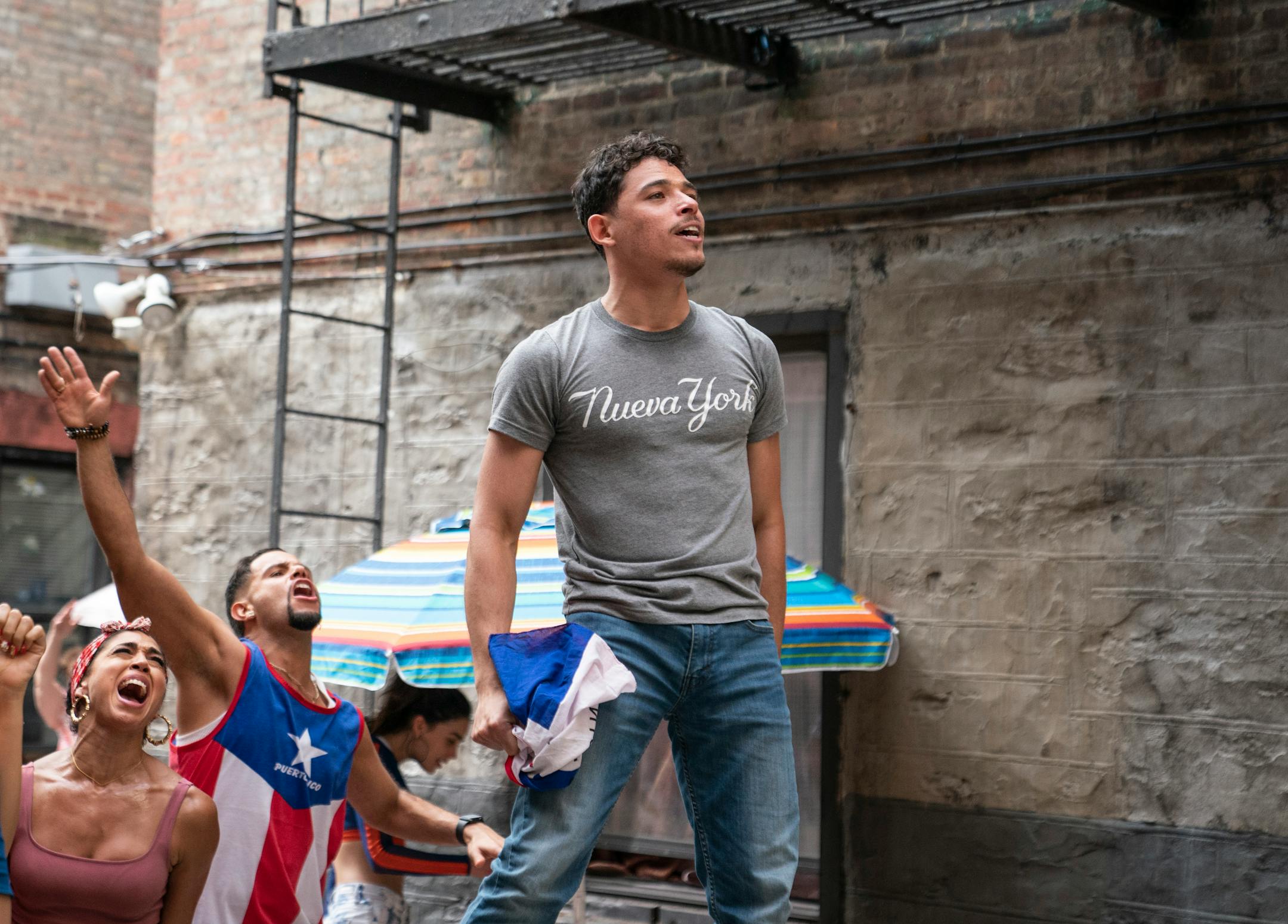
Just as exhilarating as being back in a movie theater was what was being projected: "In the Heights," a cinematic rendition of the theatrical hit from 2008 that made Lin Manuel Miranda a cultural force well before "Hamilton" hit Broadway (and soon, the world) in 2015.
Actually, there's a lot of the "Hamilton" vibe in "In the Heights" (which was co-created by Quiara Alegría Hudes). Or, more chronologically accurately, there's a lot of "In the Heights" vibe in "Hamilton," despite the difference in eras and characters, with America's Founding Fathers in "Hamilton" and an extended Latin American family and friends finding their way in "In the Heights."
But if the characters in the exuberant musical are different, their character is fundamentally the same. All are hard workers (hustlers, even), strivers and dreamers (and some actual "Dreamers," or undocumented migrants, in "In the Heights"). Both cohorts are mostly immigrants. European in "Hamilton" — with the notable exception of Alexander Hamilton himself, who hailed from the Caribbean — just like most of the "In the Heights" characters, a charismatic crew of Dominicans, Puerto Ricans, Cubans and others. Above all, everyone displays an unapologetic, if unspoken, patriotism, believing in the iconic, embryonic America idealized by Hamilton's contemporaries or the work-in-progress America that is the gritty reality vividly lived by the "Heights" characters.
The setting, albeit centuries apart, is similar too: New York City, often downtown, in "Hamilton," and up in the Washington Heights neighborhood that gives the newly released film its name. But once again, the themes are the same, summed (and sung) by Miranda's Hamilton: "On the bow of a ship, heading for a new land/In New York, you can be a new man," an idea and ideal that seems identical in the ethos of the men — and as prominently, women — in "In the Heights."
But as New York City stars on stage and screen, cities themselves seem to have lost luster among an increasing number of Americans. In fact, the very kind of urbanity that so compels in "In the Heights" repels, at least temporarily, more and more New Yorkers. And Angelinos, Chicagoans and other denizens of 10 big cities across the country, according to a Brookings Institution analysis released this week headlined "America's largest cities saw the sharpest population losses during the pandemic, new census data shows."
Large cities, wrote William H. Frey, a senior fellow at the Brookings' Metropolitan Policy Program, "showed exceptionally slow or negative growth during the pandemic year." Among the top 10, "eight registered lower growth in 2019-20 than in 2019-19; six displayed their lowest growth in the last decade; and five lost population."
While some midsize cities stayed steady or showed gains (most notably Seattle, Tampa, Tucson, Fort Worth and Austin, Texas), a suburban surge accelerated. "The most recent year's city growth declines have further impetus to the suburban growth advantage that took root midway in the 2010s decade," Frey wrote, noting that "at the time, much attention was given to the 'return to the city' movement for young adults and seniors, along with the attraction of immigrants to urban centers. However, this advantage was short lived, with much of it attributable to the impact of the 2007-09 Great Recession and depressed housing market, which 'stranded' many young adult millennials to urban centers. As the 2010s wore on and the job and housing markets picked up, city-to-suburban shifts reemerged."
The shift could kick into a higher gear, given the tight labor and housing markets that are an indication of the post-pandemic, pent-up demand economy of today. Add to that lower birthrates, the work-from-home technological transformations as well as spiraling crime rates (including, tragically, in Minneapolis and St. Paul), and big cities' prospects seem precarious.


