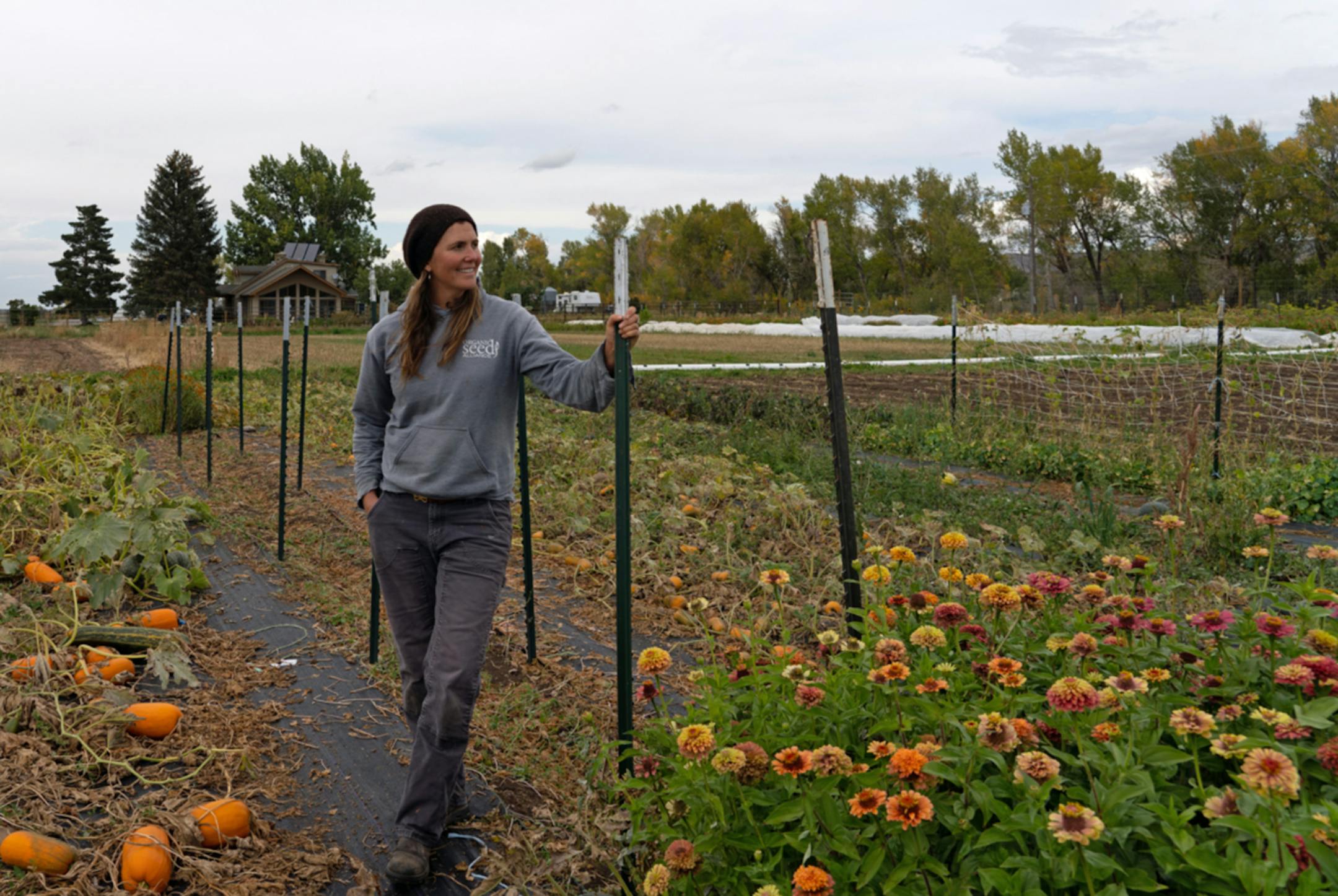
Laura Parker's boots are thick with mud as she moves slowly down the row of sorghum on her farm, High Desert Seed, in the Upper Uncompahgre Valley of southwest Colorado. Hidden on each stalk, beneath a spray of dried flowers, are seeds that can be eaten or saved for planting.
"I'm using natural systems [to adapt seed varieties], and I want my seeds to be resilient in those systems," Parker says. "A lot of the seed available right now has been grown in the most gentle climates in the country; what I am doing is making hardy seeds."
Parker carefully clips each stalk at knee level and hands armfuls to Mae Turner, one of her four employees, who will transport it to a greenhouse where the seeds will be separated from the chaff.
Since 2015, the 35-year-old Parker has been producing open-pollinated seeds on roughly 4.5 acres near the town of Montrose, which — along with the entire Western Slope of Colorado — is experiencing a historic drought.
While thirsty crops like alfalfa and corn dominate the region, Parker has emerged as a leader in revitalizing a wide variety of crops that grow well in arid ecosystems. She uses real-time growing conditions to develop drought-hardy vegetable, grain, and legume varieties that farmers across the Southwest can grow in the conditions created by the changing climate. Currently, she has 133 varieties of vegetables and grains available, with about 50 more in development.
Farmer Mark Waltermire, owner of Thistle Whistle Farm in Hotchkiss, Colo., sources many of the seed varieties he grows for his community supported agriculture (CSA) program from High Desert Seed. And he has seen the value of this local breeding first-hand. "Having someone who is willing to adapt seeds to our climate allows me to be better at growing food for my community," says Waltermire.
Breeding for drought tolerance
Growing up in a ranching family near the town of Rifle, Colo., Parker has spent her life surrounded by farmers and ranchers who have had to be responsive to ecosystem pressures. Before beginning her own farm, Parker worked on many levels of the food system and seed landscape, which gave her the perspective to understand where she could drive positive change and empower small farmers to remain productive in dry environments.