In praise of losing: It's the key to winning

Author contends that defeats are something we need.

Chicago Tribune
January 1, 2017 at 8:00PM
11 Apr 1996: Greg Norman of Australia watches his shot as he equals the coure record of 63 during the first round of the Masters golf tournament at the Augusta National Golf Club in Augusta, Georgia. Mandatory Credit: Stephen Munday/ALLSPORT
Greg Norman suffered a famous collapse at the 1996 Masters. (The Minnesota Star Tribune)

It's not unusual for sports reporters to write about losing. No team or athlete wins every contest.

But to read a sports guy waxing poetically about the benefits of it? Not so common.

That's just what Sam Weinman, an editor at GolfDigest.com and a longtime hockey and golf writer, has done with what is, in effect, an ode to losing.

"My argument is that we end up learning more from our failures than we do from our successes," Weinman writes. "And I maintain we're better served listening to those who have lost constructively than those who've simply won. These are the strongest people we know, and in a society still uneasy with failure, their insights are more valuable than ever."

Weinman makes his argument in the book "Win at Losing: How Our Biggest Setbacks Can Lead to Our Greatest Gains." It's instructive reading for anyone who wonders how to cope with defeat — at work, sports and life.

He was inspired to write the book after watching his 10-year-old son melt down after losing a tennis match, and it's filled with insights for parents who hope to help their kids not just lose gracefully, but bounce back stronger and smarter.

Weinman interviewed people famous for their epic losses — Michael Dukakis, who won just 111 delegates to George H.W. Bush's 426 in the 1988 presidential election; Susan Lucci, nominated and passed over for 18 Emmys (she won the 19th time); golfer Greg Norman, famous for his 1996 Masters collapse — about how they picked themselves up after defeat, and how those defeats served them.

"The point isn't that you should strive for mediocrity," Weinman writes. "But uninterrupted success is a fantasy. Losing is something not only that we should tolerate but also that we need."


Weinman weaves in perspectives from psychologists, including Stanford University's Carol Dweck and Jonathan Fader, author of "Life as Sport." Fader talks about "contingency management" — our ability to deal with unforeseen challenges — and argues that shielding yourself from failure is a mistake.

Consider taking the same route to work every day, Fader offers, and discovering one day that your route is blocked. A person adept at dealing with setbacks quickly navigates an alternate route. "Imagine a world where for every negative result, we just sat in our car, not moving," he says.

Unanticipated defeats make us more agile, Weinman maintains. We don't do a bang-up job of rewarding — or revering — losers, though.

"No one sets out to be a good loser, in the same way that no one sets out to be an ex-husband," he writes. "I used to think of losing as one would curing a hangover or avoiding prosecution: If you've achieved a level of proficiency at it, you probably ought to consider what that says."

But watching his son go to such a dark place after defeat — and hearing his wife say, "My God, he's you." — inspired Weinman to search for ways to embrace a growth perspective that doesn't just view losing as an eventuality, but also as an opportunity.

"People in a growth mind-set don't just seek challenge," Dweck told Weinman. "They thrive on it."

One of the things that makes losing so difficult to endure, Weinman contends, is how bleak life seems in its wake. Kids, especially, lack the life experience and perspective to remind them that the feeling is temporary.

In the immediate aftermath of losing, it can be hard to remember there will be another game, another test, another audition. Even as adults, we forget there will be other job offers, other dates, other elections.

"In some form or another," Weinman writes, "there's always a new race to run."

Reading the stories from the other side of famous defeats, as well as the psychological benefits of those defeats, is useful.

Weinman interviewed Ralph Cox, a hockey standout who broke his ankle in a game a month before tryouts for the 1980 Olympic team. He talked to Weinman about feeling embarrassed, as if he'd let a lot of people down, and being bitterly disappointed not to be at the Olympics with his teammates.

"Having to find my way out of the darkness was at times a very painful experience," Cox told Weinman. "But 95 percent of it was incredibly powerful. Failure, if done properly, is the magical opportunity to create success and happiness."


Susan Lucci is shown in this May 22, 1995 photo. Lucci who has played Erica Kane on "All My Children" for more than 20 years, was nomineed for the 16th time Wednesday, April 3, 1996 in the outstanding lead actress category for the 23rd annual Daytime Emmy Awards. (AP Photo/Adam Nadel) ORG XMIT: NYR127
Susan Lucci, who has played Erica Kane on “All My Children” for more than 20 years, was repeatedly nomineed for an Emmy before finally winning. (AP Photo/Adam Nadel) (The Minnesota Star Tribune)
Democratic presidential candidate and Massachusetts Governor Michael Dukakis answers questions during the second presidential debate with opponent Vice President George Bush at Pauley Pavilion on the UCLA campus in Los Angeles, Ca., Oct. 13, 1988. (AP Photo) ORG XMIT: APHS144
Democratic presidential candidate and Massachusetts Governor Michael Dukakis answers questions during the second presidential debate with opponent Vice President George Bush at Pauley Pavilion on the UCLA campus in Los Angeles, Ca., Oct. 13, 1988. (AP Photo) ORG XMIT: APHS144 (The Minnesota Star Tribune)
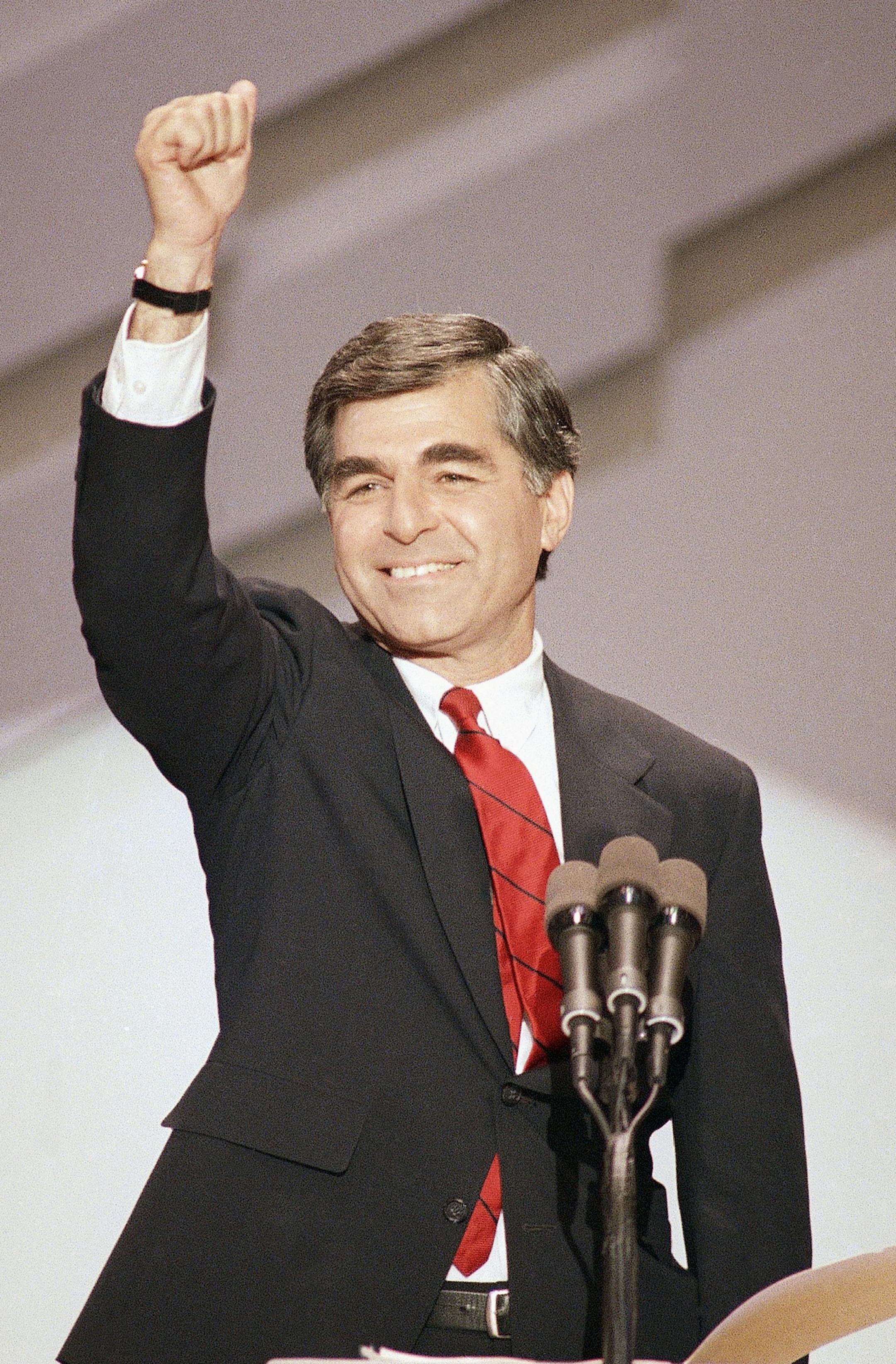
Michael Dukakis at Democratic National Convention in July 1988. (AP Photo)
Michael Dukakis at Democratic National Convention in July 1988. (AP Photo) (The Minnesota Star Tribune)
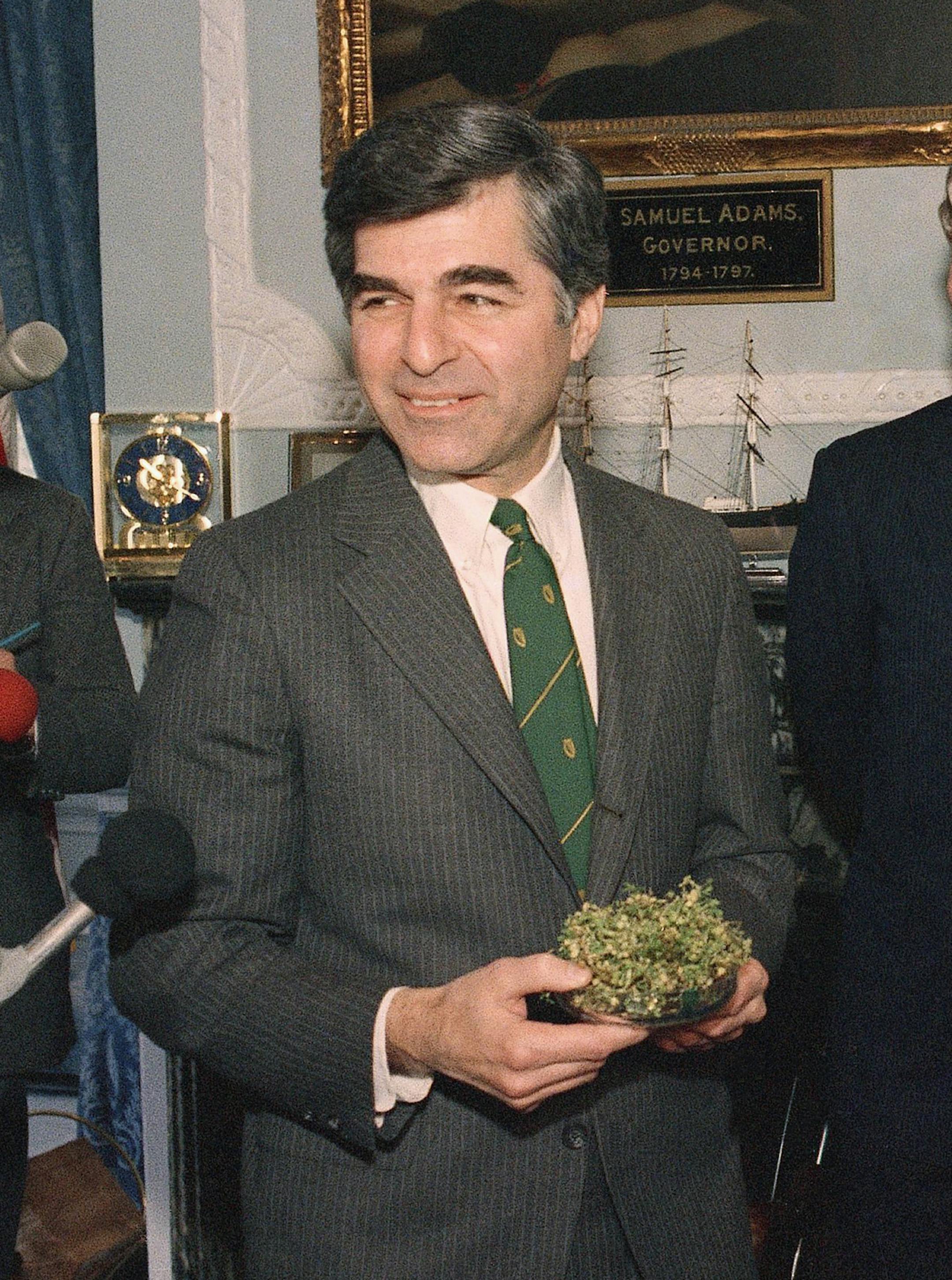
Massachusetts Governor Michael S. Dukakis, left, holds a bowl of shamrocks presented to him by the Irish Consul General Patrick Curran, center, and Breda O?Mahoney of the Irish airline Aer Lingus at his office on Tuesday, March 17, 1987 at the Statehouse in Boston. The presentation was made in honor of St. Patrick?s Day and a bit of Irish luck might help Dukakis in his intended bid for the 1988 Democratic presidential nomination. (AP Photo/Mark Lennihan)
Massachusetts Governor Michael S. Dukakis, left, holds a bowl of shamrocks presented to him by the Irish Consul General Patrick Curran, center, and Breda O?Mahoney of the Irish airline Aer Lingus at his office on Tuesday, March 17, 1987 at the Statehouse in Boston. The presentation was made in honor of St. Patrick?s Day and a bit of Irish luck might help Dukakis in his intended bid for the 1988 Democratic presidential nomination. (AP Photo/Mark Lennihan) (The Minnesota Star Tribune)
about the writer

about the writer

Heidi Stevens

More from No Section

See More
FILE -- A rent deposit slot at an apartment complex in Tucker, Ga., on July 21, 2020. As an eviction crisis has seemed increasingly likely this summer, everyone in the housing market has made the same plea to Washington: Send money — lots of it — that would keep renters in their homes and landlords afloat. (Melissa Golden/The New York Times) ORG XMIT: XNYT58
Melissa Golden/The New York Times

It’s too soon to tell how much the immigration crackdown is to blame.