

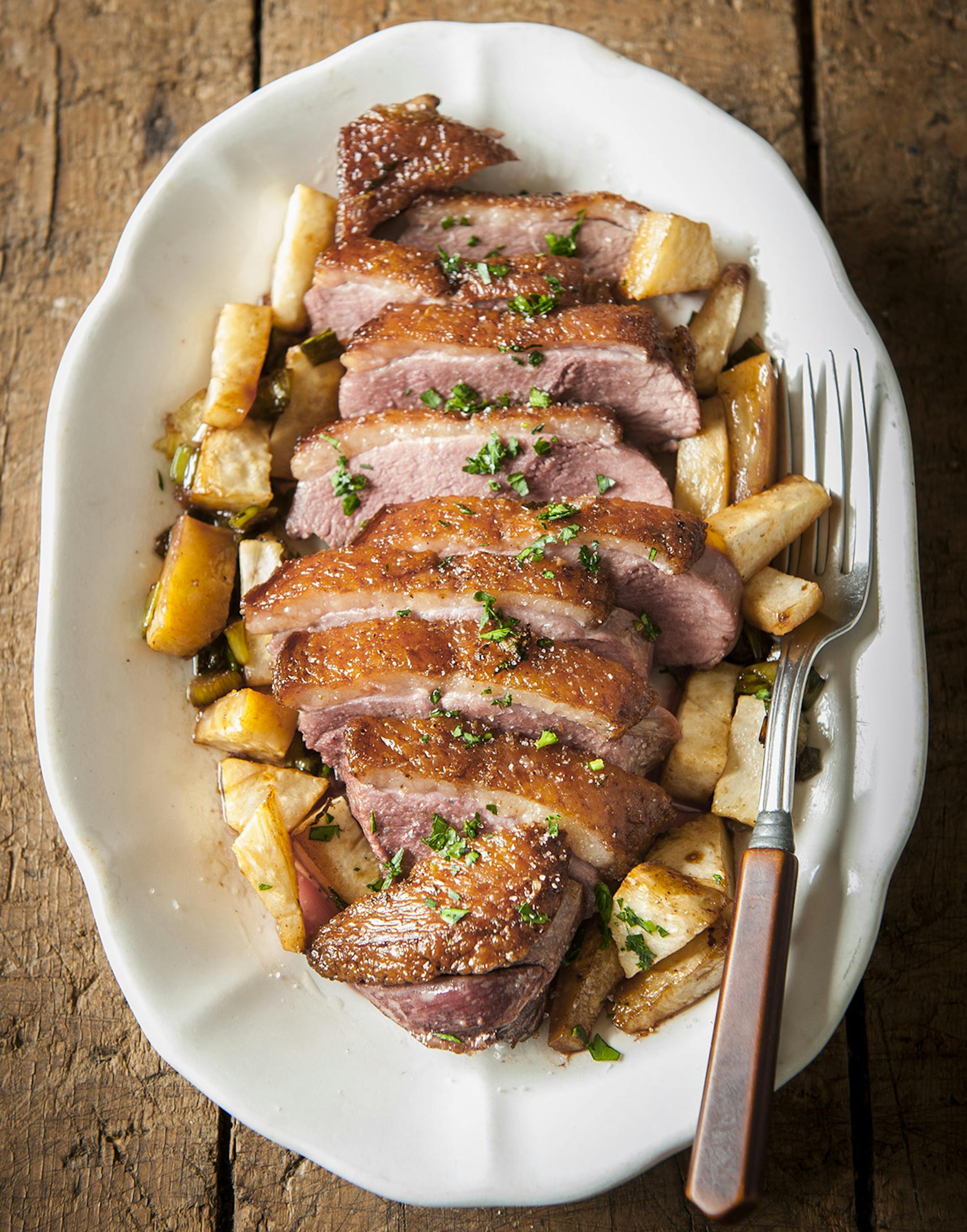
Don't ask why it's taken me so long to discover how easy it is to cook duck.
I may have associated it with Lucia's Restaurant in Minneapolis, now closed, and those beautiful dinners I could never re-create at home.
But I can attest that duck breast is easy, forgiving and quick.
Duck is a whole different bird from chicken or turkey; it's actually a red meat, akin in flavor and texture to steak.
You'll find fresh and frozen duck (whole and parts) at several of our local butcher shops (Lowry Hill Meats and Clancey's Meats & Fish in Minneapolis and St. Paul Meat Shop in St. Paul). They carry a variety that's similar to the Pekin duck raised on Wild Acres Farms in Pequot Lakes, Minn. Whole duck and duck breast are also available at our Twin Cities natural food co-ops.
The Pekin duck is, perhaps, the easiest and most satisfying to cook. Its flavor is rich without being gamey and it has just enough fat, not too much. The best thing duck breast has going for it is that combination of skin and fat. The latter bastes the skin perfectly, allowing it to brown with ease, and ensures that the meat stays moist and juicy. Once rendered, the fat can be stored in a glass jar and refrigerated, ready for frying up the most amazing potatoes and eggs.
To pan-roast duck breast, the first step is to score that fat with a sharp knife (lightly, without piercing the meat). Then, unlike most sautés, begin by placing the duck breast skin-side down in a cold, ungreased, pan; a well-seasoned heavy cast iron skillet works best. Cook the duck breast slowly over low heat to allow time for the fat to render and the skin to crisp. Flip, continue cooking and, as with steak, look for the juices to appear on the surface of the meat.
According to the U.S. Department of Agriculture, duck meat is safe to eat at 165 degrees on an instant-read digital meat thermometer. But many chefs prefer to serve it more rare. I like to finish it off in the oven.


