

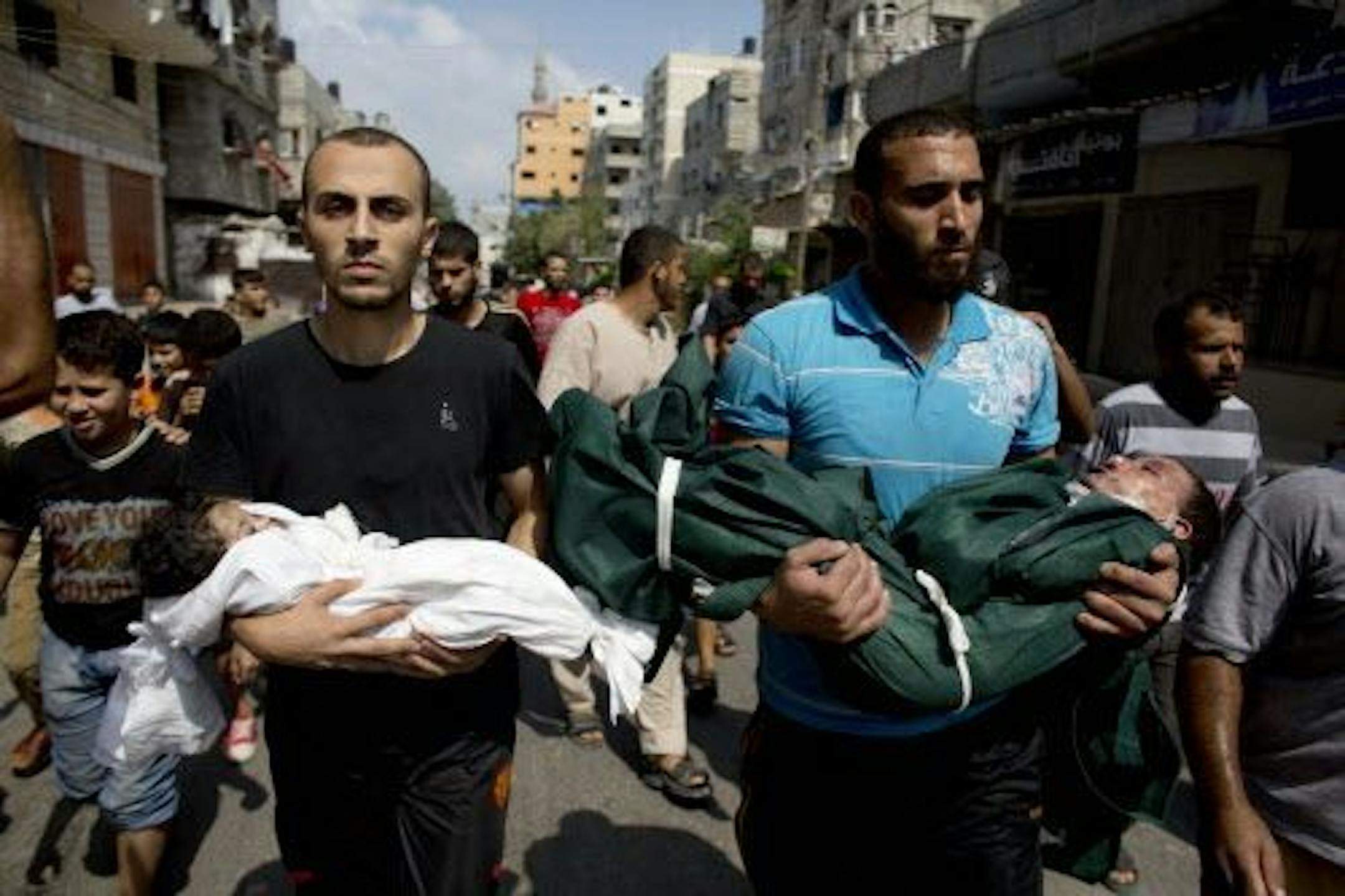
JEBALIYA CAMP, Gaza Strip — The airstrike that crushed the Najam family home in this refugee camp set in motion a grim but increasingly familiar process as the Gaza war claims victim after victim. A search through the rubble for bodies and body parts. Relatives claiming the dead from the morgue. Then a swift burial in a hastily dug grave with a cardboard name tag instead of a tombstone.
With such tragedies becoming routine, most Palestinians are responding with a measure of sobriety to the violent deaths that are now part of daily life in Gaza. Some suppress their grief behind a faith that the dead are martyrs in the fight against Israel and destined to go to heaven. Others are just too preoccupied with their own survival to mourn.
"What happened to them could happen to us," Youssef al-Doqs, a 22-year-old neighbor of the Najams, said Monday as he watched six stone-faced men silently searching through a mound of debris that was their two-story home in the Jebaliya refugee camp. "As for me, Youssef, I am not afraid of death," he said, sucking on a cigarette.
Late Monday morning in Shati, a different refugee camp in Gaza City, an Israeli warplane struck a house that stood on a narrow lane. Children, some as young as 8 or 9, helped rescue workers searching the rubble for bodies and survivors by forming a human chain between the targeted house and a main street. They passed to one another bits of debris, which the last member of the chain on the street end dropped onto a growing heap.
Nearly 1,900 Palestinians have died since Israel launched a campaign of airstrikes against Hamas-ruled Gaza on July 8 in response to weeks of rocket attacks into Israel by Hamas and other Gaza militants. More than 60 Israelis, mostly soldiers, have been killed in the war.
While the Palestinian militant groups openly aim their rockets and mortar shells at Israeli cities hoping to harm civilians, Israel says it is strictly targeting launch sites as well as militants who often embed themselves among Palestinian civilians. Israel also has said it is doing its utmost to avoid harm to civilians, urging them in phone calls, leaflets and text messages to leave areas about to be attacked.
Nevertheless, most of the Palestinians killed have been civilians — and they include some 400 children.
Israel has not explained the airstrike Sunday night that killed seven members of the Najam family, including a 90-year-old man and at least two children. It was the latest in what the U.N. says have been dozens of Israeli attacks that killed three or more members of one family in a single strike, with several cases of more than a dozen members wiped out.


