

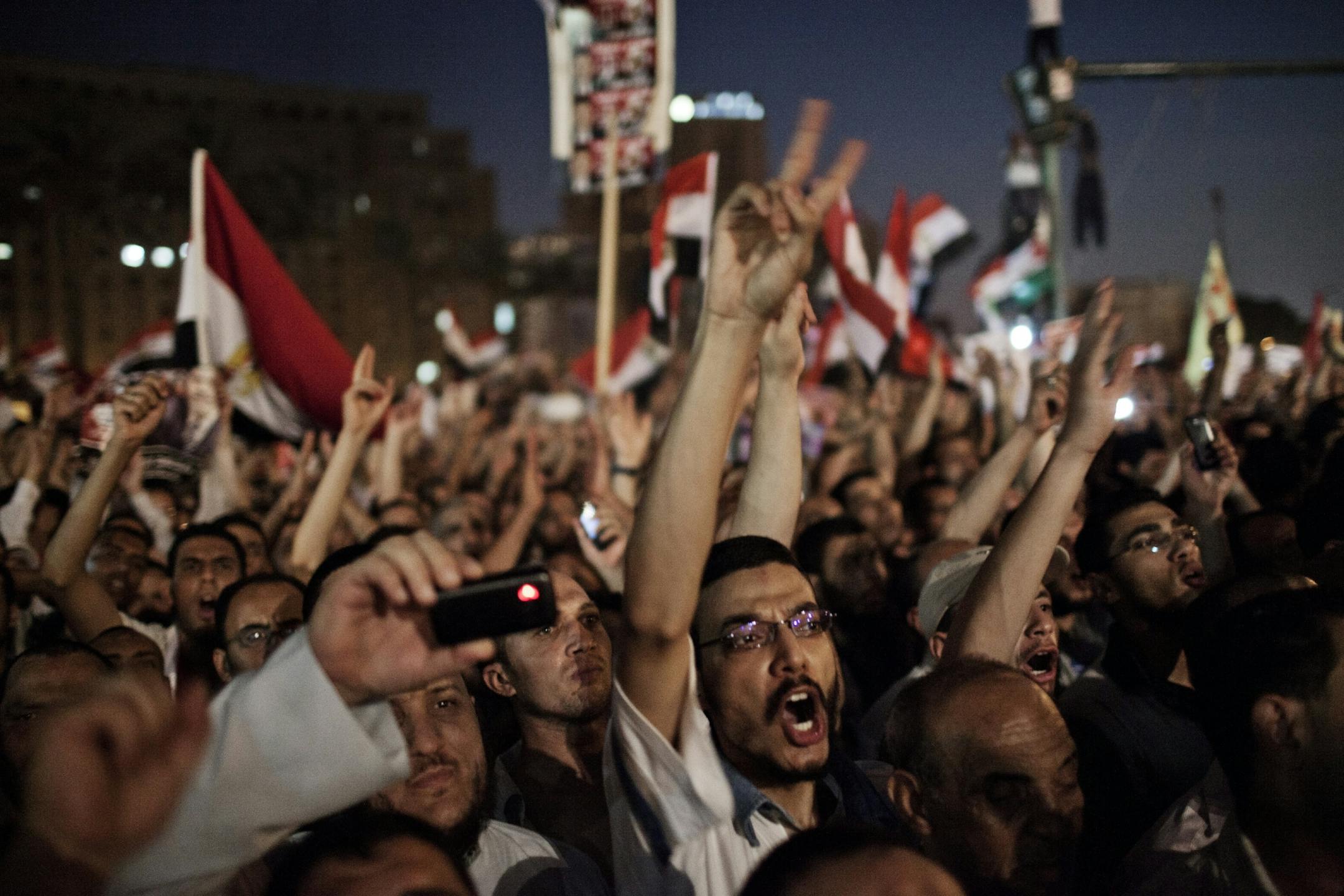
What should have been a moment of triumph in Egypt's 17-month pursuit of a democratic future has turned dark and foreboding. In the runoff election for president that concluded Sunday, preliminary results point to a narrow edge for the Muslim Brotherhood's candidate, Mohamed Morsi.
That alone is a remarkable milestone for a once-banned Islamist group that spent decades in the shadows. But as the polls were closing, the ruling generals abruptly took action to neuter the presidency.
The council of generals who have run Egypt since Hosni Mubarak's fall last year had pledged to hand over power to a civilian government by the end of this month. They renewed the promise Monday, but their words rang hollow.
On Sunday, just as the polls closed, they published an interim constitution that strips the presidency of power. For now, it appears the Egyptian revolution is being swallowed by the repressive forces of the past.
Official election results are to be announced Thursday. But with parliament dissolved, no constitution, the constitutional-drafting process disrupted and the presidency weakened, the path ahead looks unstable.
Adding to the uncertainty was a cryptic comment made by Sameh Ashour, the head of the civilian council advising the generals, who told al-Jazeera that the next president would occupy the office "for a short period of time, whether or not he agrees."
The military council may have calculated that the United States would look the other way while it usurped the first democratic election for president in Egypt's history. After all, that's been the administration's pattern so far.
On Monday, the State Department said that the military must honor its commitments to allow a transfer of power to civilian control and that its decisions "will have an impact on the nature of our engagement."


