
If repeal has failed, Minnesota leaders say, try repairing the federal health law

They point specifically to stabilizing insurance markets and addressing rising health care costs and premiums.

July 19, 2017 at 3:32AM
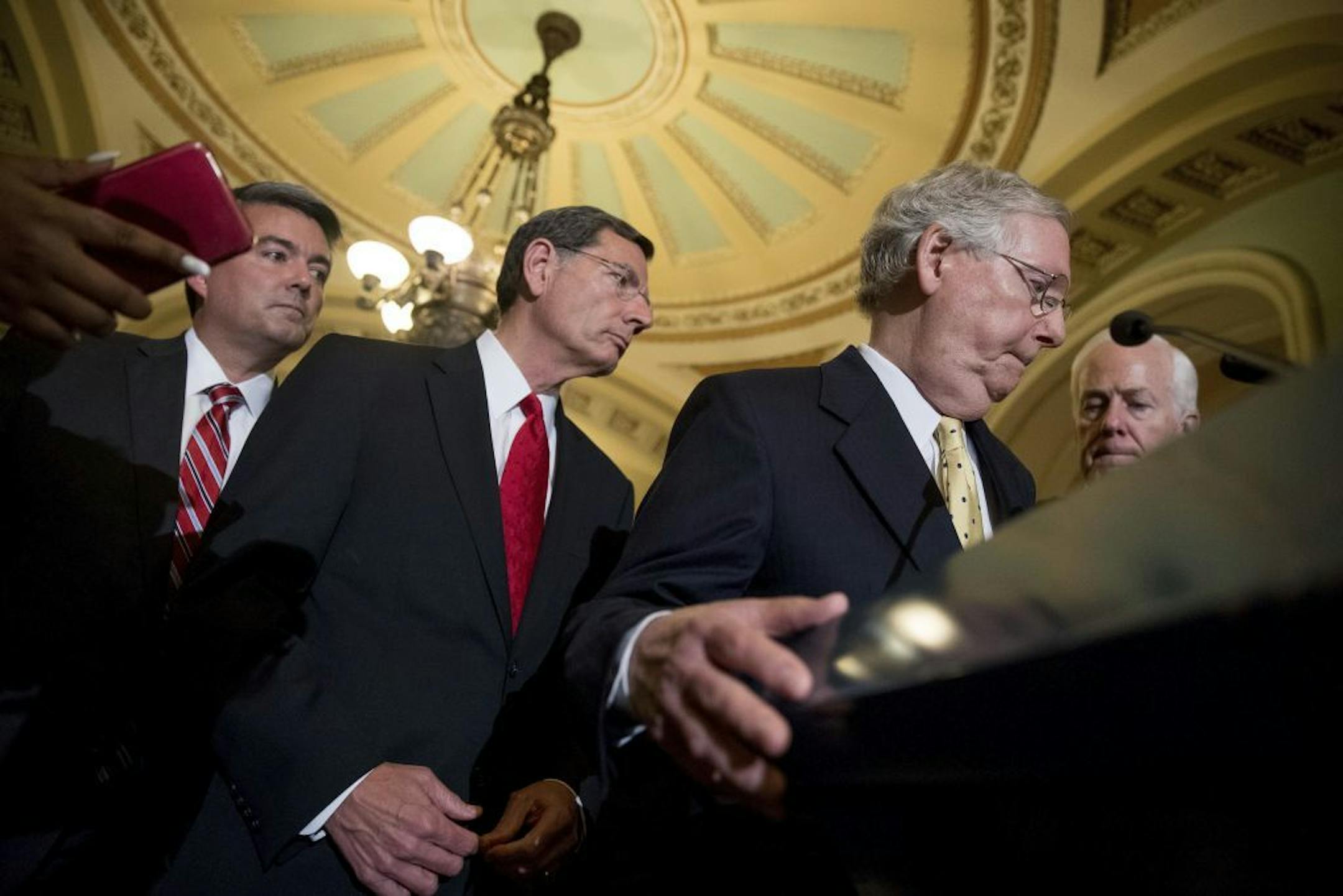
From left, Sen. Cory Gardner, R-Colo., Sen. John Barrasso, R-Wyo., Senate Majority Leader Mitch McConnell of Ky., and Senate Majority Whip Sen. John Cornyn of Texas, participate in a news conference on Capitol Hill in Washington, Tuesday, July 18, 2017. President Donald Trump blasted congressional Democrats and "a few Republicans" over the collapse of the GOP effort to rewrite the Obama health care law.
From left, Sen. Cory Gardner, R-Colo., Sen. John Barrasso, R-Wyo., Senate Majority Leader Mitch McConnell of Ky., and Senate Majority Whip Sen. John Cornyn of Texas, participate in a news conference on Capitol Hill in Washington, Tuesday, July 18, 2017. President Donald Trump blasted congressional Democrats and "a few Republicans" over the collapse of the GOP effort to rewrite the Obama health care law. (Associated Press/The Minnesota Star Tribune)

With the collapse of a Senate effort to repeal Obamacare, Minnesota health and business leaders called on Congress Tuesday to repair the existing law — specifically to stabilize insurance markets and address rising health care costs and premiums.

A Senate bill that would have replaced the Affordable Care Act collapsed Monday night when it lost the support of additional Republican senators, while a plan Tuesday to simply pull the plug on the 2010 law without a replacement also appeared unlikely to garner the 50 votes needed to bring the bill to the floor for a vote. But officials in Minnesota said there are several steps Congress and the Trump administration can take to make the current law perform better for consumers, physicians and the general public.

"Maybe we can get to some bipartisanship here that puts people before politics," said Dr. Penny Wheeler, chief of executive of Minneapolis-based Allina Health System. "I think this gives us a chance to do that."

Michael Guyette, chief executive of Blue Cross and Blue Shield of Minnesota, the state's biggest health insurer, said a large federal program like the Affordable Care Act needs continual fixes and adjustments to make it more effective.

"It takes time to adjust these programs," said Guyette. "We never got a chance to fix what came out of Obamacare."

Specifically, several said Washington should approve a reinsurance program like that authorized by the Minnesota Legislature last session, which would set the stage for more affordable premiums by buffering some of the risk undertaken by private insurers in unpredictable health markets.

"No matter what was going to happen at the federal level, that needed to happen, STAT, to stabilize our insurance market," said Bentley Graves of the Minnesota Chamber of Commerce.

The reinsurance plan would use government funds to offset the high costs of the sickest patients who buy individual health plans on the state exchange. That would in turn allow health plans to keep their premiums lower.

Graves said that if Obamacare is going to remain the law of the land states should also use the waivers and flexibility already granted to them.

"Even if nothing changes with the ACA, there is theoretically still some opportunity there to say, 'How does our market work, and how could we change it to make it better?' " said Graves, the chamber's director of health care and transportation policy.

David Durenberger, a former Republican U.S. senator from Minnesota who was regarded as a health care authority during his time in Washington, says political leaders should "take a deep breath" and start over.

"The focus should be on keeping people healthy and providing them the most consistently effective health care available in the community," he said. Republicans need to come up with a vision, he added, for how the legislation will improve the health care system in the long run, not just the health insurance system.

While there is more hope for a bipartisan approach, there still is much doubt about how the majority GOP will proceed over the next few weeks, especially because Republicans have campaigned for years on the elimination of Obamacare.

"It is hard to tell whether this is truly dead or whether this is going to take another form and come back," said Minnesota Human Services Commissioner Emily Piper. "It is all moving so fast and all hinging on just a few senators."

Carolyn Pare, chief executive of the Minnesota Health Action Group, said she hopes Congress and the Trump administration will expand efforts to pay medical providers for the value of their care, not just the amount they provide, and to study what types of care pay off. "So we can determine what sort of services are higher value and which services don't provide value but only increase costs," she said.

And, Pare said, while some businesses decry the costs and tax disadvantages of Obamacare, they also would have lost money switching their policies and infrastructure if they had to adapt to a new law.

"This isn't just like fairy dust for employers," Pare said. "All of them have had to work hard to be in compliance with the laws that exist."

An employer survey earlier this year found that many are comfortable with existing federal requirements that health plans cover pre-existing conditions and have no lifetime benefit caps. The costs of reporting and regulatory requirements were bigger issues.

Letting Obamacare fail is not a good next option for GOP leaders and President Donald Trump, Pare added. "It's unconscionable, actually, because it affects people. We're not just talking about this for kicks."

Trump could easily take small steps to undermine Obamacare and hasten its failure, said Andy Slavitt, a former federal health administrator who lives in Edina. Trump could, for example, stop funding enrollment call centers and outreach campaigns, and halt enforcement of the federal mandate that Americans have health insurance — a mandate designed to keep insurance pools large, diverse and economically viable.

Slavitt said any of those steps would hurt millions of consumers and the overall health system. "I'm worried the president doesn't have a strategy," he said, "so I think it will be up to Congress to be the adults in the room."

The Trump administration also could stop so-called "cost-sharing reduction" payments, which help make out-of-pocket insurance payments affordable for lower-income consumers.

"They just can't let the whole thing crater," said Guyette of Blue Cross. "I think there is a lot of interest on both sides of not letting tens of millions of people go without coverage."

Staff writer Christopher Snowbeck contributed to this report.

Glenn Howatt • 612-673-7192

about the writers

about the writers

Glenn Howatt

Editor

Glenn Howatt has been with the Star Tribune since 1990 where he has specialized in health care reporting and data journalism.

See Moreicon

Jeremy Olson

Reporter

Jeremy Olson is a Pulitzer Prize-winning reporter covering health care for the Star Tribune. Trained in investigative and computer-assisted reporting, Olson has covered politics, social services, and family issues.

See Moreicon