
Opinion | What the ICE surge foretells about the potential for election disruption

If antidemocratic scenarios are overwrought, they at least point to the need to rebut smears of Minnesota’s election integrity.

Columnist Icon
The Minnesota Star Tribune
January 21, 2026 at 7:30PM
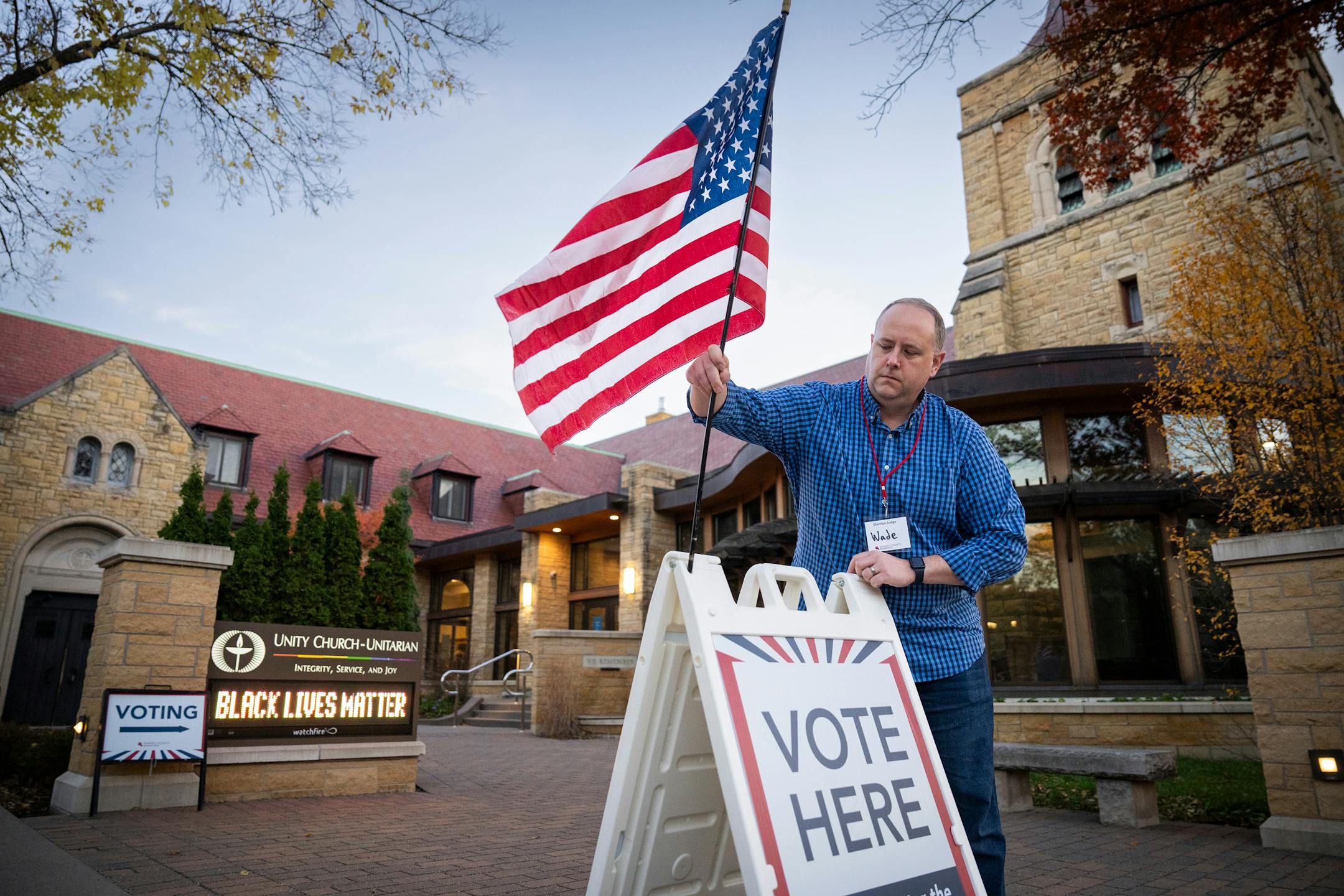
A volunteer election judge puts out the American flag and voting signs outside the polling place Unity Church on Election Day in St. Paul on Nov. 4, 2025. (Leila Navidi/The Minnesota Star Tribune)

Opinion editor’s note: Strib Voices publishes a mix of commentary online and in print each day. To contribute, click here.

•••

The Jan. 14 Clean Elections Minnesota webinar on potential federal meddling in Minnesota elections was proceeding nicely (or so it seemed to the moderator, yours truly). The participants were about to delve into the finer points when one of them — Attorney General Keith Ellison — announced with apology that he had to make an immediate exit.

A “work-related emergency” had arisen, Ellison said. He said he couldn’t say more.

The expression on his face told me and several hundred viewers that something unwanted and unwelcome had happened again in Minnesota — something at the hands of the Immigration and Customs Enforcement (ICE) officers that had swarmed this state.

Our hunch was confirmed moments after we signed off. We learned that during a scuffle at a north Minneapolis duplex, an ICE agent had shot and injured Julio Cesar Sosa-Celis, a 24-year-old DoorDash driver and undocumented immigrant.

No one in Minnesota needed reminding that it was the second shooting in Minneapolis at ICE hands in a week.

As Ellison abruptly left the webinar, the slightly flustered moderator silently sputtered about ICE’s intrusion into an hour that was supposed to be devoted to elections, particularly the one that’s less than 10 months away.

Then it occurred to me: We may have just witnessed a telling episode. It told — or rather, foretold — that ICE and/or any other federal military presence foisted on Minnesota this year could be an election disrupter. It’s even plausible that election disruption is an unstated but primary goal of ICE’s Operation Metro Surge, here and in other blue-voting places.

After all, the Republican president has been quite open about his desire for the nation to forgo the coming midterms.

“When you think of it, we shouldn’t even have an election,” Trump told Reuters last week.

He has also broadly hinted that — following Ukraine’s example — an election could be skipped if a nation were experiencing war or civil unrest. And he has recently expressed regret for not deploying the National Guard to confiscate ballots after the 2020 election.

That last move, one can imagine, would be a lot more easily engineered if bands of armed ICE agents already stood outside the polls. Or if U.S. military troops were dispatched to a state where citizens had the temerity to protest Trump’s actions.

Visions of that sort are understandably chilling to democracy lovers — and no state is more democracy-loving than Minnesota. Through a half-century of elections, it has led the nation in voter turnout more often than any other state.

But the anti-democratic scenarios are also — likely — overwrought, assured Ellison and the other webinar participant, Minnesota Secretary of State Steve Simon.

“The [U.S.] Constitution says nothing, not one word, about a president of the United States … asserting power or control over administration of elections.” Simon said. The states are constitutionally, unambiguously in charge.

What’s more, he said, Minnesota law is clear: There can be no preemptive posting of law enforcement personnel of any kind outside a polling place. Law enforcement can be summoned to the polls by election officials — no one else.

Ellison added: “These days, anything is possible. But within 15 minutes, we’ll be in court” if the Trump administration tries to stop an election or seize the ballots. “I can’t tell you what he’s going to do, but I can sure tell you what we’re going to do. We’re going to defend this state in court, and we’re up to it.”

Ellison’s office has proven that resolve with more than 40 lawsuits in the past year, a number of them filed in collaboration with Simon’s office. Democracy defenders can take assurance from the experience and determination of these two veteran public servants at their offices’ respective helms.

My hope is that they will find time this year for more than lawfare. I’d like to see more of their energies devoted to what our webinar offered — a public-information rebuttal of the smear that the Minnesota election system is rife with fraud.

That’s the slander that has been used to justify a host of Trumpian attempts to meddle in state election administration. No credible evidence backs up the charge. Painstaking anti-fraud practices are employed by this state’s elections administrators on practically a daily basis.

It should be easy for Minnesotans to find and know those facts and share them with others. As of a few years ago, more than a dozen states issued widely distributed voters’ guides that, among other things, explained the process by which voter registration occurs and fraudulent registration is averted. Minnesota should consider doing the same.

Lori Sturdevant is a retired Star Tribune editorial writer. She is the author, co-author or editor of 15 books, including “Turnout: Making Minnesota the State that Votes,” with Joan Anderson Growe (Minnesota Historical Society Press, 2020).

about the writer

about the writer

Lori Sturdevant

Columnist

Lori Sturdevant is a retired Star Tribune editorial writer and columnist. She was a journalist at the Star Tribune for 43 years and an Editorial Board member for 26 years. She is also the author or editor of 13 books about notable Minnesotans. 

See Moreicon

More from Columnists

See More
card image
Leila Navidi/The Minnesota Star Tribune

If antidemocratic scenarios are overwrought, they at least point to the need to rebut smears of Minnesota’s election integrity.