

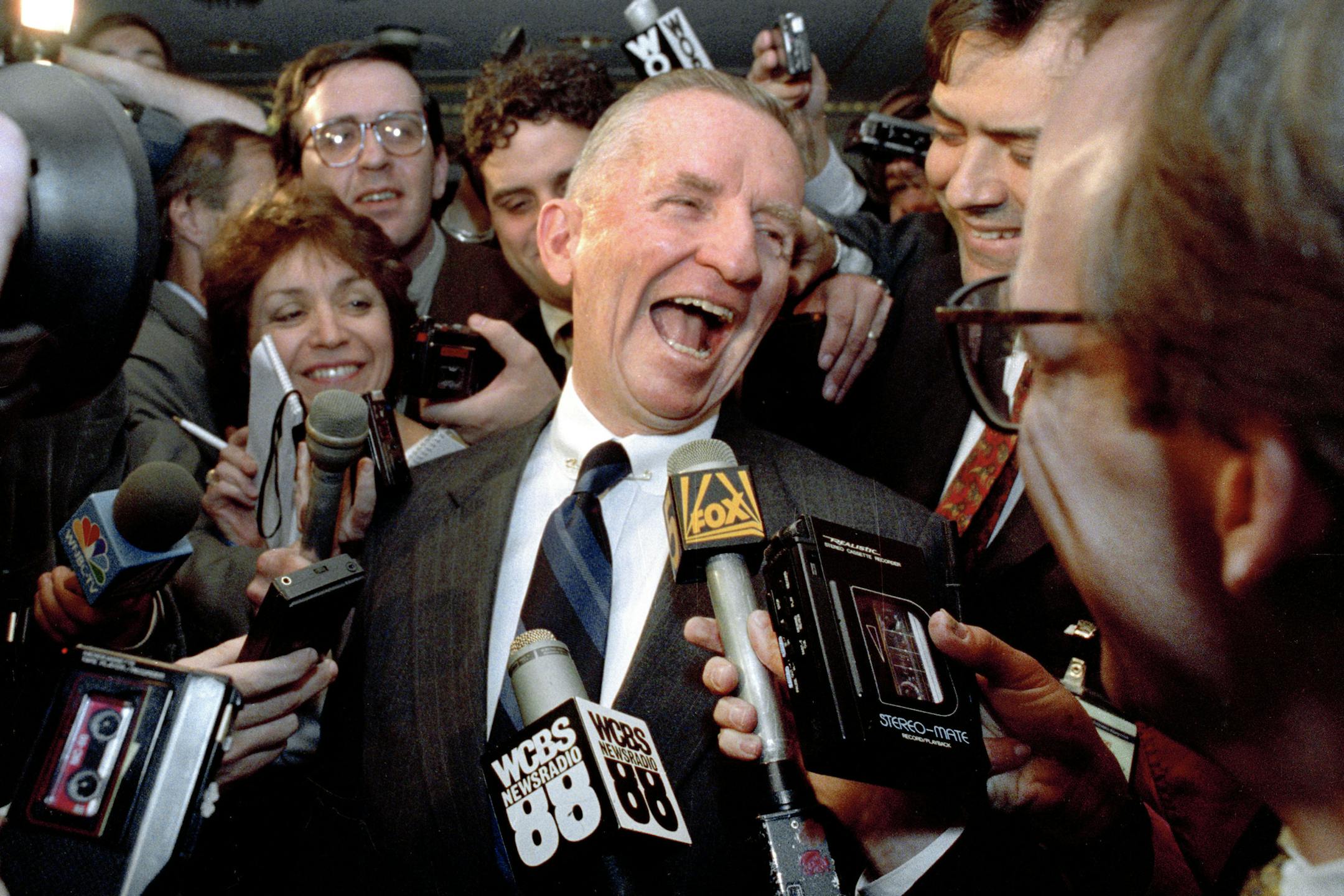
Here's my favorite memory of Ross Perot: During his 1992 run for the White House, he kept pointing out that Capitol Hill was the only workplace in America where the employees could park their cars but the owners couldn't.
Zing!
"We're the owners of this country," Perot declared. "We don't act like the owners." He built his two presidential campaigns around the idea that the people (as he liked to say) should start acting as if they were the bosses, rather than scared rabbits (which he also liked to say).
The colorful and controversial billionaire, who died this week at the age of 89, is best remembered for his presidential runs in 1992 and 1996. After a stint in the Navy, he founded Electronic Data Systems in 1962 with an initial $1,000. In 1984, he sold the company to General Motors for $2.5 billion (over $6 billion today).
Perot made a virtue of wealth, and long before his presidential runs was somehow always in the news. This is a guy who in 1969 flew to Moscow to try to persuade Soviet authorities to let him add Christmas gifts for American prisoners of war to their next supply plane to North Vietnam. Who paid for security for two narcotics agents targeted by drug traffickers. Who bought horses for New York City's mounted police. In 1973, he paid for a weekend extravaganza, including a ticker-tape parade, for U.S. troops who had been imprisoned at North Vietnam's notorious Son Tay prison camp — and for the Green Berets whose rescue mission went awry when the prisoners turned out to have been moved elsewhere.
When Perot spent 1991 and 1992 musing publicly about whether or not he should run for president, nobody took him seriously. But once he got into the race, he drew enthusiastic (or at least curious) crowds. To those who found themselves sick of the incumbents, Perot was attractive. "The guys in Washington," he would remind the crowds, "work for us."
People liked him. He prefigured Donald Trump in the sense that he was, as one study notes, "a walking oxymoron — a billionaire populist, an extraordinary ordinary person." The scholar Roderick P. Hart referred to Perot's grassroots supporters as "an assemblage of malcontents" — people who were for one reason or another unhappy with politics or with the country's direction, but who found Perot relatable: "He's like us, only richer."
Only richer: Back then, a billionaire running for president was a new and strange thing. Few voters my age are likely to forget Dana Carvey's delicious sendup of Perot on "Saturday Night Live." Carvey/Perot promised to take no salary should the nation's economy remain flat or grow by only one or two percentage points. But should it do better, he'd get paid:


