
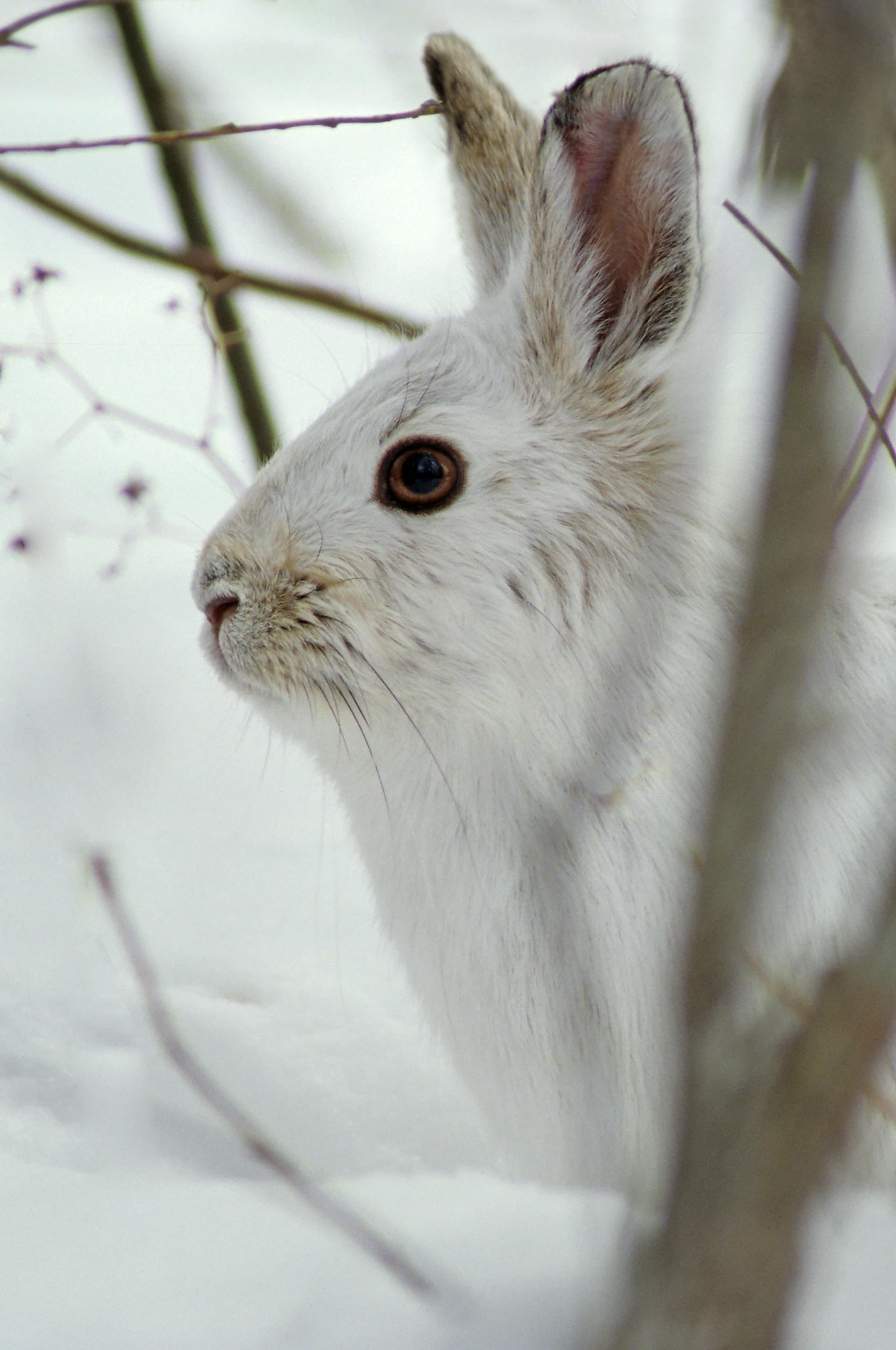
Hunting snowshoe hares takes teamwork

Even with one group of hunters driving them toward another, the brilliantly camouflaged animals are not easy to bring down.

February 24, 2008 at 3:37PM
(Photo By Bill Marchel/The Minnesota Star Tribune)

BRAINERD, MINN. - When a group of archers met last Sunday at the local Caribou coffee shop, they happened onto a few other patrons also dressed in outdoor garb.

Some of the people, I'm sure, were ice anglers, whose intent was to spend the day staring at a bobber, and hoping something might be stirring in the depths. Others probably planned to cruise the area trails aboard snowmobiles.

None, I'm sure, were planning, as we were, to ply the aspen forests while brandishing bows and arrows in search of snowshoe hares, wonderfully camouflaged and secretive forest critters that are seldom seen by chance.

During winter, snowshoe hares wear coats of white, an astonishing metamorphosis from their summer brown fur. This transformation allows the hares to travel ghostlike through the frigid forest -- those cryptic coats of white providing them near-perfect camouflage against the snow. They travel nearly effortlessly across the snow because of a profusion of hair on their outsized feet. Some hunters call snowshoe hares "chameleons of the cold."

Snowshoe hares are experts at using every nook and cranny of their home ranges to escape a variety of predators, including wolves, coyotes, foxes, bobcats, owls and hawks.

And bow-and-arrow-wielding hunters.

Our bunch included Lindy Frasl of Fort Ripley, Rolf Moen of Nisswa, Jay Strangis of Baxter, Dan Beraldo and Brian Smude from Brainerd, and me.

Our first stop was a tract of property that had been logged several years ago. The area has since regenerated with aspen saplings so thick one's vision is reduced to scant yards. But the young aspens are the key to locating snowshoes because the trees provide them food in the form of bark and twigs, and cover in which to hide from predators.

Under a cloudy sky, and with the temperature hovering just below freezing, we entered the woods like so many Elmer Fudds. A brisk north wind swayed the aspens, a forewarning of more below-zero weather. The snow was not particularly deep for February, but the crusty surface required that we lift our feet with every step.

Our favorite method of hunting snowshoe hares is to make short drives. Usually two or three hunters attempt to push the hares while the others take stands. We execute short, circular drives of 200 yards or less, preferably with meadows, roads or other openings on at least one or two sides to act as barriers. Snowshoe hares are reluctant to cross any opening and are thus funneled past the waiting standers.

Our initial drive was hare-less, but we did jump a cottontail rabbit. A relatively fresh snow allowed me to track the rabbit while the rest of our hunting group took stands near the animal's hideout.

When pursued, a common trait exhibited by rabbits and hares is to circle back to where they were first jumped, and that's just what this cottontail did, with me hot on the trail. Lindy and Dan each got a shot, but their arrows went astray. Eventually the rabbit escaped by running into a culvert.

On our next drive, Lindy, Rolf and Brian took stands while Jay, Dan and I pushed toward them. As we neared the standers, I was slightly out of position and I watched a hare blow past me like a wisp of smoke. But Jay was able to circle behind me and force the hare back into the void between the drivers and standers.

Once again the drivers advanced toward the standers. As the human gantlet closed, I spotted the hare about 15 yards ahead, its dark eye and dusty ears the only chink in its winter disguise. Slowly I nocked an arrow, took a few careful steps to my right until I could see the hare's head clearly through the heavy cover, drew my bow and let the arrow fly. The first hare of the day was in the bag.

And so the day went. A drive here, a push there, and every now and then someone would manage to shoot an arrow. Eventually, darkness drove us from the woods.

We had seen at least five hares, and had managed to add one more to the bag. Between us we had taken seven shots, and two arrows had found their mark.

Snowshoe hare populations are subject to cyclic highs and lows. This year, the hare population is down, at least in the areas my friends and I had hunted. But snowshoe hares can be found in huntable numbers, even during a population ebb.

Snow, of course, aids in finding the animals, and deep, fluffy snow concentrates the hares even further, making them easier to hunt because then they are reluctant to leave their network of trails into untracked snow. Thus the hares can often be chased several times past waiting standers.

The hunting season for snowshoe hares in Minnesota runs through Friday, and the daily limit is 10 hares apiece. At least one article of clothing above the waist must be blaze orange.

Bill Marchel, a wildlife photographer and outdoors writer, lives near Brainerd. bill@billmarchel.com

about the writer

about the writer