

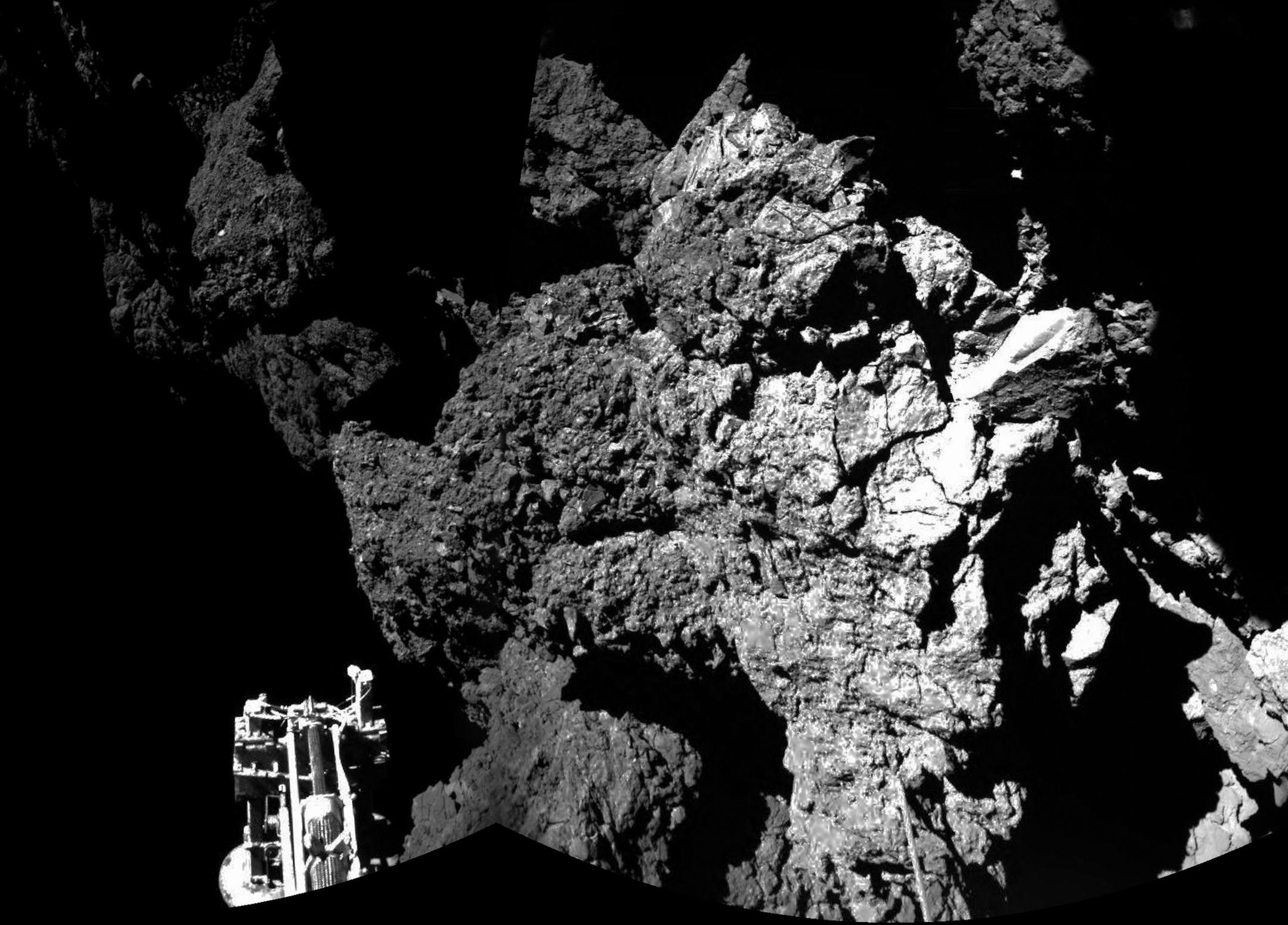
The Philae lander's precise location remains a mystery more than a week after it touched down on a comet, but science detectives say they are getting closer to figuring out where it ended up.
Researchers have narrowed the lander's final resting spot to a 1,150-foot stretch just outside a basin on the comet's "head," or perhaps, to a spot within the basin.
To reach this conclusion, the scientists used data collected by the CONSERT experiment, which was originally designed to get a sort of ultrasound reading on the comet's nucleus.
It took two spacecraft to pull off the experiment. The radio waves were generated by the Rosetta orbiter and received by Philae. The waves traveled through the nucleus to get to the lander and were altered by what they encountered in the comet's icy heart. The lander collected the data, and then sent it back to the orbiter, which in turn sent it to Earth.
As it turns out, CONSERT's data can also provide clues about the lander's location. Scientists used it to measure the distance between Philae and Rosetta during periods when the radio waves went directly from orbiter to lander. They were also able to make measurements when the waves went into the core.
Using that information, they have narrowed the lander's position to two areas.
The next step is to use a high-resolution camera on Rosetta to look for the lander in the areas where CONSERT predicted it might be.
Philae made a total of three landings on the comet. The first was in a preselected site that was relatively boulder-free and offered the lander at least six hours of sunlight a day to power its battery. But when harpoons designed to tether the lander failed to deploy, Philae bounced twice before settling.


