

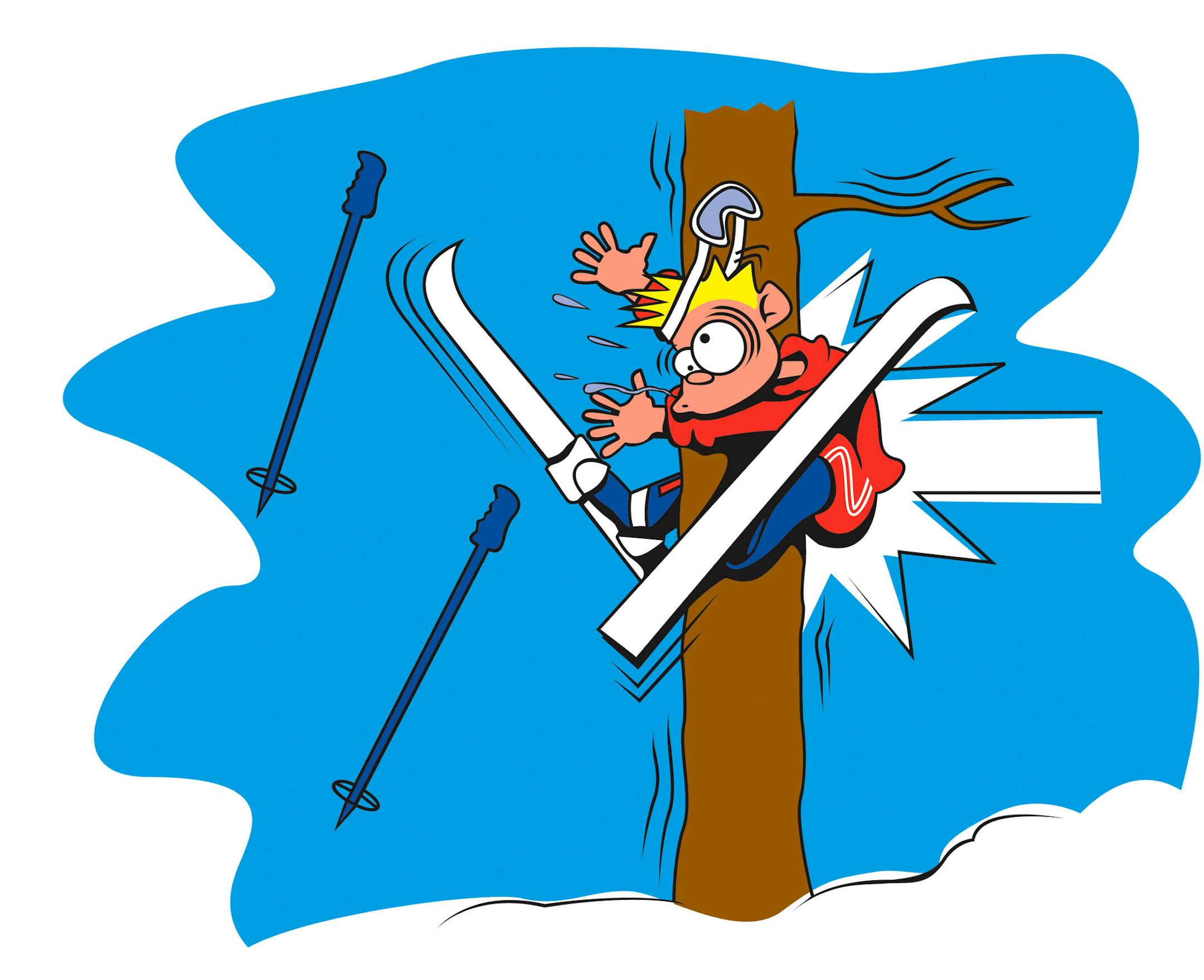
On a glittering January afternoon, infusing cold air as energy, I skied a favorite Nordic trail. I approached the top of a hill I've swept down several hundred times over 37 winters. The snow was fast, so I didn't attack the slope. A few years ago I would've double-poled the first 20 feet regardless, pounding out velocity, but I'm aware that my skill has eroded.
The trail describes a steep S-curve between crowded trunks of 70-year-old red pines. It's narrow, and the bottom isn't visible. I was focused, but almost immediately I was going faster than I wanted. I considered dropping to my derrière, but that's risky, too — I once broke a ski on a bailout. The tracks were solid, hard-edged, so I hung on. Just past the middle of the S-curve, speed trumped skill. I was snowplowing with one ski, clinging inside the track with the other. But when the latter ski jumped the groove, I lost the edges of both and veered off the trail.
I saw the old pine coming and threw up my left arm just before smacking into the trunk, tempering a "head-on" collision into a violent ricochet. The pain was outstanding, and I yelped as I flopped back onto the trail in a jumble of poles and skis. I laid there and groaned, gingerly moving my wrist to see if it felt fractured. I couldn't believe I hadn't snapped a ski or a pole. It took several minutes to rise, a painful struggle to release bindings. Besides hurt, I was also angry. In four decades on skis, logging thousands of miles, I'd never hit a tree.
I felt betrayed. By what? The snow, the tree, the skis were all unbiased and had made no promises. I'm older, yes, but no one had forced me to hit the trail. A squirrel chattered from the canopy as I tested a knee and gingerly clipped boots back into bindings. Its voice sounded mocking, but that was presumptuous — the squirrel was probably paying no mind to a clumsy, non-climbing human. It would be far more attentive to the pine martens or goshawks I've seen in those woods.
I pushed off, limping a little — if such can be accomplished on skis — and after a half-mile or so, despite a throbbing wrist, mostly recovered the pleasure of the path. It was too fine a day for quitting. Snow-arched boughs framed transoms of azure sky. Shafts of sunlight glazed the rosy bark of pines. I heard ravens and blue jays.
But the sense of betrayal lingered. I'd recently read a memoir by the novelist Wallace Stegner, where he recalled an episode in school "when I split my thumb down to the first joint on a bench saw in shop, and bled all over the place, and bawled, not so much in pain as in outrage that the world could treat me so." That was part of it — our intense petulance when an indifferent cosmos fails to consider us as special, neglecting to shield us from authenticity and accident.
An hour later when I glided to the trailhead parking lot and my truck, the feeling was further resolved: I seemed suddenly foreign, even in a cherished locale as familiar as our living room.
I drove home on a road from where, a few seasons earlier, I'd witnessed an arresting episode: a white wolf on black ice. The small kettle lake had been drenched in early spring light, and though April was brand-new, the temperature was 70 degrees. I stopped the truck to stare, and the wolf glanced my way. It was big, probably close to a hundred pounds, and surely the sun-rotted ice was frail. I could see no obvious reason for the wolf to be in the middle of the 8-acre pond — no prey, no carcass, no other wolves. If all background — muskeg, forest, sky — suddenly vanished, the "white wolf on black ice" could be an old lithograph, a stylized illustration of wildness in a 19-century tome.


