

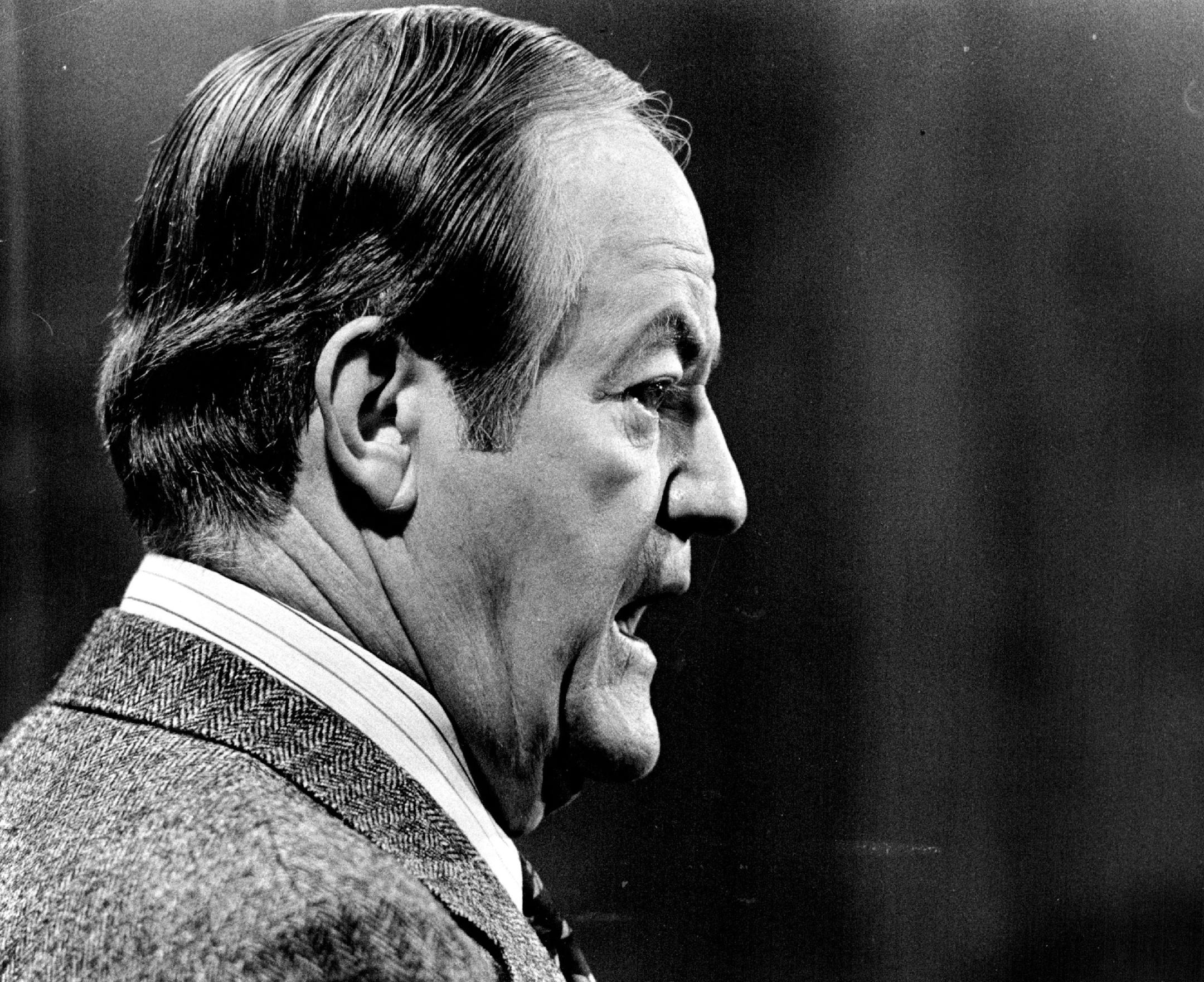
In May 1950, Hubert Humphrey, the firebrand liberal from Minnesota, took to the floor of the Senate to call for passage of a fair employment practices commission to root out systematic racial discrimination in hiring. "So long as men and women and children of color are discriminated against in the United States," Humphrey insisted, "the colored people of the world have the right to suspect our professed friendship for them."
Figures like Humphrey, who came to be known as "Cold War liberals," argued that the struggle against Soviet totalitarianism could be won only if the U.S. proved that democracies could deliver social justice more effectively than communism could. In the course of researching a book on Humphrey, I have been struck by how absolutely central this claim was not only to him but also to others, including the historian Arthur Schlesinger, the author of "The Vital Center"; the labor leader Walter Reuther; and the theologian Reinhold Niebuhr, founders, along with Humphrey, of Americans for Democratic Action, the leading advocacy body for anti-communist liberals.
President Joe Biden grew up in the world of liberal anti-communism, which stretched from the end of World War II to the early stages of the Vietnam War. We should not be surprised that he has turned back to that moment, and to that language, at a time when democracy once again seems threatened by authoritarianism. "The triumph of democracy and liberalism over fascism and autocracy created the free world," Biden wrote earlier this year in an essay in Foreign Affairs laying out his worldview. "But this contest does not just define our past. It will define our future, as well."
Is that really true? In 1950, the Soviet Union menaced the West both as a military and an ideological force. Today, neither China nor Russia poses anything like an existential threat to the U.S. or the West. Yet democracy is being eaten away from inside by nationalism, by religious extremism, by corruption. India, Turkey and Brazil, democratic success stories for all their shortcomings only a decade ago, are now sliding toward autocracy, imprisoning critics and marginalizing minorities. Far-right parties have been gathering strength in Western Europe over the last decade, and increasingly so since the 2015 refugee crisis. No fully established democracy has surrendered its norms more rapidly than the United States, which over the last decade has fallen from 22nd to 33rd in Freedom House's annual Freedom in the World index. In November, 48% of Americans voted for an incumbent president who had spent four years demonstrating his contempt for those norms. The crisis, in short, is both domestic and global.
It is true that the U.S. plays a less central role in the world today than it did 70 years ago. Over the last four years, the world's democracies, whether in the West or in East Asia, have stopped looking to America for leadership. Europe has weathered a succession of grave crises with virtually no help from us. Yet we have negative proof of American influence in the way that illiberal leaders in Hungary and Poland, and nationalist figures elsewhere, have pointed to the U.S. as proof that they represent the wave of the future. Trumpism has been a disaster for beleaguered figures like President Emmanuel Macron of France and Chancellor Angela Merkel in Germany. You do not have to be intoxicated with "American exceptionalism" to believe that the U.S. needs to take a leadership role on restoring democracy.
"Lead" need not be a euphemism for "dominate." Though we think of the Cold War as a series of military and diplomatic crises, liberals like Humphrey always understood it as a battle of ideas — a struggle over "the fundamental issue of man's right to freedom," as he put it when introducing civil rights legislation once again in 1958. The Marshall Plan as well as later food aid programs constituted acts of global leadership. But so, too, was civil rights, which liberals regarded as the ultimate demonstration project for the moral capacities of democracy. "If we wish to inspire the peoples of the world whose freedom is in jeopardy," President Harry Truman said in his historic 1948 message to Congress proposing laws banning employment discrimination and lynching as well as segregation in interstate transport, "we must correct the remaining imperfections in our practice of democracy."
Though preoccupied with the Soviet threat, the Cold War liberals regarded domestic policy as the hammer with which they could forge a democratic world order. Now our situation is reversed. At a moment when the coronavirus pandemic has ravaged the economy and killed 400,000 people and counting, foreign policy feels like an afterthought; yet our failures at home contribute to democratic erosion abroad. To take only the most obvious and shameful example, the haplessness of President Donald Trump's response to the pandemic — and, if somewhat less egregiously, that of other Western nations — stands in glaring contrast to China's success in both reducing deaths and restoring economic growth. Asian democracies, including Taiwan and Japan, have done just as well, but it is China, right now, whose demonstration project looks most powerful. Trump's canting about "the China virus" and his bluster over China's (genuinely unfair) trading practices only accentuate America's weak position at a time when China is aggressively promoting its model of autocratic capitalism through trade, investment and cultural diplomacy.
A politics of democratic renewal would once again bind together domestic and foreign affairs. Biden has in fact argued that such a policy must begin with a reassertion of moral principle at home by banning torture and ending the gross mistreatment of migrants at our borders. Only then, having restored at least a measure of legitimacy, would Biden seek to revitalize the tattered global order by convening what he calls a "summit of democracy" in order to build a unified response to both autocratic states and backsliding democracies.


