Hubble Telescope's unlikely journey enables 25 years of space study

Few icons of science have had such a perilous existence, surviving political storms, physical calamities and the simple passage of time in the service of cosmic exploration.

The New York Times
May 3, 2015 at 4:17AM
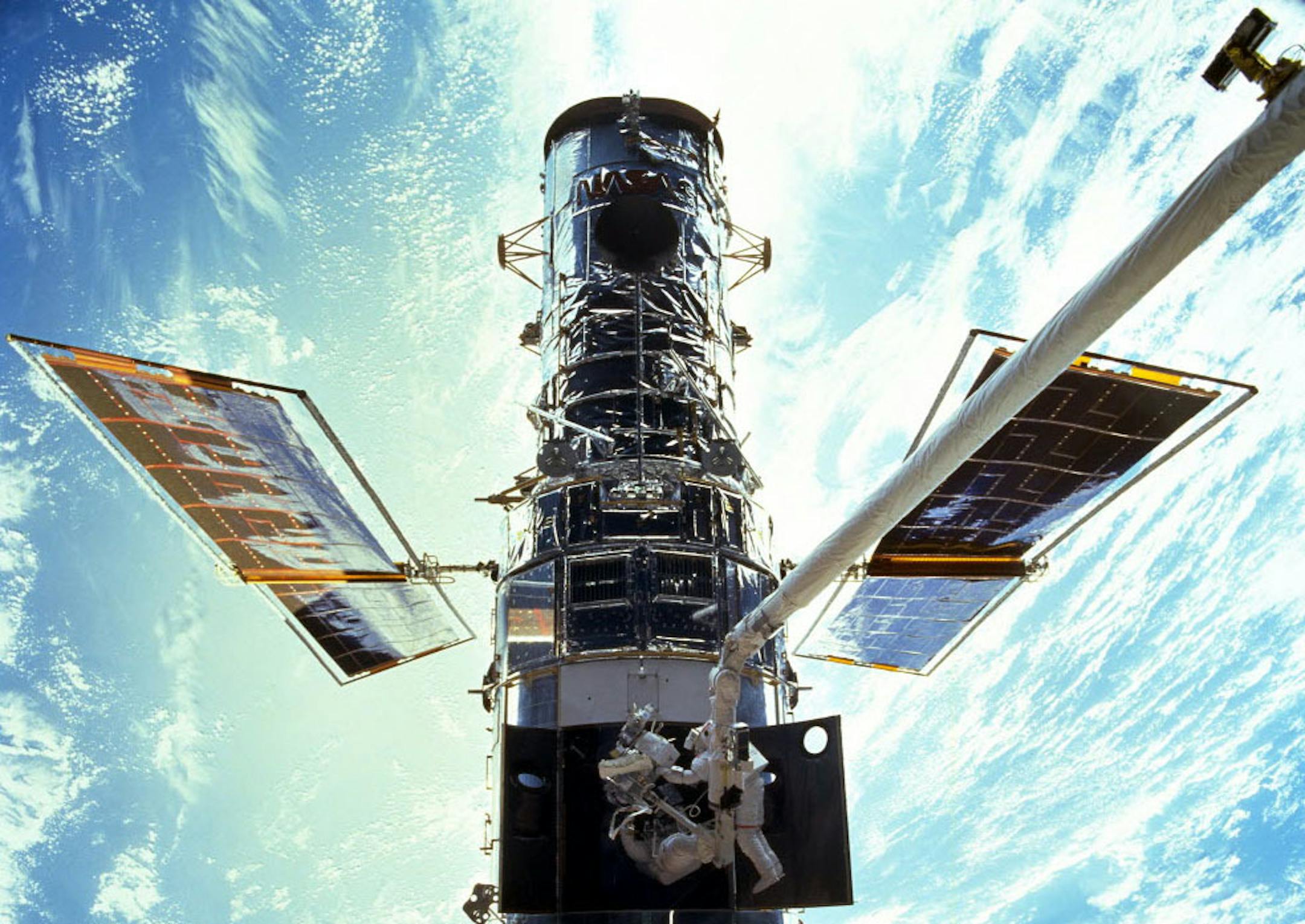
In this image provided by NASA/JSC, astronauts Steven L. Smith and John M. Grunsfeld are photographed during an extravehicular activity (EVA) during the December 1999 Hubble servicing mission of STS-103, flown by Discovery. The Hubble Space Telescope, one of NASA'S crowning glories, marks its 25th anniversary on Friday, April 24, 2015. With more than 1 million observations, including those of the farthest and oldest galaxies ever beholden by humanity, no man-made satellite has touched as many mi
In this image provided by NASA/JSC, astronauts Steven L. Smith and John M. Grunsfeld are photographed during an extravehicular activity (EVA) during a December 1999 Hubble servicing mission. (Vince Tuss — Associated Press/The Minnesota Star Tribune)

Against all odds, it's 25 years in space and counting for the Hubble Space Telescope.
Few icons of science have had such a perilous existence, surviving political storms, physical calamities and the simple passage of time in the service of cosmic exploration.
In 1946, the astronomer Lyman Spitzer Jr. had a dream. A telescope in space, above the unruly atmosphere, would be able to see stars unaffected by the turbulence that blurs them and makes them twinkle. It would be able to see ultraviolet and infrared emissions that are blocked by the atmosphere and thus invisible to astronomers on the ground.
It took more than three decades for the rest of the astronomical community, NASA and Congress to buy into this dream, partly as a way to showcase the capabilities of the space shuttle, still in development then, and the ability of astronauts to work routinely in space.
By the time the telescope was launched into space from the space shuttle Discovery on April 25, 1990, it had been almost canceled at least twice and then delayed after the explosion of the shuttle Challenger in 1986.
When the Hubble was finally deployed, NASA's spinmasters instantly hailed it as the greatest advance in astronomy since Galileo. And it might have been except for one problem: The telescope couldn't be focused. Instead, within days it became a laughingstock — a "technoturkey," in the words of some of its critics.

Designed using spy satellite technology, Hubble had an 8-foot mirror, just small enough to fit into the space shuttle cargo bay.

But because of a measuring error during a testing process that was hurried to save money, that big mirror wound up misshapen, polished four-millionths of an inch too flat, leaving the telescope with blurry vision. It was the kind of mistake, known as a spherical aberration, that an amateur astronomer might make, and it was a handful of astronomers who first recognized the flaw — to the disbelief and then the dismay of the engineers and contractors working for NASA.

For bright objects, astronomers could correct for the flaw with image processing software. But for the fainter parts of the universe, the Hubble needed glasses.

NASA scientists shrugged off their heartbreak and worked to figure out a way to provide corrective lenses.

Three years later, the space shuttle Endeavour and a repair crew led by Story Musgrave — astronaut, pilot, surgeon, spacewalker and Zen gardener — rode to the rescue.

In five tense days of spacewalks, they replaced the telescope's main camera and installed tiny mirrors designed to correct the Hubble's vision.

The rest of the universe snapped into crystalline focus. And NASA could stop holding its breath.
The Hubble was the first big-deal telescope of the Internet age, and its cosmic postcards captivated the world. Trained on a patch of sky known as the Hubble Ultra Deep Field in 2010, the telescope's keen eye discerned swarms of baby galaxies crawling out of the primordial darkness as early as only 600 million years after the Big Bang.

In perhaps its most iconic image, called "Pillars of Creation," the Hubble recorded baby stars burning their way out of biblical-looking mountains of gas and dust in a stellar nursery known as the Eagle nebula.

These postcards were not without controversy. The Hubble's camera records in black and white, through filters that isolate the characteristic light from different atoms, such as sulfur, hydrogen and oxygen. Then the different layers are assigned whatever colors look good to the eye and best show off the underlying astrophysics rather than their natural colors.

"Pillars of Creation," for example, is presented in earth tones of green and brown and is oriented to look like a Turner landscape, while the natural emissions from the nebula are shades of red.

Technological hiccups have also continued. In 1999, four of the six gyroscopes that keep the telescope pointed failed, and the Hubble went into "safe mode." A crew was hastily dispatched to replace the gyros. That was the first of what would be three trips to the telescope by John M. Grunsfeld, an astronaut, astronomer and now NASA's associate administrator for science, who would win the sobriquet "Hubble Repairman" for his feats. The telescope has been reborn again and again over the years, thanks to the efforts of astronaut servicing crews.

In 2009, Grunsfeld led one last mission to the Hubble. He was the last human to touch the telescope, patting it as the shuttle Atlantis prepared to let it go again. But that does not mean the telescope has ceased to touch humanity.

On the contrary, it continues to deliver news about this thing we are all part of — a universe — but barely understand.


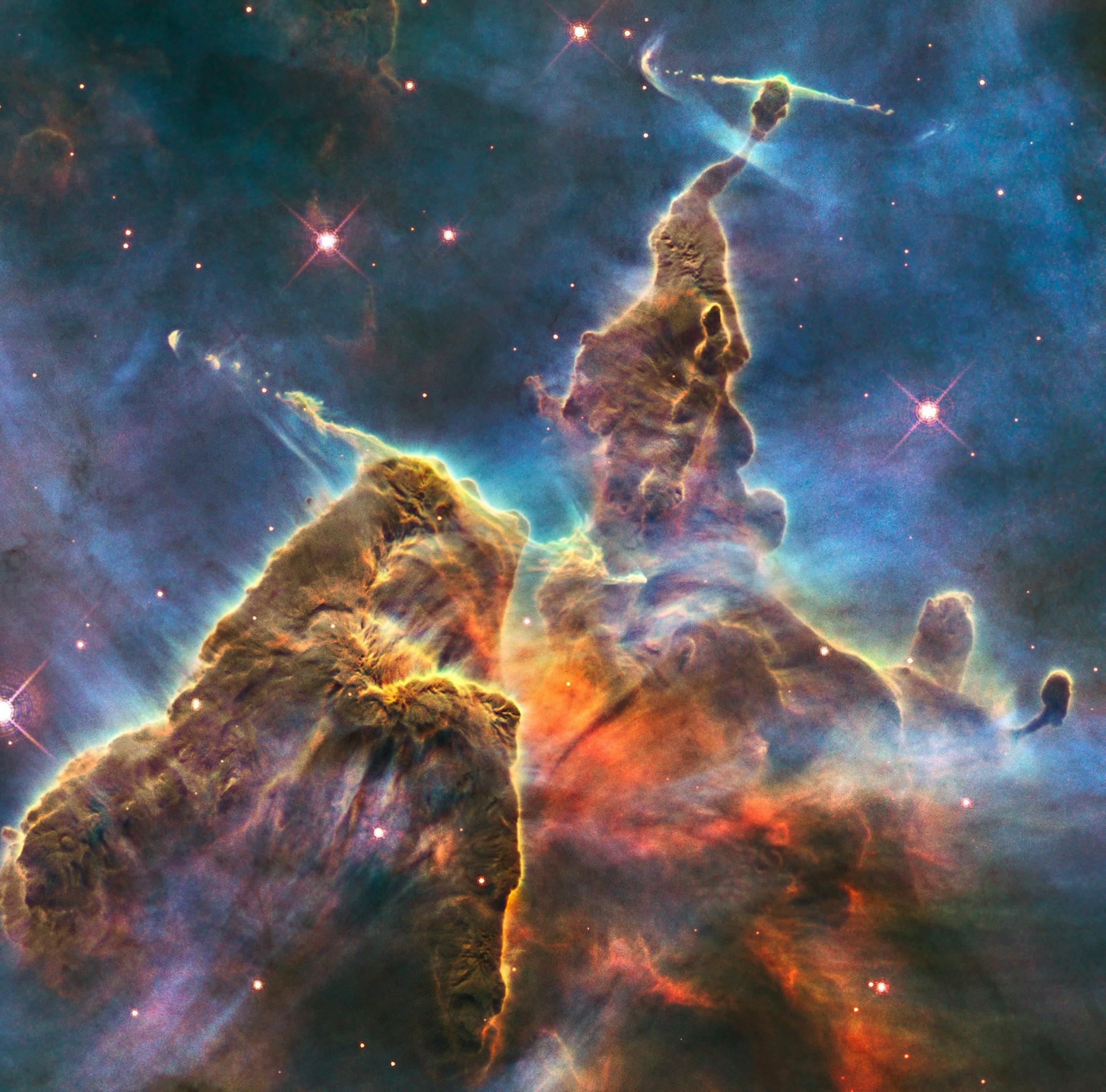
This February 2010 image made by the NASA/ESA Hubble Space Telescope shows a three-light-year-tall pillar of gas and dust in the Carina Nebula which is being eaten away by the light from nearby bright stars. Inside, infant stars fire off jets of gas that can be seen streaming from towering peaks. The stellar nursery is located 7500 light-years away in the southern constellation of Carina. The colors in this composite image correspond to the glow of oxygen (blue), hydrogen and nitrogen (green), a
This February 2010 image made by the NASA/ESA Hubble Space Telescope shows a three-light-year-tall pillar of gas and dust in the Carina Nebula which is being eaten away by the light from nearby bright stars. Inside, infant stars fire off jets of gas that can be seen streaming from towering peaks. The stellar nursery is located 7500 light-years away in the southern constellation of Carina. The colors in this composite image correspond to the glow of oxygen (blue), hydrogen and nitrogen (green), and sulphur (red). (The Minnesota Star Tribune)
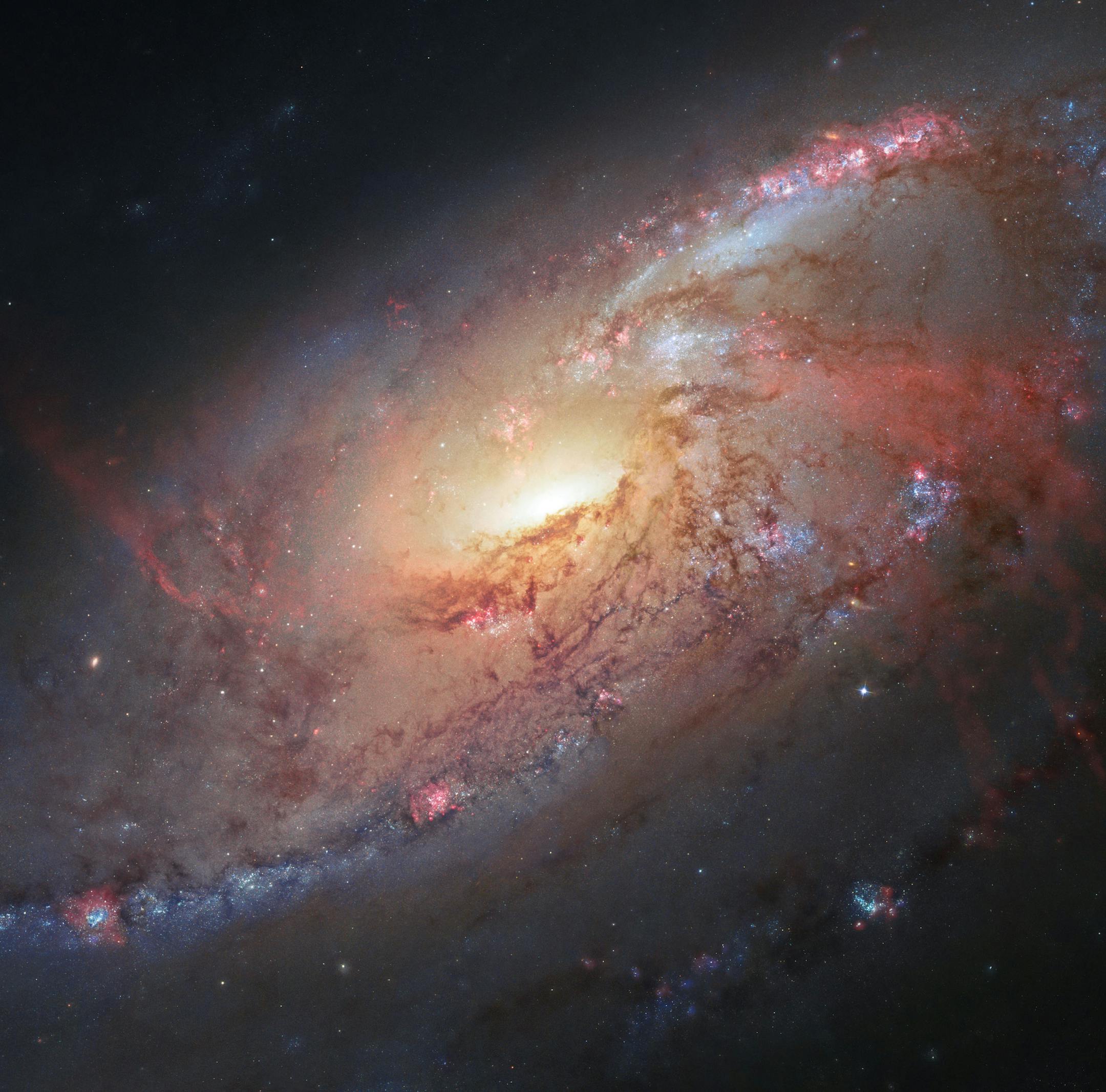
This image made by the NASA/ESA Hubble Space Telescope shows M106 with additional information captured by amateur astronomers Robert Gendler and Jay GaBany. Gendler combined Hubble data with his own observations to produce this color image. It is a relatively nearby spiral galaxy, a little over 20 million light-years away. The Hubble Space Telescope marks its 25th anniversary. A full decade in the making, Hubble rocketed into orbit on April 24, 1990, aboard space shuttle Discovery. (NASA/ ESA/ H
This image made by the NASA/ESA Hubble Space Telescope shows M106 with additional information captured by amateur astronomers Robert Gendler and Jay GaBany. Gendler combined Hubble data with his own observations to produce this color image. It is a relatively nearby spiral galaxy, a little over 20 million light-years away. (The Minnesota Star Tribune)
about the writer

about the writer

DENNIS OVERBYE