

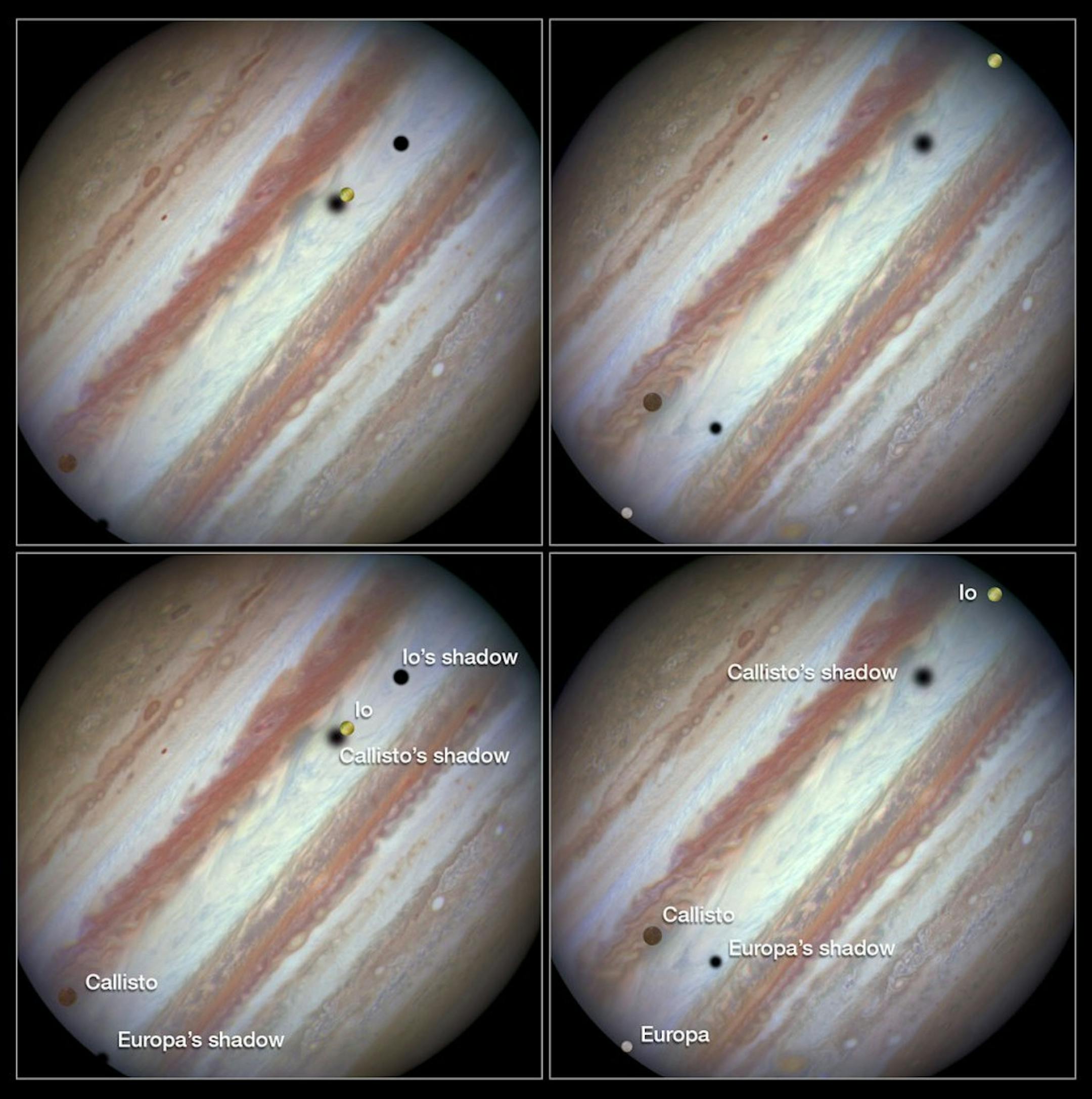
Jupiter has more stable moons than any other planet in the solar system (67) but the four Galilean satellites are the most famous. Discovered by Galileo himself, they're the planet's four largest moons. Io, Europa, Ganymede and Callisto have different orbits, and seeing three of them pass the face of the planet is something that only occurs once or twice in a decade.
The Hubble space telescope managed to catch the rare event on Jan. 23. The two photos, taken 40 minutes apart, show Io, Europa and Callisto passing in front of their host planet at the same time.
Ganymede didn't get the memo, but you can see the fourth moon's position in Hubble video.
Europa may have barely made an appearance, but it's the most exciting of Jupiter's moons. It may even be one of the most exciting things in our solar system. The moon is covered in an icy ocean, and many scientists hope it contains the same kind of extreme microbial life found deep in frozen Arctic waters on Earth. NASA's new budget includes funding for an unmanned Europa mission, so we hope we'll be swinging by for a visit soon. Washington post


