

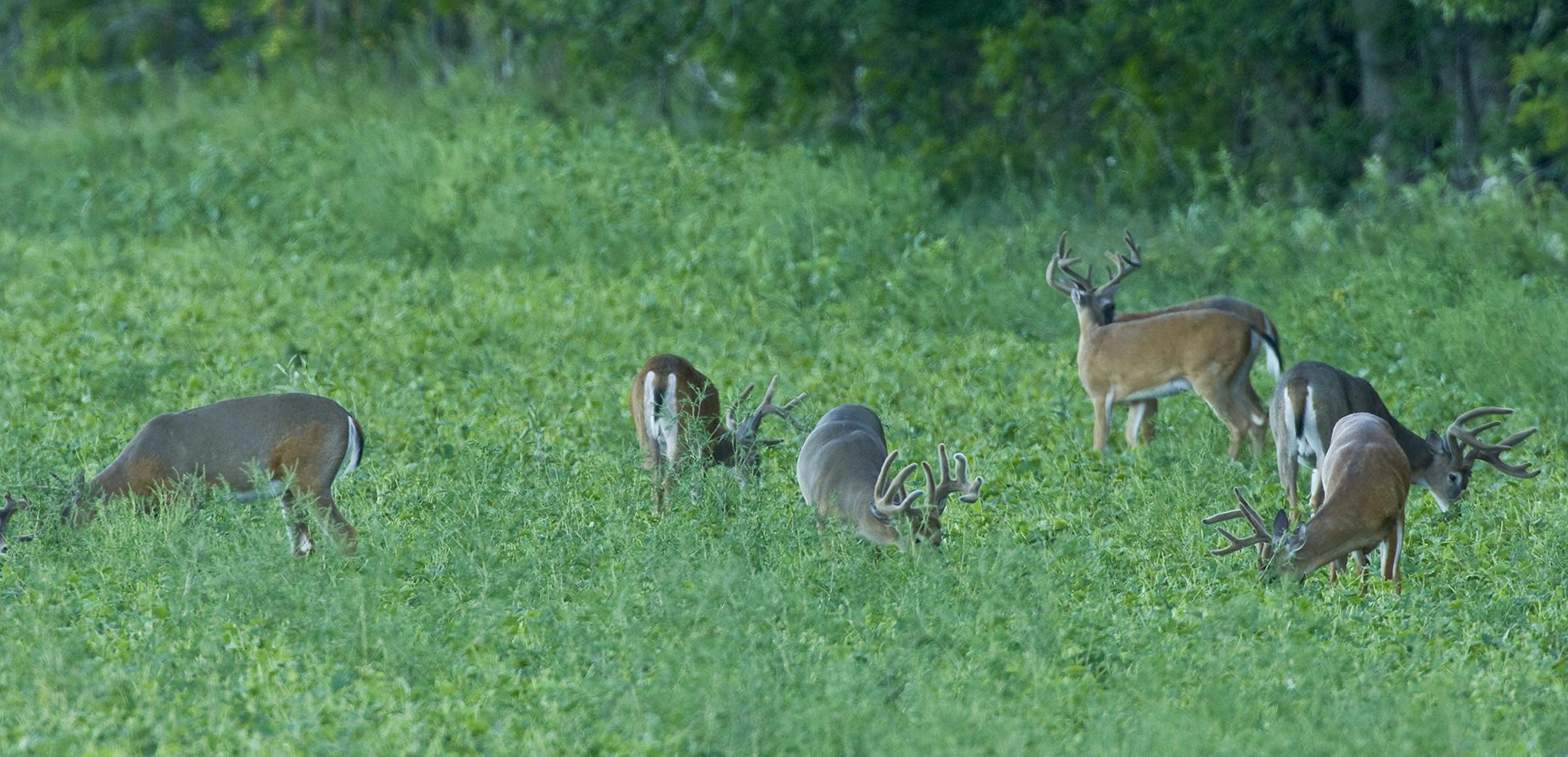
Whitetail bucks' antlers are at least three-fourths grown by now. The antlers will continue to mature for the next few weeks. The soft velvet of the antlers will begin to peel around the first of September, revealing the hard bone beneath.
What does this mean for the average deer hunter?
Bucks glimpsed now during scouting efforts carry enough antler that a hunter can accurately predict the final growth. Any odd antler characteristics you see now (including drop tines) will be noticeable and easily recognized during the fall hunting season. Now, perhaps more so than any other time of the year, whitetail bucks can be found feeding during daylight hours, often in open farm fields. That includes big bucks.
Whitetail bucks often gather in groups during the summer. Some hunters call these bands of velvet-clad males "the boys of summer." Spying from afar on these groups can provide a lesson in deer biology. During the fall rut bucks express dominance by clashing their antlers during sparring or, at times, all out battles. Their aggression is more subtle in the summer. Sometimes a dominant buck will approach his comrade with a sidling walk, a signal in the world of the whitetail to step aside. Other times a buck will display his superiority by laying back his ears and cocking his head, similar to a belligerent dog.
Whitetails feed on a variety of native foods during late summer, but it seems they can't resist an agricultural field of alfalfa or soybeans. Sometimes finding a group of feeding whitetails is as easy as cruising the back roads during the last hour or two before sunset, with binoculars ready. The best fields are remote — or at least over a hill and out of sight of any roadways.
The opposite can also be true. Occasionally whitetails will feed unbothered along a busy highway or freeway. These deer have probably become accustomed to heavy traffic. They are seldom spooked since few commuters ever notice them and fewer still pull over to spy on them.
A few summers ago, during what meteorologists described as a severe summer drought, I found an irrigated soybean field that had attracted an impressive group of bucks. Each evening a dozen or so bucks — including a few dandies — fed on the soybeans. It was the biggest summer gathering of whitetail bucks I've ever seen, owing mostly to the drought.
Late-summer whitetails are most active the day after a storm front has passed. When an August cold front whisks away the sticky, humid air, giving way to a cool, dry breeze from the northwest, deer will appear energized and on their feet — just like humans.


