
How the tariffs stole Christmas

The prices of the toys and electronics we want to place under the tree, and the solar panels we want to light that tree, are getting out of control.

Tribune News Service
December 12, 2022 at 11:45PM
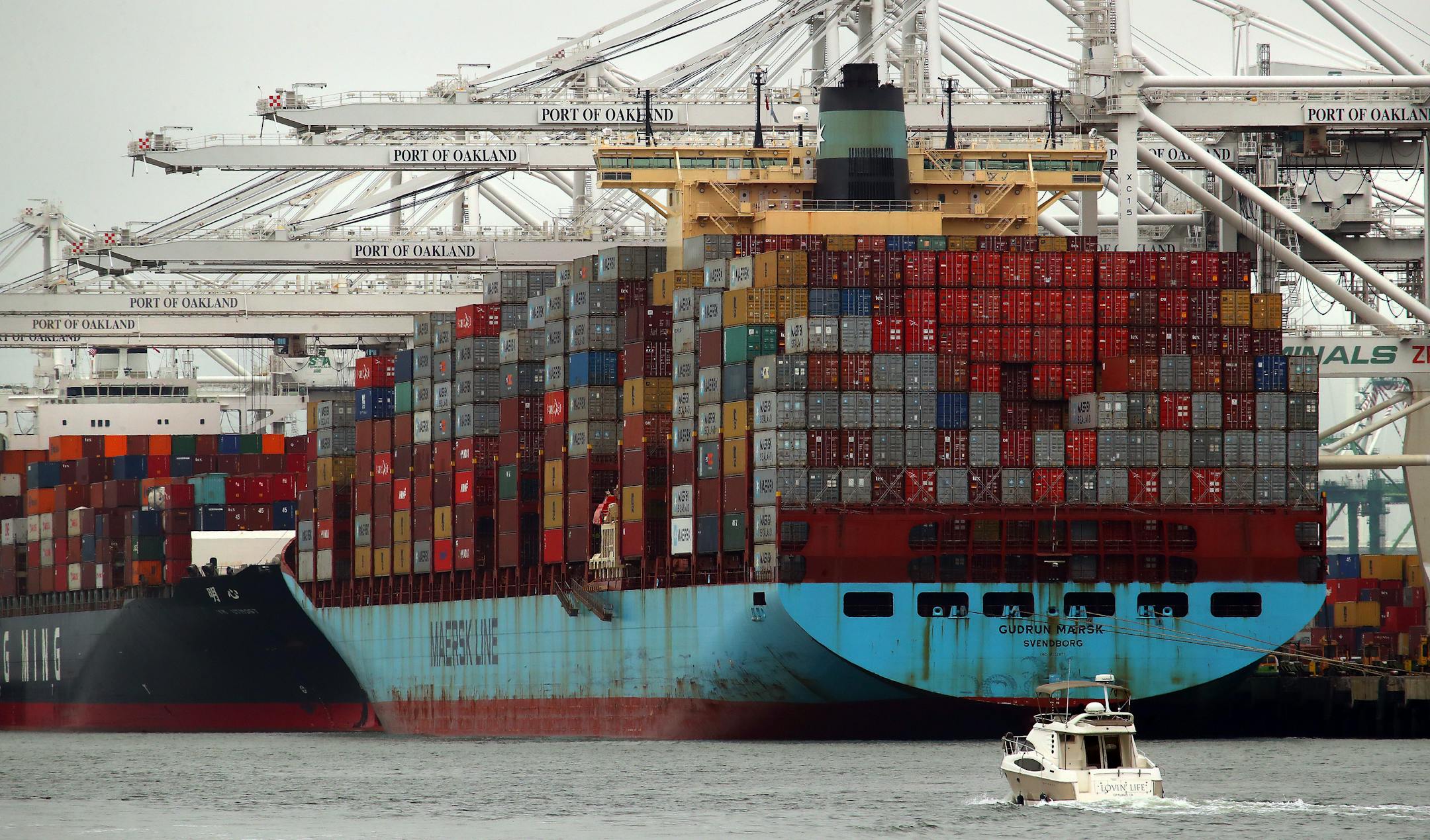
Container ships wait to be unloaded at the Port of Oakland on Monday, July 2, 2018, in Oakland, Calif. (Ben Margot, Associated Press/The Minnesota Star Tribune)

Opinion editor's note: Star Tribune Opinion publishes a mix of national and local commentaries online and in print each day. To contribute, click here.

•••

This time of year, most inflation-weary Christmas shoppers — and perhaps even the inflation-fighting Fed — would welcome an end to our government's effort to raise the prices of the goods we buy in high volume.

The federal government is on track to collect some $100 billion this year in tariffs on imported goods. The import duties are being added to lots of items on our shopping lists, running up the prices of clothes, toys, electronics and even the solar panels needed to shift America from fossil fuels to renewable energy. The latter are at the heart of a controversy showing, unfortunately, why we shouldn't expect relief any time soon.

Since 2016, under Republican and Democrat leadership, trade wars have become a governing habit. Total retail sales will hit more than $7.3 trillion in 2022. The tariffs equal roughly 1.4% of that. That's a pretty healthy dose of inflation.

In recent years, tariff tax revenues paid mostly by Americans have accelerated sharply. They climbed from $38.5 billion in 2017, when the Trump administration began hiking tariffs on China and friendlier countries like Canada and France, to roughly $53.3 billion in 2018, $77.7 billion in 2019, and on to $89.1 billion in 2021.

Former President Donald Trump famously saw himself as gatekeeper to the U.S. economy and happily referred to himself as a "tariff man" — but President Joe Biden has quietly maintained the same stance.

Figuratively speaking, for six years, our government has put rocks in our harbors to keep out foreign-made goods. Scrooge would be proud. In each instance, tariffs were said to improve the well-being of some Americans or industries, sometimes supplemented by patriotic or even environmental appeals. But it's all at the expense of a lot of other Americans.

We call the practice "protectionism," but the industries and groups gaining protection are numerically few, highly organized and politically active. Those picking up the tab are much larger in number, diverse and less organized, and so most of them — like you and me — quietly pay the cost. As usual, the politics favor those who know how to play the game.

Protectionism can feel pretty good when you are a U.S.-based solar cell startup getting a boost. But it doesn't feel so good when, as a U.S. power generator, you must now pay for more-expensive domestic solar cells and can't even find enough components to complete a major project.

This gets us to the current controversy, which has its roots in 2018, when Trump imposed tariffs on solar cells produced in and shipped from China. The move was initially embraced by the Biden team, and then temporarily relaxed when U.S. solar installers begged for more supply and as we awaited a government investigation into alleged Chinese maneuvering around the tariffs.

In December, following months of investigation and now in the midst of holiday shopping, the Department of Commerce concluded that Chinese firms rearranged their production so that products could be finalized in Southeast Asia, the source of 80% of U.S. solar cell imports.

But putting aside China's apparent disregard for the spirit of the law, what was the actual result? U.S. consumers have enjoyed lower-cost solar panels, at least when they could get them. Meanwhile, planet Earth may have become a wee bit less troubled by climate change.

One might think such an outcome would be celebrated by progressives and pro-market politicians alike. But that's not the world we live in. Instead, unless intervention occurs, the findings will lead to punitive tariffs and more restrictions on the importation of solar cells, an action now opposed by U.S. industries begging for relief so that they can satisfy consumer demand for more solar power.

Wouldn't it be better just to let Americans buy what they need, whether they're shopping for loved ones or figuring out how to light all those Christmas trees?

Bruce Yandle is a distinguished adjunct fellow with the Mercatus Center at George Mason University, dean emeritus of the Clemson College of Business, and a former executive director of the Federal Trade Commission.

about the writer

about the writer

Bruce Yandle

More from Commentaries

See More
card image
The Minnesota Star Tribune

The Aerospace Complex coming to the UMore site in Rosemount is a collaborative project that will support national security.

card image