

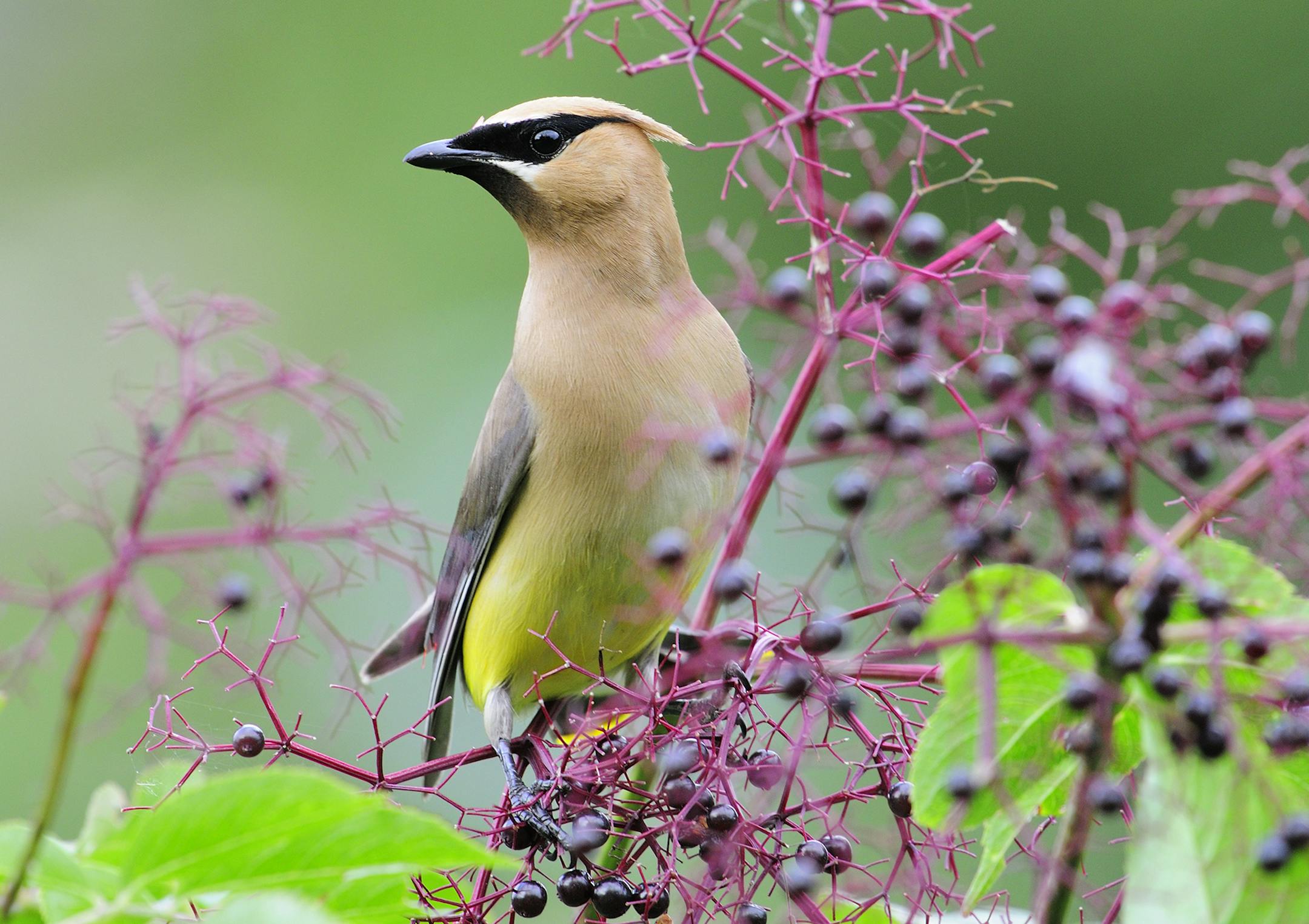
The days are getting shorter and a sense of urgency exists among the local bird population. Some birds will stock up on available foods to shore up fat reserves for their coming migrations. Even Minnesota's full-time residents, who remain here for the freeze, will strive for a layer of fat. They must enter winter in prime condition.
Luckily, a variety of fruits and nuts begin to ripen just as summer wanes, providing table fare for our hungry feathered friends. About 15 years ago, I planted a hedgerow of American elderberry plants in my yard, knowing a variety of birds would feed upon the abundant purple berries the plants produce during August. I planted the hedge in a place where sunlight would shine on its branches both morning and late afternoon. All the better for attaining that perfect photo when, in a year or two, my elderberry plants would be heavy with fruit and attract a variety of bird species.
Fast forward to August 2013: The wine-colored fruit of my elderberry hedgerow began attracting birds, particularly cedar waxwings. So I placed a tent blind in photography range of the ripe clumps. I located the blind so that the soft yellow light of an evening sun would fall on my subjects.
Then I waited a day or two for the birds to become accustomed to the blind.
I entered the blind late one afternoon, when the weather conditions were just right — meaning cloudless and calm. I had noted a variety of birds were savoring the elderberries earlier that day. I placed my camera and a 600 mm telephoto lens on a tripod and maneuvered the lens so it poked through a porthole in the blind. When all was satisfactory, I began my vigil while seated on a campstool.
It didn't take long for the birds to return. A catbird was first. It gobbled down a few berries while I took several images. Then a brown thrasher appeared. It seemed leery of my blind and stayed low in the heavy cover until it disappeared.
I was peering from a window in the blind when I saw a flock of cedar waxwings land in the upper branches of a nearby dead bur oak. For a few minutes, the waxwings seemed content to remain out of photography range. Finally, one by one the colorful birds descended upon my fruit-covered hedgerow and began to gobble up the purple berries. I was positioned perfectly when one particularly colorful adult waxwing landed on the very clump of fruit where my camera was aimed. I took a number of images before the entire flock flew off in unison. This is typical behavior of cedar waxwings.
I remained in the blind for another half-hour or so, hoping the waxwings would return. They didn't. But a mix of other birds came and went, including several species of warblers.


