

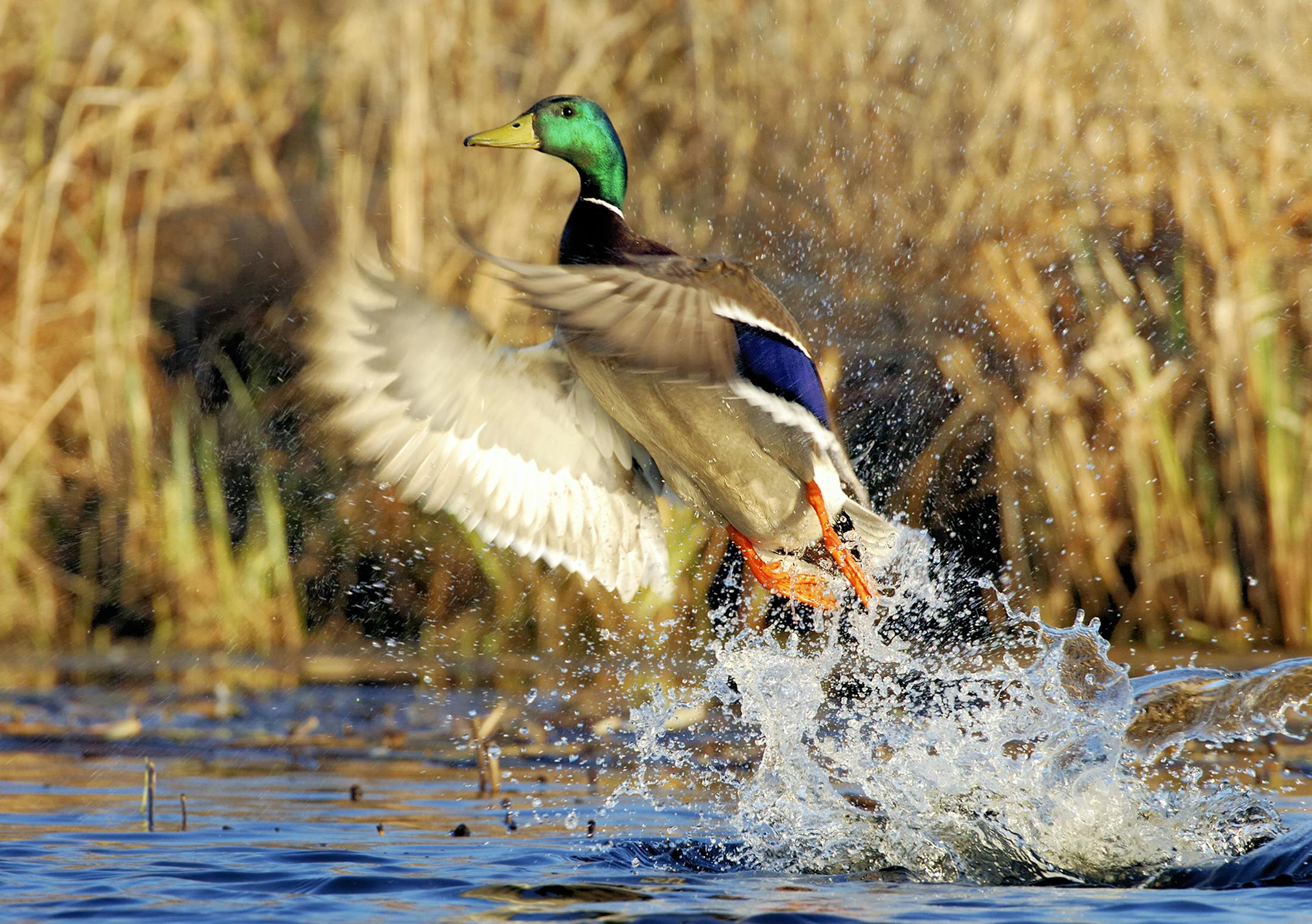
Some wildlife photos happen haphazardly. Others are well-thought-out, as when a vision of a certain species of animal in just the right light and with the perfect background becomes reality.
The image of the mallard at right was one of the latter. I intensely wanted it: A drake mallard leaping from a marsh. The bird would need to be broadside, or nearly so, and the angle of the light would have to be just right in order to illuminate the iridescent green head and blue wing speculum. The photo would not come easily — I knew that. The weather would have to be perfect, and then I would need my subject to appear in a precise location.
I donned a pair of waders and sloshed into a cattail marsh. My plan was to scout out that precise location.
I would need about 20 yards of open water in front of me, but yet some cattails or other vegetation in which to hide. At the location, I would be facing east, all the better for a late afternoon sun to light my subject. The wind needed to be strong and from the north or northeast.
People familiar with waterfowl know that most species of ducks, when taking flight from the water, jump or angle into the wind.
Puddle ducks, such as mallards, teal and wood ducks, slap the water with their wings, and use their webbed feet to launch them upward. Diving ducks (scaup, redheads and canvasbacks) need a bit of a run before taking flight. That's because their wings are smaller and narrower.
The weather cooperated a few days after my scouting trip. In the late afternoon, I slipped on my waders and, with camera and telephoto lens, carefully made my way through waist-deep mud and water to my previously chosen spot. I was camouflaged from head to toe.
I placed the tripod in front of me, and nestled the legs into the mud until it was solid. Then, I waited.

