

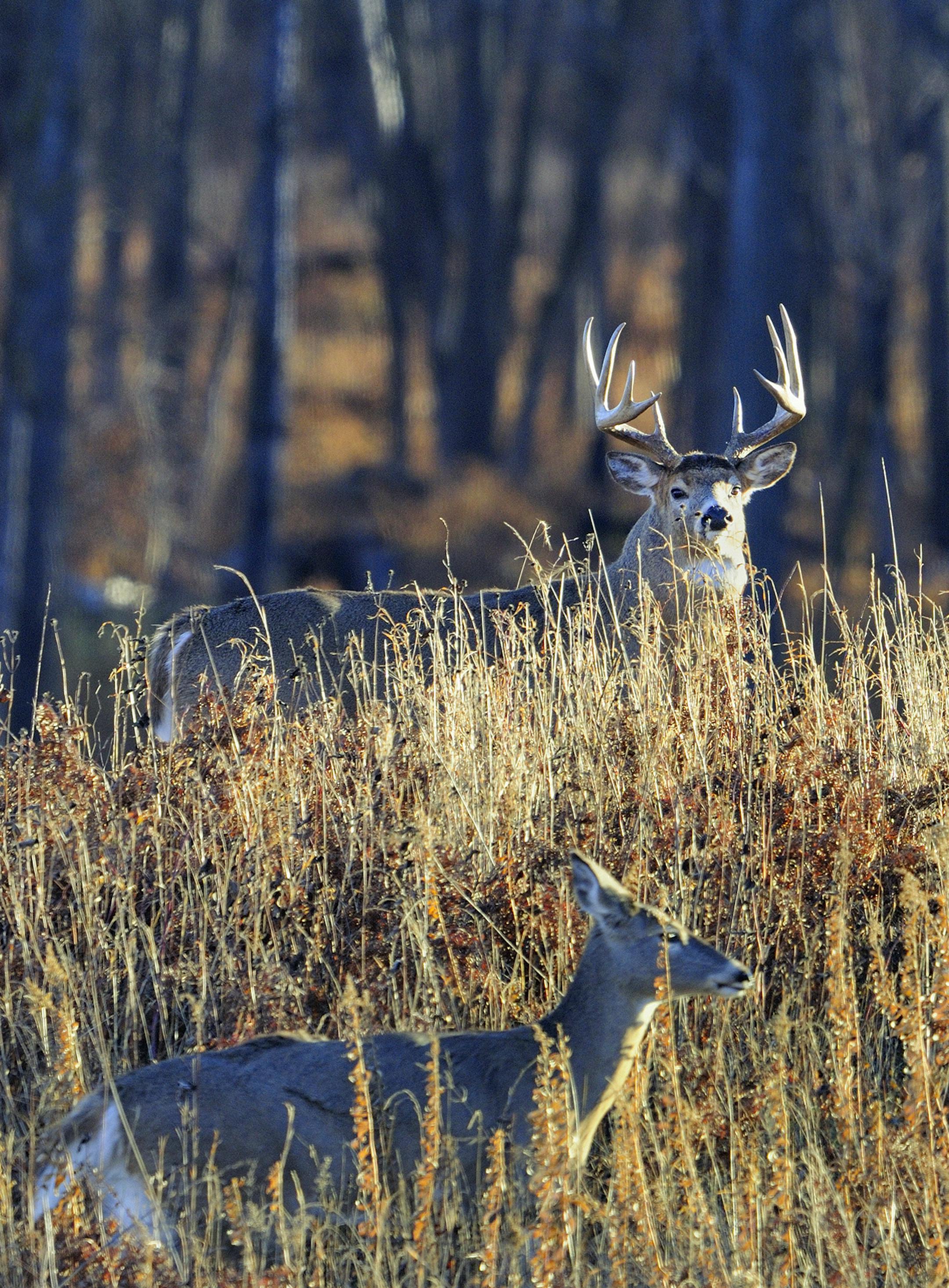
On a cool, crisp November afternoon I went tiptoeing along the northern edge of an overgrown woodland meadow. I was carrying a tripod mounted camera with a telephoto lens thrown over my right shoulder. I wore camouflage clothing from head to toe, including a facemask.
The whitetail deer were rutting. My plan was to see if I could locate a doe in estrus, or breeding condition. I was relatively certain any such doe would be escorted by one or more bucks. Their minds would be on procreation, less so on safety, allowing me to stalk within camera range.
A slight southerly breeze ruffled the vegetation. I hoped the sound would muffle my footfalls from the sharp ears of any deer.
As I rounded a corner along the meadow's edge, I spotted a doe standing on a distant hillside. She didn't notice me. The doe was alone, as far as I could tell, but I stood for many minutes watching her. Occasionally she fed on the dry leaves of goldenrod plants, but mostly she just stood there.
I noticed the doe's tail was, at times, slightly elevated, and her rump was drooping a bit. I recognized those signs — she appeared to be in estrus. But, after more than 10 minutes of watching her, I could not locate a suitor.
Every now and then the doe would stare to her left with ears cupped forward, as if listening for noises just over the hill. I was convinced another deer was just beyond the rise and out of my sight.
The doe continued to appear preoccupied. Every time she looked away, I took a few cautious steps in her direction. I wanted to close the distance in order to obtain a better image.
Then I saw him. At first just his huge antlers appeared atop the rise in the meadow. Step by step, he walked slowly toward the doe, his huge body becoming more visible with every advance.

