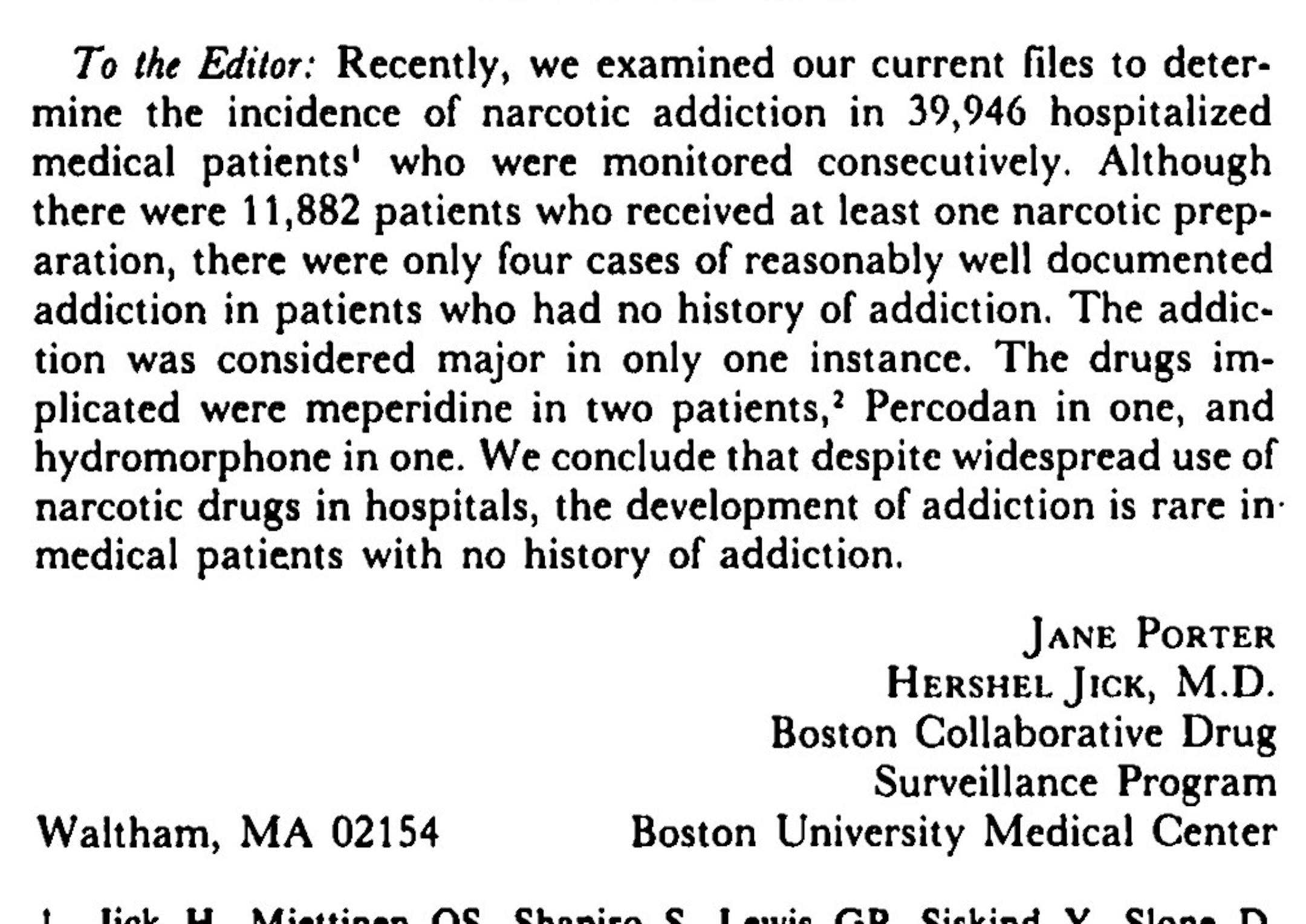
Nearly 40 years ago, a respected doctor wrote a letter to the New England Journal of Medicine with some very good news: Out of nearly 40,000 patients given powerful pain drugs in a Boston hospital, only four addictions were documented.
Doctors had been wary of opioids, fearing patients would get hooked. Reassured by the letter, which called this "rare" in those with no history of addiction, they pulled out their prescription pads and spread the good news in their own published reports.
And that is how a one-paragraph, five-sentence letter with no supporting information helped seed a nationwide epidemic of misuse of drugs like Vicodin and OxyContin by convincing doctors that opioids were safer than we now know them to be.
Last month, the journal published an editor's note about the 1980 letter and an analysis from Canadian researchers of how often it has been cited — more than 600 times, often inaccurately. Most used it as evidence that addiction was rare, and most did not say it only concerned hospitalized patients, not outpatient or chronic pain situations such as bad backs and severe arthritis that opioids came to be used for.
"This pain population with no abuse history is literally at no risk for addiction," one citation said. "There have been studies suggesting that addiction rarely evolves in the setting of painful conditions," said another.
If those claims sound ridiculous now, it's because they are. More than 183,000 people have died in the United States from prescription opioid overdoses since 1999, according to the Center for Disease Control and Prevention. Millions of other Americans struggle with painkiller addiction.
"It's difficult to overstate the role of this letter," said Dr. David Juurlink of the University of Toronto, who led the analysis. "It was the key bit of literature that helped the opiate manufacturers convince front-line doctors that addiction is not a concern."
Hospital databases were so limited in 1980 that we can't be confident there weren't more problems, or cases discovered after patients were discharged, Juurlink said.