

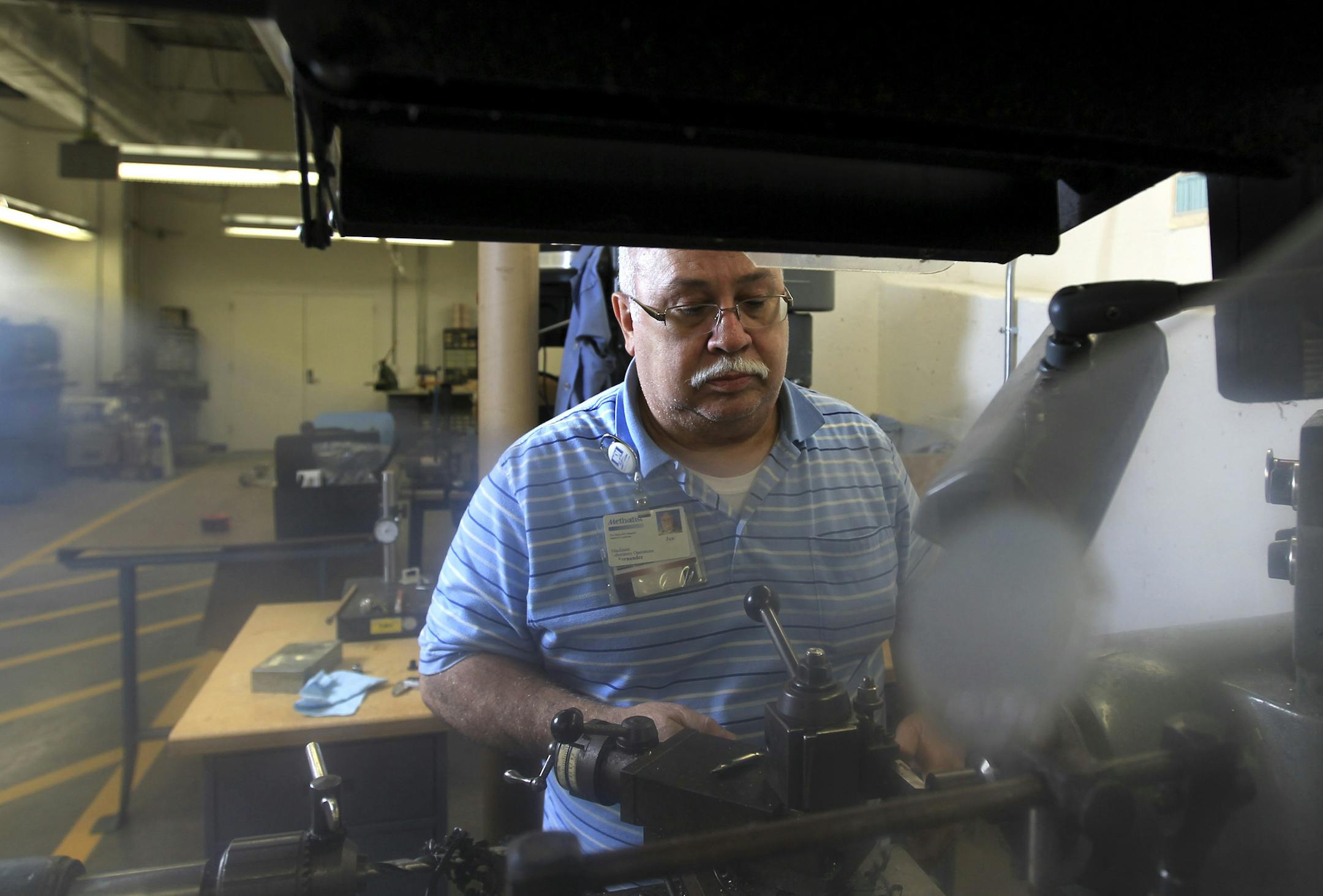
On the second level of a parking garage at Houston Methodist Hospital, behind an inconspicuous door, sits a workshop of aging machines that have helped make significant contributions in the field of cardiovascular medicine.
Hospital machinist Juan Fernandez spends his days in the former storage facility measuring, drilling and carving out tools that help mend failing hearts, heal broken limbs and foster scientific discoveries. While Fernandez has no medical expertise or formal engineering education, he has worked in the Texas Medical Center for more than 25 years, building tools for physicians and researchers, turning their visions into realities.
Working with various materials from plastics to metals, Fernandez has created everything from microscope slide holders and surgical instruments to prototypes for cardiovascular devices. In the 1990s, he helped world-renowned heart surgeon Dr. Michael DeBakey create a prototype for the left ventricular assist device, known as the LVAD, a blood flow pump that has saved the lives of countless heart patients awaiting transplants.
'He's absolutely a resource'
"He's helped advance science and medicine in the Texas Medical Center," said Stephen Igo, director of the Entrepreneurial Institute for the Houston Methodist DeBakey Heart & Vascular Center. "There's no doubt about it."
Fernandez, 65, began his career in the Medical Center in 1985 at the Baylor College of Medicine, where he ran the machine shop. But when budget cuts forced Baylor to close the machine shop in October 2010, Fernandez was left without a job. Igo jumped on the opportunity to bring him to Methodist in 2011.
"He's absolutely a resource," Igo said. "People will show up with drawings on napkins, envelopes or a piece of paper and he'll turn into a finished product."
Born in Mexico, Fernandez and his family moved to Houston when he was 7. His first brush with machines came in high school when he took a vocational welding class. After he graduated in 1968, one of his older brothers got him work with a company that made parts and tools for oil rigs.
After more than 15 years making parts for oil rigs, his company relocated. He ran across a newspaper job listing from Baylor for a machinist. "Why would Baylor need a machinist? " he remembered thinking. Three months later, he started the job.


