

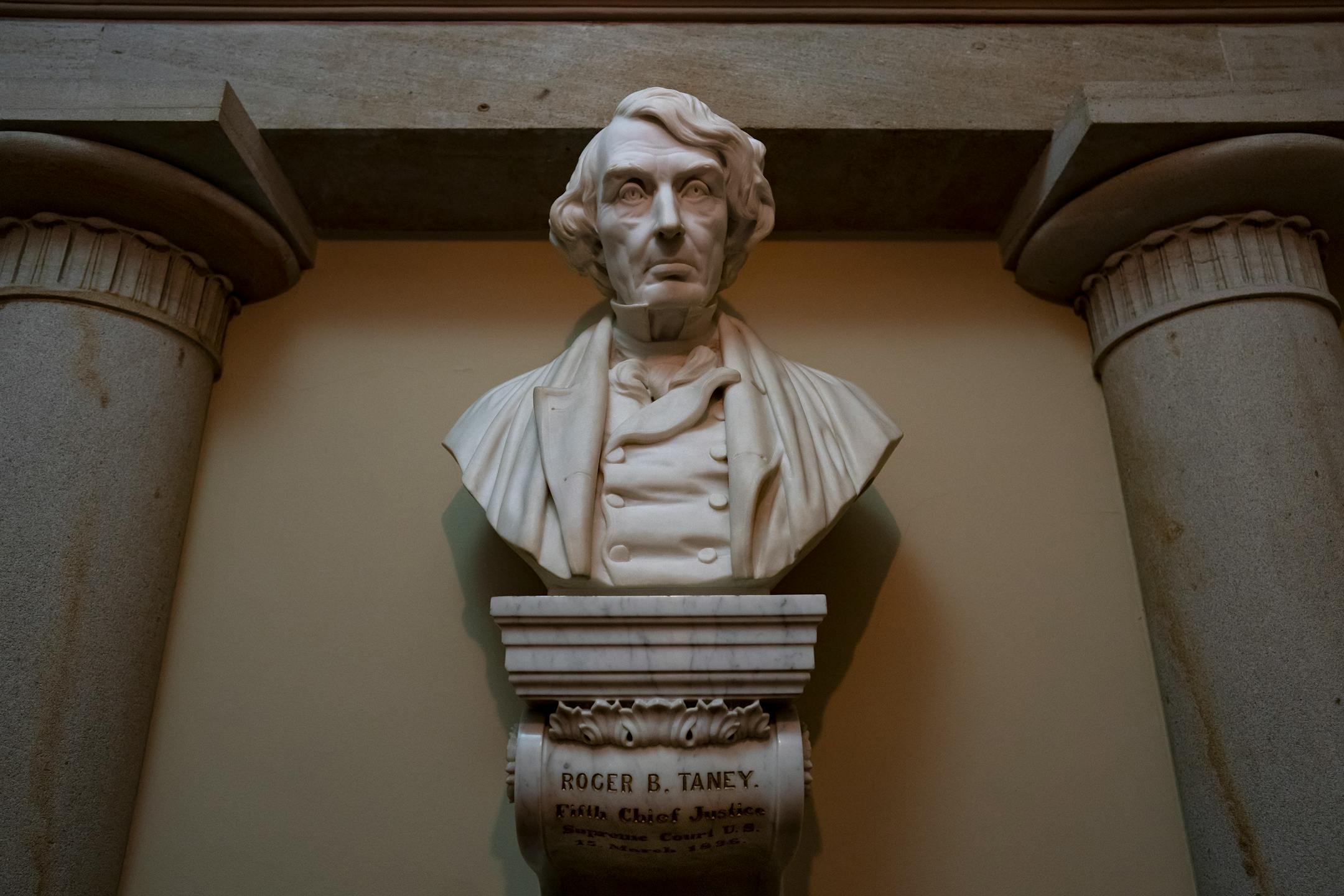
WASHINGTON - The House on Wednesday passed a bill that would remove a bust at the U.S. Capitol of Roger B. Taney, the chief justice who authored the majority Supreme Court opinion protecting slavery in Dred Scott v. Sandford.
The House passed the measure by voice vote, and it now heads to President Biden for his signature. The Senate had passed it by voice vote last week.
If signed into law, as expected, the bill would direct the Joint Committee of Congress on the Library to remove Taney's bust not more than 45 days after the bill is signed into law. The bill would also direct the committee to replace Taney's bust with one of Thurgood Marshall, the first Black Supreme Court justice.
In 1857, Taney wrote the decision in the case of Scott — a Black man born into slavery who used the courts to demand his freedom — that Black people were not U.S. citizens and could not expect protections from the federal government.
People of African descent, Taney wrote then, "had for more than a century before been regarded as beings of an inferior order, and altogether unfit to associate with the white race, either in social or political relations; and so far inferior, that they had no rights which the white man was bound to respect." A Black person, Taney added, "might justly and lawfully be reduced to slavery for his benefit."
Taney's opinion, which also stated that Congress could not prohibit slavery from U.S. territories, came to be viewed as one of the worst Supreme Court decisions in history. A bust of Taney's likeness sits outside the Old Supreme Court Chamber on the first floor of the Capitol.
"Taney's authorship of Dred Scott v. Sandford ... renders a bust of his likeness unsuitable for the honor of display to the many visitors to the Capitol," the text of the bill states. "... While the removal of Chief Justice Roger Brooke Taney's bust from the Capitol does not relieve the Congress of the historical wrongs it committed to protect the institution of slavery, it expresses Congress's recognition of one of the most notorious wrongs to have ever taken place in one of its rooms."
On the House floor Wednesday, Rep. Zoe Lofgren (D-Calif.) said the bill was literally about "who we put on a pedestal."

