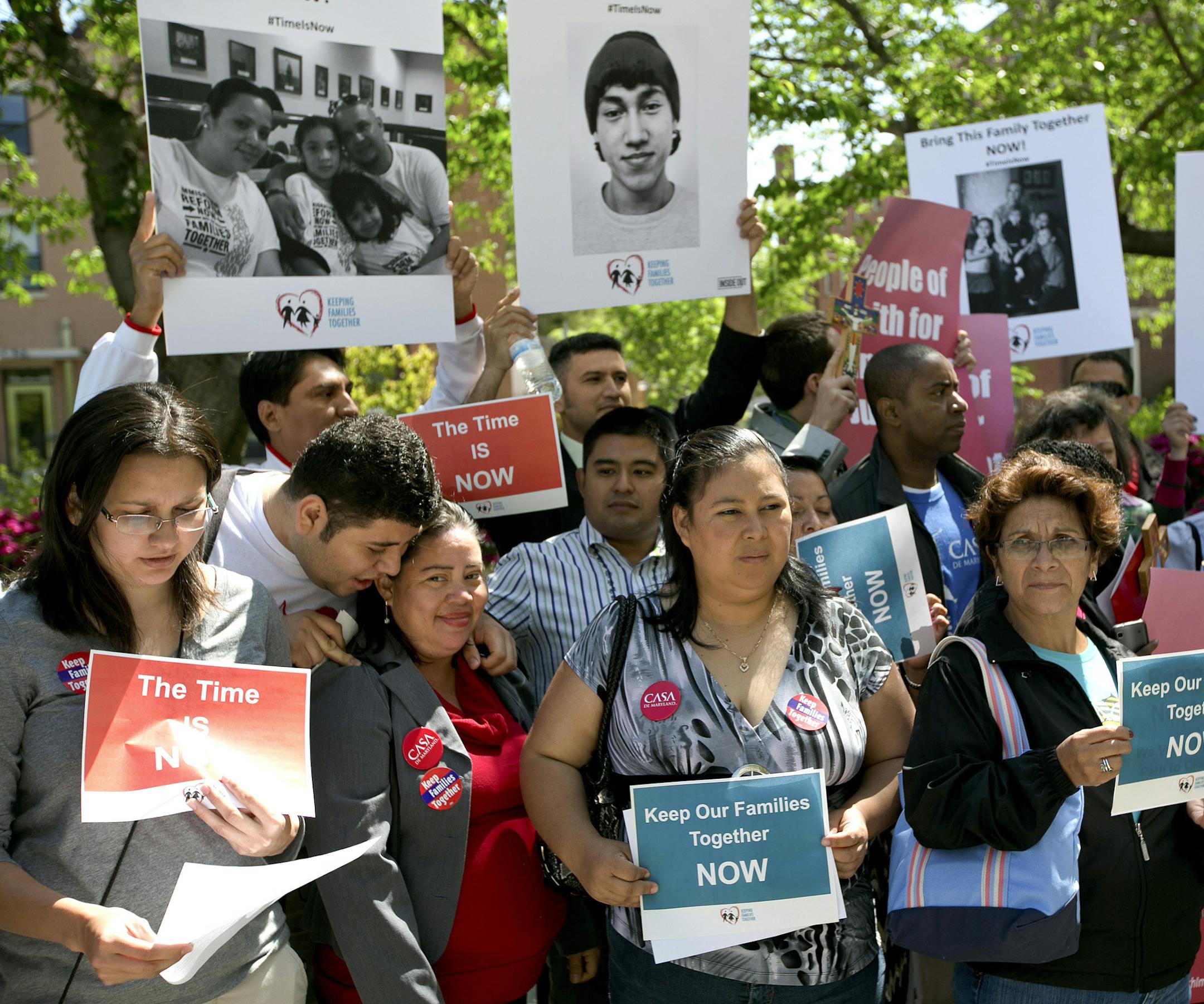
WASHINGTON – House Republicans will tackle the immigration issue in small pieces, shunning pressure to act quickly and rejecting the comprehensive approach embraced in the Senate and endorsed by President Obama, a key committee chairman said Thursday.
House Judiciary Committee Chairman Bob Goodlatte, R-Va., declined to commit on finishing immigration legislation this year, as Obama and a bipartisan Senate group wants. He said bills on an agriculture worker program and workplace enforcement would come first, and he said there'd been no decision on how to deal with legalization or a possible path to citizenship for the estimated 11 million immigrants living here illegally, a centerpiece of a new bipartisan Senate bill.
"It is not whether you do it fast or slow, it is that you get it right that's most important," Goodlatte said at a news conference to announce the way forward on immigration in the House. He said that while he hopes to produce a bill this year, "I'm going to be very cautious about setting any kind of arbitrary limits on when this has to be done."
The approach Goodlatte sketched out was not a surprise, but it was a sign of the obstacles ahead of congressional passage of the kind of far-reaching immigration legislation sought by Obama and introduced last week in the Senate by four Republican and four Democratic lawmakers. Many in the conservative-led House don't have the appetite for a single big bill, especially not one that contains a path to citizenship, still viewed by some as amnesty. Instead they prefer to coalesce around consensus issues like border security, temporary workers and workplace enforcement.
But if the Senate's comprehensive approach faces obstacles in the House, the House's piecemeal approach won't fly in the Senate.
Two of the lead Senate authors, Sens. Chuck Schumer, D-N.Y., and John McCain, R-Ariz., rejected the piece-by-piece approach at a breakfast meeting with reporters Thursday. Schumer and McCain said that anytime an immigration issue is advanced individually, even something widely supported like visas for high-tech workers or a citizenship path for those brought as children, lawmakers and interest groups start pushing for other issues.
"What we have found is, ironically, it may be a little counterintuitive, that the best way to pass immigration legislation is actually a comprehensive bill, because that can achieve more balance and everybody can get much, but not all, of what they want," Schumer said. "And so I think the idea of doing separate bills is just not going to work. It's not worked in the past, and it's not going to work in the future."
McCain and Schumer also said that immigration legislation must have a path to citizenship.