
Homebuilding skid varies across the metro

January 15, 2008 at 5:37AM
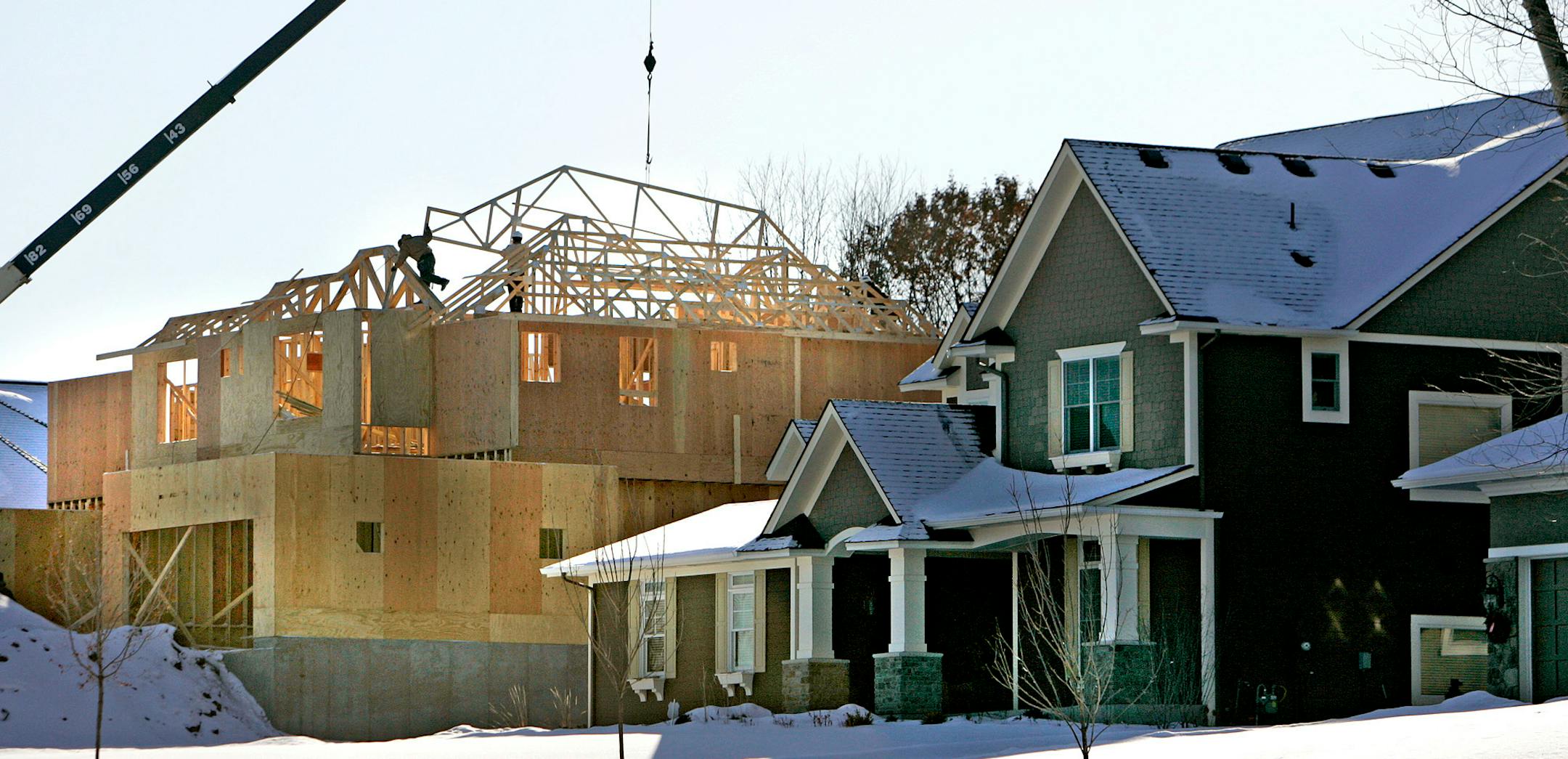
Workers build a home in the Pinehurst neighborhood of Chanhassen on Lake Harrison Circle.
Workers build a home in the Pinehurst neighborhood of Chanhassen on Lake Harrison Circle. (Stan Schmidt — Star Tribune/The Minnesota Star Tribune)

Years ago, a guy like Barry Sittlow might have had to ask for help from his numbers people in remembering exactly how many homes were being built in his city. But not these days.

How hard can it be, after all, to count to three?

Two years after builders got permits for 45 homes in St. Paul Park, where Sittlow is city administrator, the grand total for 2007 was just that: Three.

Twin Cities homebuilders released data last week showing that their members pulled only half as many permits to build new homes last year as they did two years earlier. Even more striking, however, are the vast differences in what's happening in individual cities across the region.

In Stillwater, the number was a tenth of what it was in 2005. In Monticello, a fifth. But other cities' numbers are holding steady, or even rising.

The city-by-city differences matter because they're evidence of how rising gasoline prices might affect the area's housing market, and the area's recent history of far-flung development.

And there's also another unsettling factor: Sudden changes in homebuilding can affect a city's finances and its taxes.

Often, it seems, the places experiencing the sharpest declines are the farthest from major job centers.

"We have a surplus of vacant, existing houses," said Jerry Bohnsack, city administrator in New Prague, which is suffering from one of the region's sharpest slumps. "I think the market has more to do with that than the city. But it's true that the further out you go, the more you see it. Three-dollar gas is probably having an impact on some commuters."

Cities holding their own tend to be those, like St. Louis Park and Chanhassen, located close to the "golden crescent" of southwest metro jobs. The greatest losses tend to be in cities like New Prague, Isanti or Buffalo.

"As home prices begin to decline, those people that, two years ago, were forced to look way out," to cities like Monticello, "can find options closer in, in Rogers, Plymouth or Maple Grove," said Ryan Jones, director of the Twin Cities division of Metrostudy, a housing research firm. "They are saying, 'Hey, the retail is already in, it's closer to work, closer to this and that.' You don't have to go out that far."

Some affluent communities also have been able to buck the decline in homebuilding, perhaps because buyers with more money worry less about either housing prices or the cost of gasoline. But the city administrator in Stillwater, hardest hit of any of the bigger communities, thinks high home prices have hurt the city.

In Stillwater, building permits dropped off to the point that the city laid off one of three employees in the permits division. The number of units permitted last year sank by 89 percent from the days when hundreds of homes were going up in new neighborhoods along Stillwater's west boundary.

The sharp drop "really hurt us," said City Administrator Larry Hansen, who thinks the bottom fell out for the higher-end houses that had proliferated in Stillwater in recent years.

This year should be better, he said: Lennar Homes has asked for city approval on master plans for a 109-house development in the city's northwest corner.

The variation in homebuilding in different communities means a lot to the cities involved. Fast-growing suburbs that had been able to invest money in things like new buildings without raising taxes, because the tax base was rising, are looking ahead with some anxiety to having to propose either cuts in services or bumps in taxes later this year.

Not every city fits the overall pattern. Close-in Bloomington, for instance, saw a big drop. And relatively distant Farmington is chugging along just fine, from 2005's 209 units to last year's 260.

But experts agree that fully built-out communities like Bloomington are deceptive to track from year to year. Much of their new construction is major projects, which can create a bulge in one year that's not really a trend.

As for Farmington, it's not all that far away in driving time from a cluster of major employers in Eagan. The city's research shows that's where commuters are heading, said chief planner Lee Smick.

"As Eagan itself is built out, we're filling a niche with affordable homes that are still only ten to 15 minutes away," she said. "I've gone that route during rush hour and the amount of traffic at that time is really not that bad."

St. Paul Park is not far out, but the city administrator thinks its measly three homes built last year is a function of the land market there.

"We don't have a lot of space that's not in the hands of large developers, who aren't doing anything right now," Sittlow said. "The housing economy is hurting almost everyone."

dapeterson@startribune.com • 952-882-9023 kgiles@startribune.com • 651-298-1554

about the writer

about the writer

David Peterson

Reporter

See Moreicon