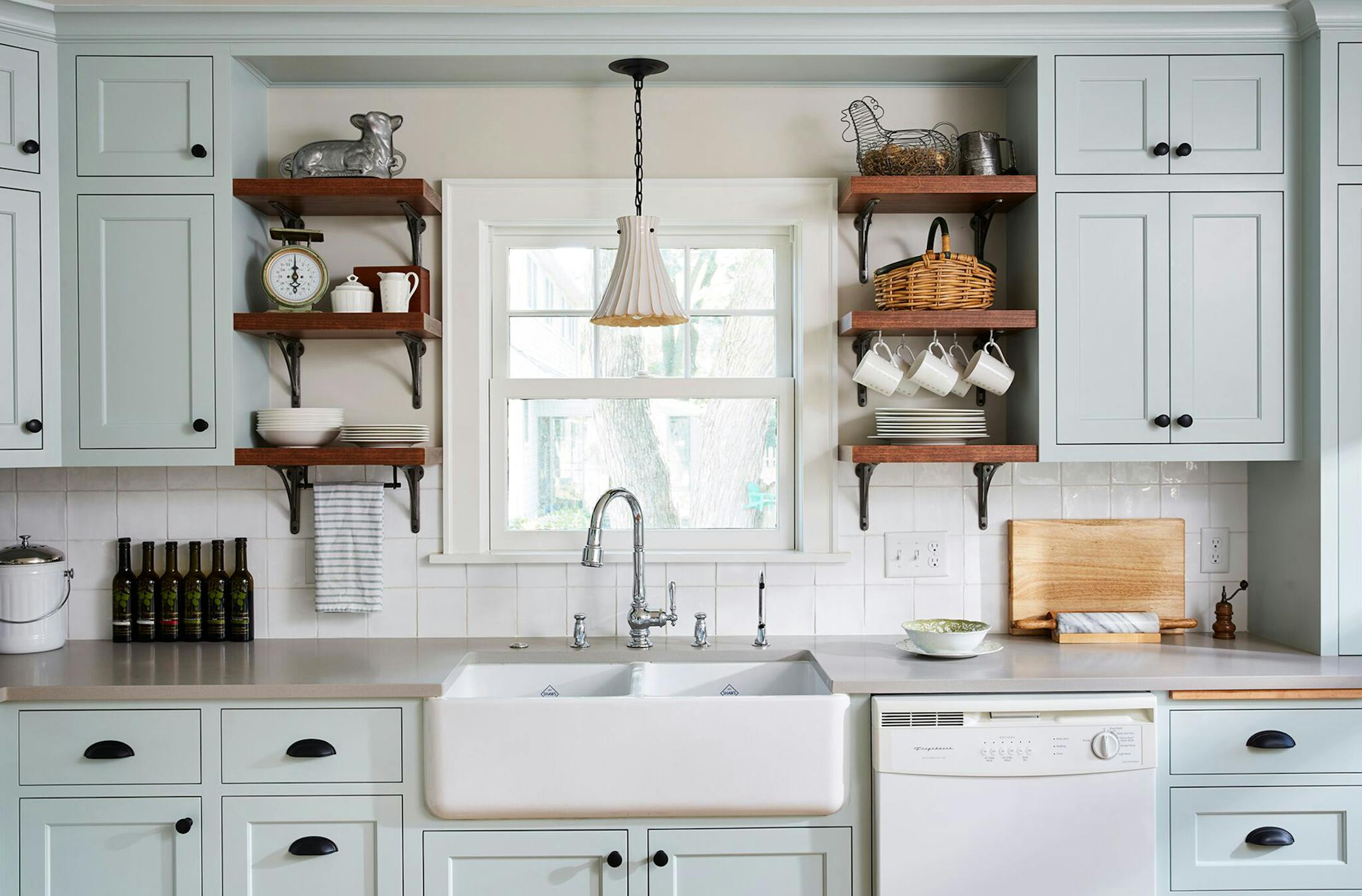
The challenge: After living in a modern condo for 16 years, Chris-Ann Lauria and her husband, Tim Roebke, were ready for something different — an old house, reminiscent of the farmhouse where Lauria grew up. "We love the character of old homes," she said. An Anglophile, Lauria dreamed of having a cozy English cottage-style kitchen like the ones she'd seen in Europe and read about in her favorite books. "English authors describe their homes in their books, and that's what I envisioned," she said. But the couple's quaint, vintage-look kitchen also had to be highly functional for 21st-century food preparation. "We cook all our meals from scratch," she said. "Our kitchen is not a museum. It is heavily used."
The starting point: A 1924 Tudor-style house in Bloomington that Roebke found while Lauria was in Milwaukee trying to sell their previous house. The market was hot, so Roebke didn't think he could wait for Lauria to get a look. "He took me around the house with his phone," Lauria recalled. They liked the charming house and its generous lot but not the kitchen, which hadn't been updated for decades. "It was bad," said Lauria. "I wanted it done immediately."
The team: Builder Curt Irmiger, 612-384-7295, Full Circle Construction, Minneapolis; designer Julie Madge, 612-799-2709, Julie Madge Interiors, Minneapolis; cabinet maker John Blundred, 612-501-2015, Tiny Red, Northfield. Roebe, an engineer, also took an active role in the kitchen's design.
Googling for help: Living in Milwaukee, Lauria had no knowledge of Twin Cities design professionals so she did a Google search, which led her to Madge's website. "I like to work with a variety of styles, a mix of old and new," said Madge. Lauria reached out, and the two connected. "We hit it off right away," Madge said. "She had a very specific vision, an authentic English cottage feel." Madge, who has visited the English countryside, understood what Lauria had in mind. Together they pored over Lauria's issues of The English Home magazine, soaking up ideas.
Infrastructure first: The original 1920s house had been a DIY affair — the grown children of the original owner stopped by at one point and said they remembered sleeping in tents in the yard while their father built their home. "It was underbuilt, clearly without permits or inspections," said builder Irmiger, owner of Full Circle. "There was a lot to correct." The plumbing behind a dropped ceiling had to be redone, and the insufficient floor joists had to be reinforced before new flooring could be installed. "It was like a trampoline when you got to the subfloor."
Open or not?: Early in the project, Irmiger suggested removing a wall between the kitchen and the dining room to create the open-concept floor plan so popular today. But Lauria was adamant. "No! We don't want a modern home. If we wanted one, we would have bought one," she said. "We're trying throughout the home to be period-specific and keep it like it is." Ultimately, the door to the living room was widened and repositioned, for better flow.
Something old: "I wanted a gas stove that was vintage-looking," Lauria said. She found what she was seeking — a refurbished 1947 O'Keefe & Merritt stove — on a California company's website. "It's really cute, with salt and pepper shakers built in, and a beautiful griddle in the middle," she said. "We love the way it looks and works."
Something blue: For the new custom cabinets, Lauria wanted a historic color that would have looked at home in the 1920s. She settled on pale, soft bluish-green, the color of a duck egg. "We tried several colors," said Madge, seeking just the right hue. "This one [Woodlawn Blue from Benjamin Moore] had the right balance of green and blue and the right intensity." Black hardware pulls complete the vintage look. But looks weren't the only priority for the new cabinets. "They were very specific — down to the inch — about how they wanted the cabinets to work," said Irmiger.