

![Talicha Whitmore and her daughter, Brooklyn, 10, in their new apartment Monday evening, January 22, 2024. Whitmore is in the process of moving into the Belfry Apartments, an affordable housing initiative of Calvary Lutheran Church, just a block from George Floyd Square in Minneapolis. ] JEFF WHEELER • Jeff.Wheeler@startribune.com](https://arc.stimg.co/startribunemedia/Y4DJGWKTZZCIDARL3RTAEOXRLY.jpg?&w=1080)
Facing a dire situation and on the verge of closure, Calvary Lutheran Church found a way to save its historic building in south Minneapolis: partner with a nonprofit and turn it into 41 apartments for people experiencing homelessness or with extremely low incomes.
The church had more than $1 million in deferred maintenance costs a few years ago, and it was unclear whether the church would be able to continue at its site. Instead of abandoning the building at 3901 Chicago Av. S., Calvary Lutheran turned the dilemma into an opportunity to help address the homelessness crisis. Calvary Lutheran reached out to nonprofit developer Trellis, and in 2021 sold the campus with the agreement that the site be redeveloped to create affordable housing. Sarah Shepherd, the church’s council president, said the partnership with Trellis was ideal and that the project aligns with their values of social and racial justice and fostering a good relationship with neighbors
“We desperately needed a solution,” Shepherd said at a ribbon-cutting event for the apartments. “We could move, we could merge with another congregation, or we could close. But Calvary was committed to our mission of being in the city for good.”
The partnership was also beneficial to the church. Trellis now leases the space to Calvary Lutheran so it can continue its weekly services. The development improved the aging space with new interiors, lighting, and a much larger food shelf in the basement, which offers groceries for residents and community members.
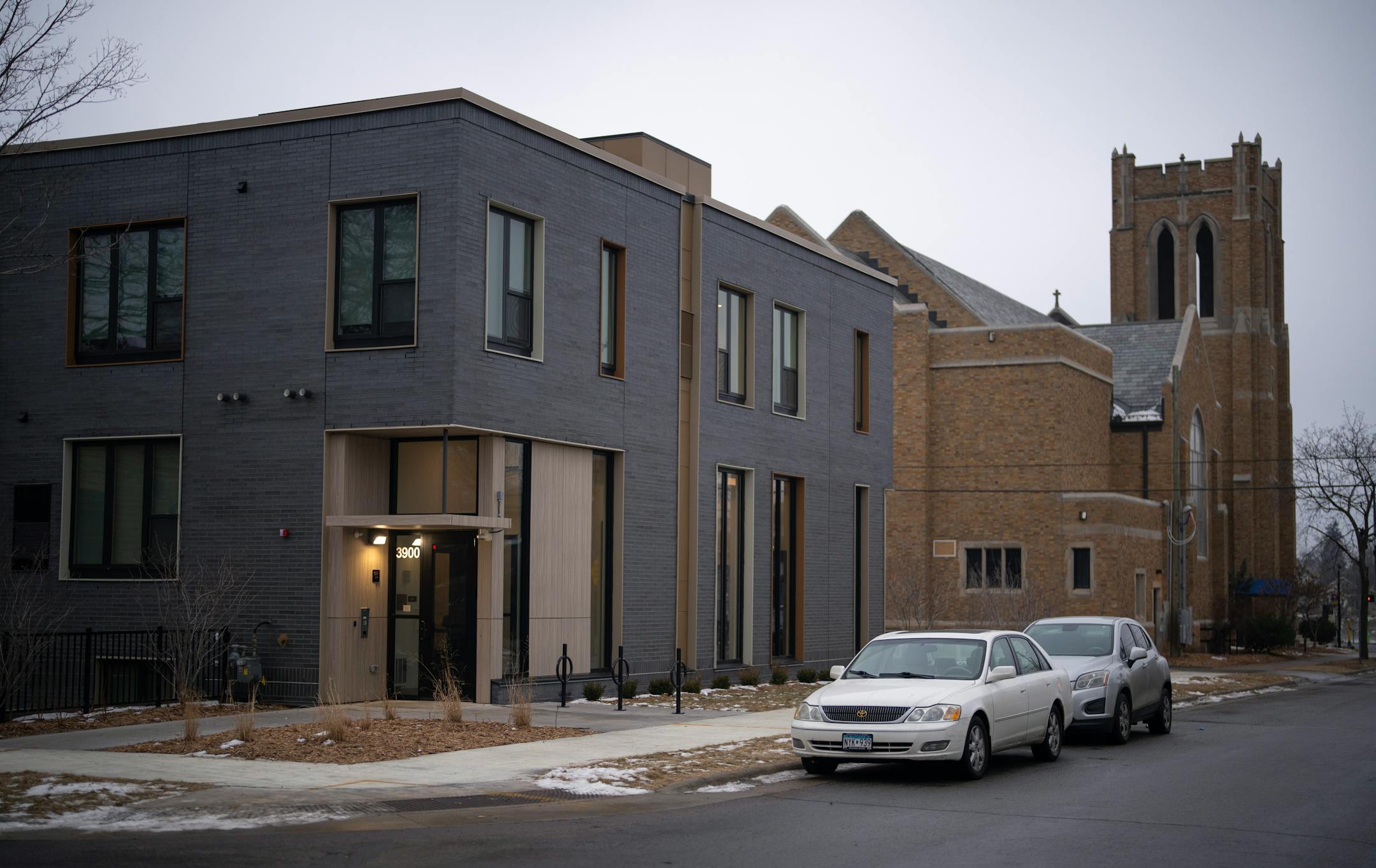
The Belfry Apartments opened in December and are in a redeveloped school building next to the church, in the church basement, and in a new apartment building next door on land which had been a parking lot. The units range from studios to four-bedrooms and are reserved for people who make 30% or less of the area median income. That ranges from a $26,100 annual salary cap for a single resident to $37,260 for a family of four.
Fifteen of the units are reserved for people exiting homelessness or with disabilities.
One of the new residents is 51-year-old Talicha Whitmore, who just moved in with her 10-year-old daughter, Brooklyn. Whitmore has spent 21 years as a cafeteria worker for public schools in Bloomington, and previously lived in Bloomington using Section 8 vouchers. But as inflation rose, she had trouble affording her housing and had to move out, realizing her income wasn’t keeping up with the higher costs of living.
“My wages weren’t going up as fast as everything else in the country,” she said.


