

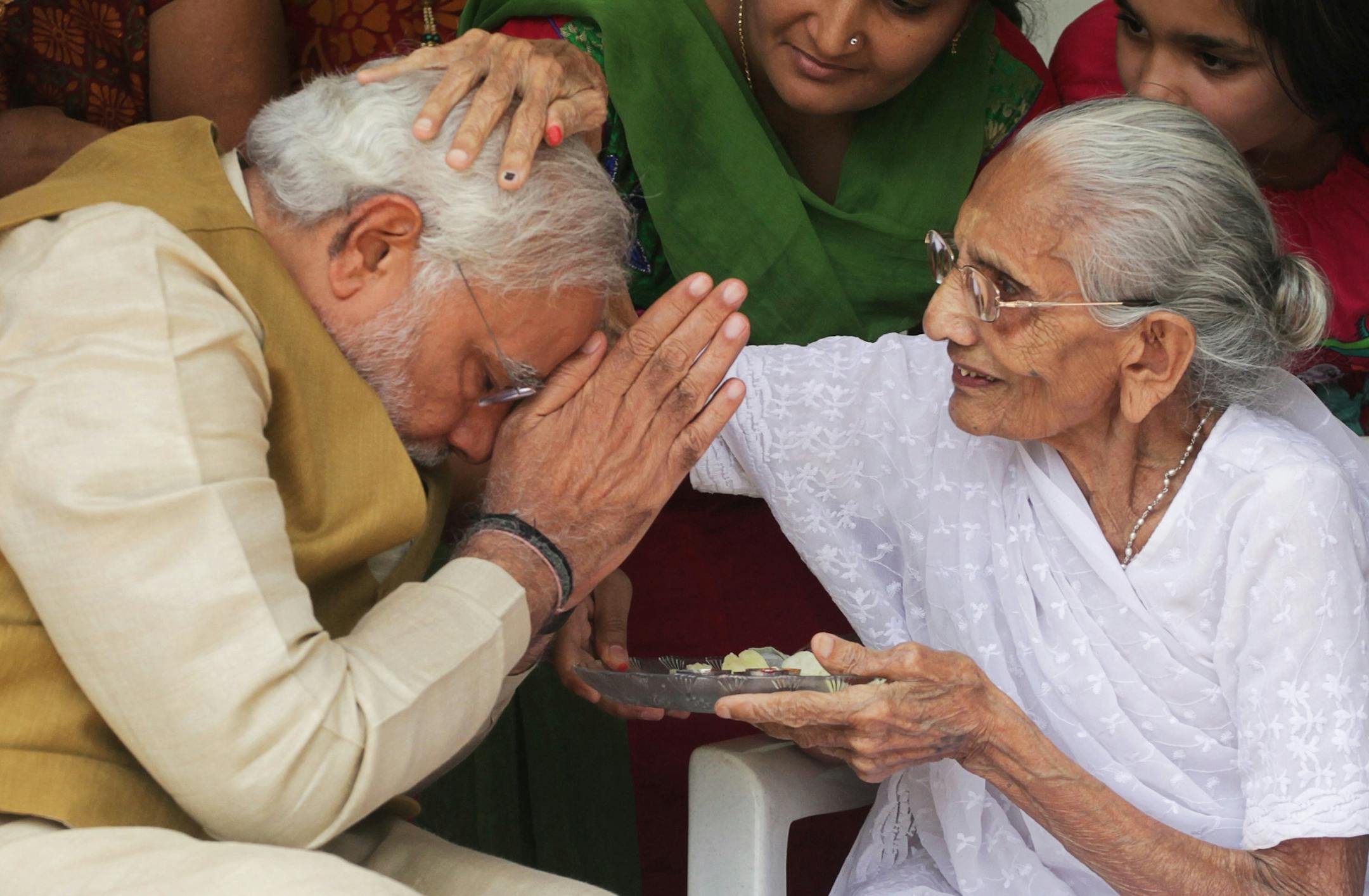
NEW DELHI – Before heading to India's snow-capped Himalayas to study Hinduism at age 17, Narendra Modi burned family photos, discarded most of his clothes and bent to touch his mother's feet to receive a blessing.
"He treated his departure like a monk would, as though he was leaving to become an ascetic," his brother, Prahalad Modi, said in his concrete-block tire shop in Ahmedabad, the largest city in the western state of Gujarat. "He had been told by his guru that he must shed all material possessions to be devoted to the cause of Hindu nationalism."
Almost five decades later, India's incoming prime minister still calls himself a Hindu nationalist. He's also a friend of billionaires and a champion of business in Gujarat, where he's served as chief minister since 2001. Economic growth rates have outpaced the national average in all but one year in that time and per-capita income has quadrupled.
Modi, 63, will take office armed with what may be the largest parliamentary mandate in 30 years after the Bharatiya Janata Party obtained a majority in parliament, defeating the long-empowered Congress party. The country is waiting to see which Modi will emerge: the Hindu activist faulted for failing to stop 2002 anti-Muslim riots or the business-friendly son of a tea vendor who is focused on reviving Asia's third-biggest economy.
"I don't see how the two are compatible," said Sumit Ganguly, professor of political science at Indiana University in Bloomington. Pursuing a Hindu nationalism agenda "is bound to produce communal violence. If you can't keep social peace in India, it's going to scare off investors, which will stump the entire Indian growth story."
The BJP trumpeted its win as a vindication of Modi's promises of economic development that cut across India's religious, caste and class divisions. Voters across the nation expressed their disapproval of slowing growth and corruption. In Uttar Pradesh, the country's most populous state and home to more Muslims than any other, Modi's party was leading in 73 of 80 seats, up from the 10 it won in the 2009 election.
Hinduism, practiced by 80 percent of Indians as of 2001, is entrenched in scriptures of mythology that offer stories of various deities and a way of life. The faith offers no method of conversion and encourages Hindus to follow values such as purity and self-restraint. The Rashtriya Swayamsevak Sangh (RSS), the Hindu nationalist group Modi belonged to, seeks to teach Hinduism in schools and spread its values across the nation.
To many Muslims — 13 percent of India's population — that message is one of exclusion, intolerance and fear. In 1990, Modi addressed a crowd of Hindu followers in Uttar Pradesh days before a group there demolished a 16th-century mosque in a cascade of violence that ended in sectarian riots and 2,000 deaths.


