
High-tech tools speed work of charting Mississippi River depths

The Corps of Engineers uses tools such as GPS to speed measurement of river depths. That helps keep the Mississippi clear for boat traffic.

September 30, 2013 at 2:48PM
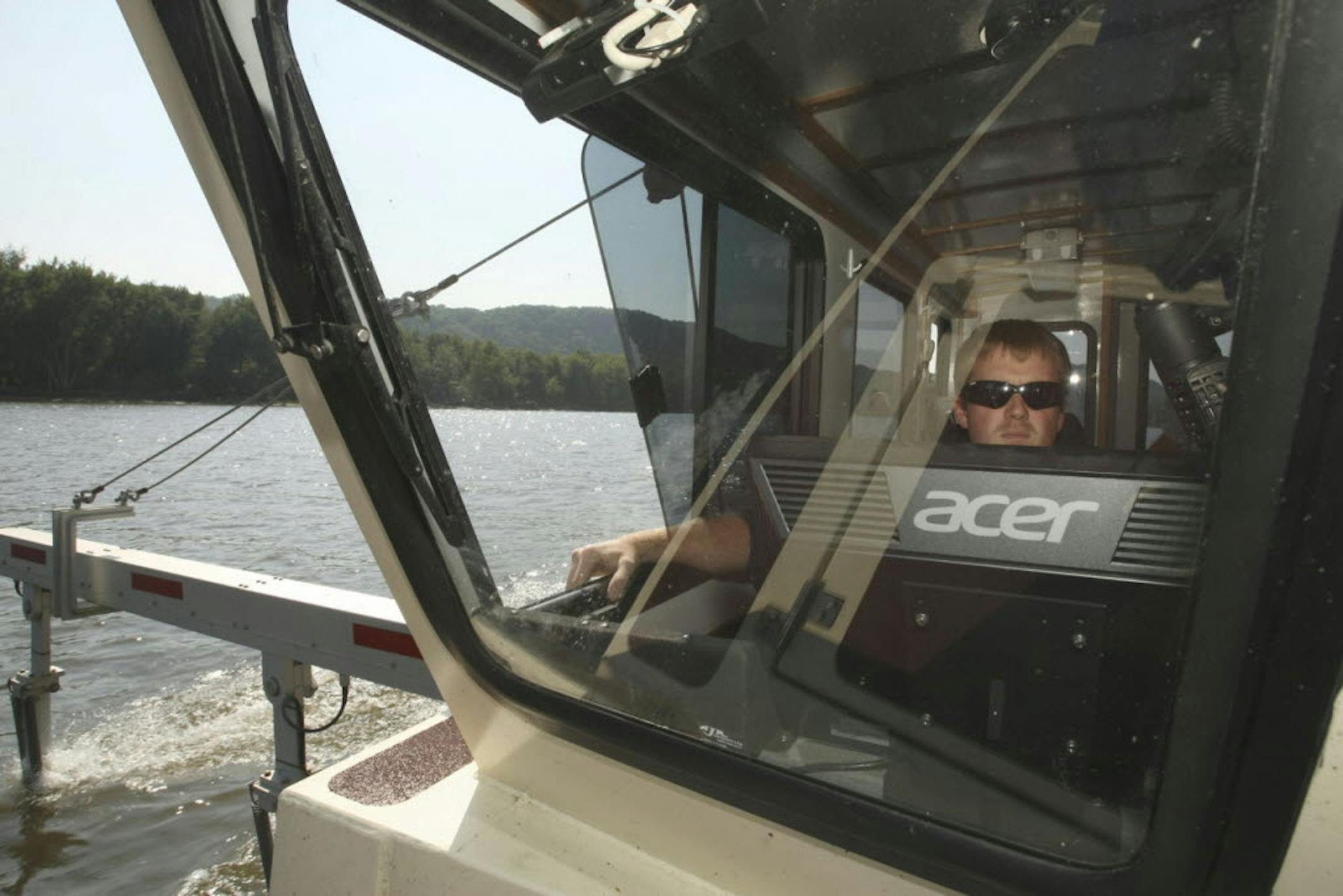
Brandon Olson, a Corps of Engineers survey technician, guides the new survey boat, Launch 22, down the Mississippi River near Red Wing, Minn.
Brandon Olson, a Corps of Engineers survey technician, guides the new survey boat, Launch 22, down the Mississippi River near Red Wing, Minn. (Stan Schmidt — Rochester Post-Bulletin via AP/The Minnesota Star Tribune)

RED WING, Minn. – Slowly, Brandon Olson steered the sophisticated 24-foot boat down the Mississippi River, its six transducers shooting sound waves to the bottom of the channel, each wave bouncing back to a receiver in front of Kurt Schroeder, who sat nearby.

On a screen, depths showed as colors what would later be translated into numbers.

The work was meticulous. Olson had to the steer the new U.S. Army Corps of Engineers sounding boat on a precise course so others would know whether the main channel between the head of Lake Pepin and Red Wing needed dredging.

"It doesn't get boring," Olson said. "The scenery changes every day. It's a beautiful area. There's plenty of wildlife. If you love the outdoors, you love this job."

Taking soundings is part of a long process that keeps the main channel at least 9 feet deep, the minimum depth for towboats to push barges up and down the river.

In 2010, about 16.2 million tons of bulk commodities, mostly grain, moved on the river in this region, said Bill Meier, acting lead engineering technician for the corps' Rivers and Harbors Project Office. Barges saved the industry $384 million that year because barges can move a ton of freight 576 miles on one gallon of fuel, compared with 413 miles for rail and 155 miles for trucks.

The new catamaran sounding boat, known technically as Launch 22, cost $486,000 and went into operation this year. It is the second such boat for the corps' St. Paul division, which covers 284 river miles and harbors on the Mississippi and on Lake of the Woods.

The boat has two 14.9-foot booms, each with two transducers, with two more transducers in the hull. Inside the boat are global positioning system units and computers to record and store readings.

While the new boat cost a lot of money, it does a lot of work much faster, Meier said.

In Mark Twain's day, the only way to measure river depth was to toss out a rope with a weight on it. Then came depth finders.

With today's GPS technology, aboat can record exactly where it is, he said. Crews now can do the work 75 times faster than in the 1960s and 10 times faster than 20 years ago, he said.

The corps tries to survey the entire river once every few years, but some parts are notorious for shoaling and have to be checked more often.

"It fluctuates," Meier said. "That's why we run the surveys."

Steve Tapp, project office operations manager, said the first step in deciding what needs to be dredged is knowing that some areas — such as Reads Landing — shoal up faster, he said. Also, towboat captains report any places that seem to be getting shallow.

Then, the corps decides where to send the survey boats, he said.

The data are then analyzed by those who can predict which places will shoal up and cause problems. They also can tell the Coast Guard to adjust marker buoys because of a channel shift.

If an area needs dredging, it is put in a queue, and the corps decides which comes first.

Private firms are contracted to do smaller jobs, but if it is a really big job, the new hydraulic dredge William A. Goetz is called in.

Even when priorities are set, the Mississippi can force changes, Tapp said. "Things are constantly moving," he said. "It makes our job pretty difficult for scheduling."

The corps once dredged about 1.4 million cubic yards annually, but cut back because of environmental and economic concerns, he said. Now the district dredges about 850,000 cubic yards a year at a cost of $8 million.

about the writer

about the writer

John weiss, Post-Bulletin of Rochester

More from No Section

See More
FILE -- A rent deposit slot at an apartment complex in Tucker, Ga., on July 21, 2020. As an eviction crisis has seemed increasingly likely this summer, everyone in the housing market has made the same plea to Washington: Send money — lots of it — that would keep renters in their homes and landlords afloat. (Melissa Golden/The New York Times) ORG XMIT: XNYT58
Melissa Golden/The New York Times

It’s too soon to tell how much the immigration crackdown is to blame.