

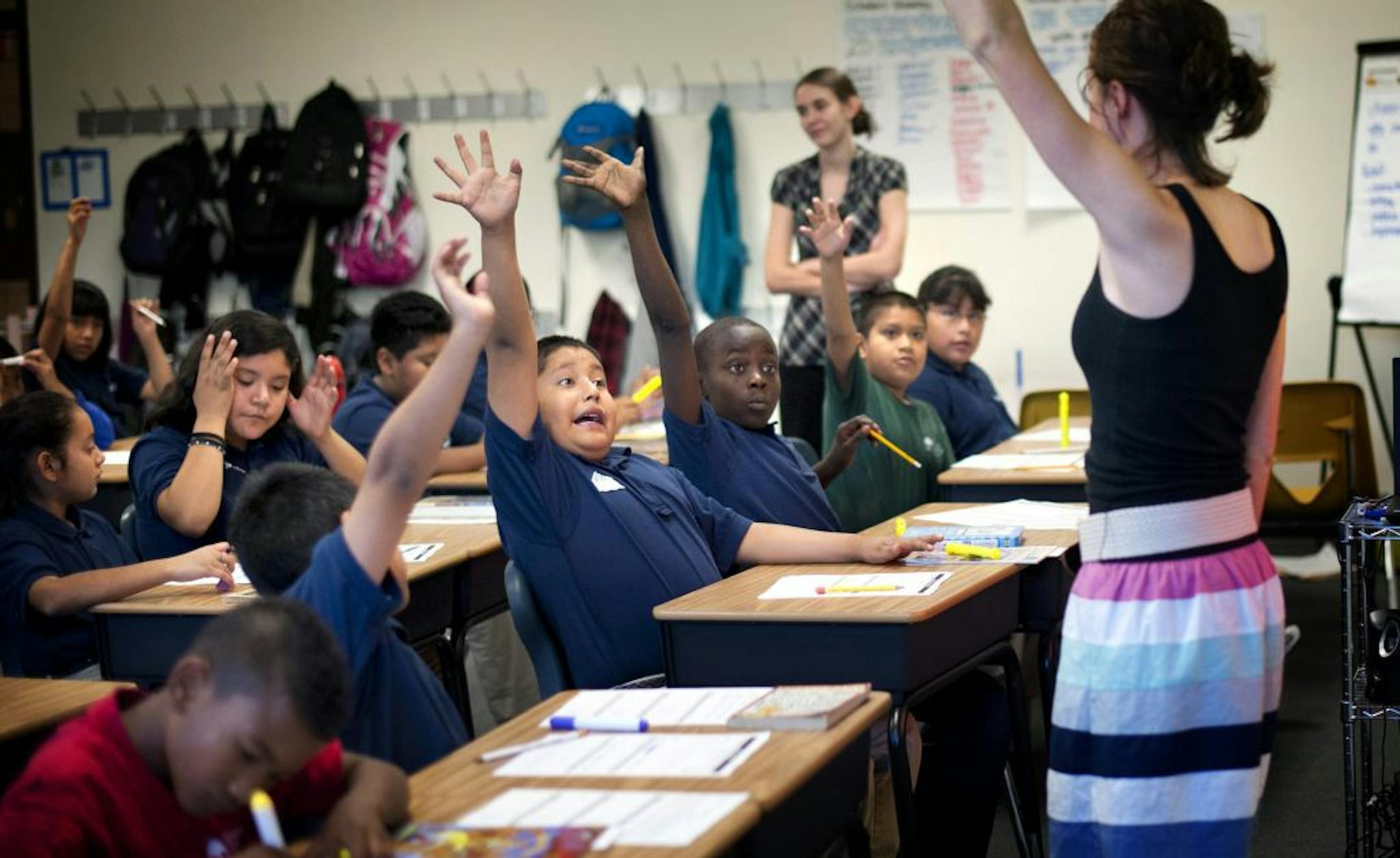
Heather Busch's school is all about college. College pennants and paraphernalia dominate the decor. Her fifth-graders will visit at least one college campus.
But they need to learn self-discipline to get there.
"Pencils down on two. One. Two," the teacher commands at the end of a class exercise.
The slap of pencils on desktops resounds precisely at the count of two.
Big goals and high expectations are the recipe for success at Hiawatha Academies, a Minneapolis school founded in 2007 that has emerged as an example of what can go right with charter schools.
The charter school movement pioneered in Minnesota passes the 20-year mark this fall without clear evidence that the schools are doing a better job than traditional public schools. Only about one-fourth of charter schools beat the state average for math proficiency; nearly one-third do so for reading. But as a group, charters score below state averages for reading and math, and some do significantly worse.
Some attribute the lackluster showing to their higher enrollment of minority and low-income students. But Hiawatha's mostly Latino students fit that description, and it far exceeds the academic records of comparable public schools.
Charter school advocates such as Charter School Partners say that's the kind of performance needed for the movement to prove its worth.


