

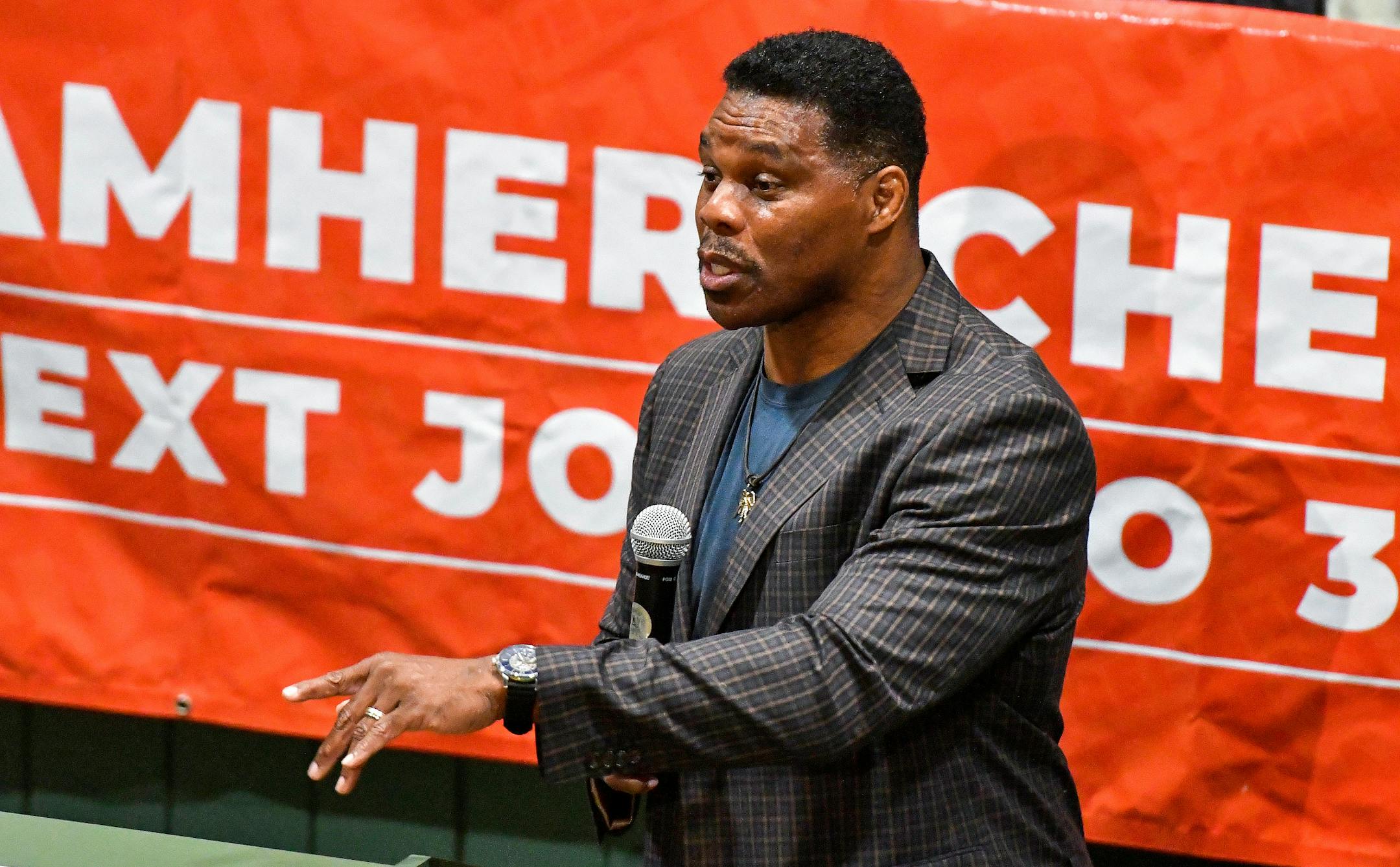
Covering Herschel Walker in Dallas was like being Superman's stenographer. He looked and carried himself like someone who played football as a hobby when he wasn't saving the world.
Improbably muscular and fast, Walker benefited from and perpetuated every myth surrounding him — that he was his high school valedictorian (he wasn't), that he graduated from the University of Georgia (he didn't), that he performed 5,000 pushups and situps every night as a youth during sitcom commercials (mathematically and probably physically impossible).
Covering Walker in Minnesota was like being Clark Kent's therapist. He was miscast as the player who could elevate a talented team to the Super Bowl, introduced midseason to an offense into which his skills did not fit, and frustrated as his prowess waned.
I covered Walker briefly for the Dallas Morning News, then moved to Minnesota to cover the Vikings for the Star Tribune. I got to know Walker a bit in Dallas and covered him intensively in Minnesota. Once, he vented to me in a long interview about being scapegoated over a trade he did not request, one that cost the Vikings a slew of draft picks and players and remains one of the most-criticized deals in NFL history.
In Minnesota, Walker transformed from a beloved national figure into a symbol of Vikings woes and mismanagement. Now he is leveraging his still-remarkable popularity in his home state of Georgia, where he was a high school and college star, into a run for the U.S. Senate.
Minneapolis-based author John Rosengren recently traveled to Georgia to meet Walker, who has no experience in elected office, and wrote an in-depth article for the Washington Post. Simply by recounting Walker's post-playing behavior and gauging the reaction of many Georgians to his candidacy, Rosengren's piece reads like a modern horror story:
- Walker asked why, if humans evolved from apes, apes still exist.
- He claimed to invent a mist that destroys COVID.
- On a Daily Caller podcast, when asked whether he would have voted for the $1.2 trillion bipartisan infrastructure bill that had just passed, Walker said, "Until I can see all of the facts, you can't answer the question."
- He said that civil rights hero John Lewis' name should not be attached to a voting rights bill because "it doesn't fit what John Lewis stood for."
- Walker was accused by his former wife, Cindy, of holding a gun to her head several times, and once holding a straight razor to her throat.
- In his memoir, Walker wrote that he fantasized about shooting a man who had not delivered a car to him on time. He wrote, specifically, "all I could think was how satisfying it would feel … the visceral enjoyment I'd get from seeing the small entry wound and the spray of brain tissue and blood — like a Fourth of July firework — exploding behind him."
- After their divorce, Walker continued to threaten to shoot Cindy, according to court documents cited in the article.
In the Republican primary on Tuesday, he is favored to become the GOP candidate to run against incumbent Raphael Warnock, a Democrat, for the Senate.
Can Walker win?


